The Full Picture of Obtaining a Ryokan Business License in Hokkaido: Steps and Costs
When you’re considering launching a full-scale accommodation business in Hokkaido, the first thing to look into should be obtaining a simple lodging license under the Ryokan Business Act. Unlike registration under the Private Lodging Business Act (the “minpaku law”), this allows for operation 365 days a year, making it an unavoidable option for owners aiming to maximize revenue. Given Hokkaido’s vast land and rich tourism resources, what steps should you take, and what budget should you plan for? Let’s break down the full picture.
The Importance of a Ryokan Business License for Enabling 365-Day Operation
Hokkaido’s tourism market has two major peaks: winter visitors seeking powder snow skiing, and summer visitors escaping the heat elsewhere in Japan. Under the Private Lodging Business Act, operating days are capped at 180 per year, meaning you can’t fully capture both of these demand peaks. Obtaining a license under the Ryokan Business Act allows year-round operation regardless of season, dramatically boosting the stability of your business.
The Key Difference from the Private Lodging Business Act
The Private Lodging Business Act is premised on offering a residence for lodging use, whereas the Ryokan Business Act is a license for running an actual lodging business as a full-fledged enterprise. The biggest difference is whether there’s a cap on operating days, but the hurdles also differ—for example, fire safety equipment requirements and the need for a change of building use (for buildings over 200 square meters). Still, in a tourist destination like Hokkaido, clearing these hurdles to secure 365-day operation is well worth the effort.
Concrete Steps Toward Obtaining Your License
To obtain a ryokan business (simple lodging) license in Hokkaido, you’ll need close coordination with the public health center, the fire department, and your municipality’s building department.
Preliminary Consultation and Confirming the Zoning District
The first step is to confirm the zoning district where your property is located, through the relevant municipality. A ryokan business license cannot be obtained in areas such as Category 1 Low-Rise Exclusive Residential Zones. Additionally, some municipalities within Hokkaido have their own supplementary ordinances imposing additional restrictions, so it’s essential to have a preliminary consultation with the public health center early in your planning.
Compliance with the Building Standards Act and Fire Service Act
Next, you need to ensure the building’s safety. Confirm whether the building’s designated use under the Building Standards Act is suitable for “lodging facility” purposes, and if necessary, go through the procedures for a change of use. Additionally, the Fire Service Act requires the installation of automatic fire alarms, emergency lighting, and guide lights. In cold regions like Hokkaido, design considerations that account for snow’s impact on smoke ventilation systems and evacuation routes are sometimes also required.
Application to the Public Health Center and On-Site Inspection
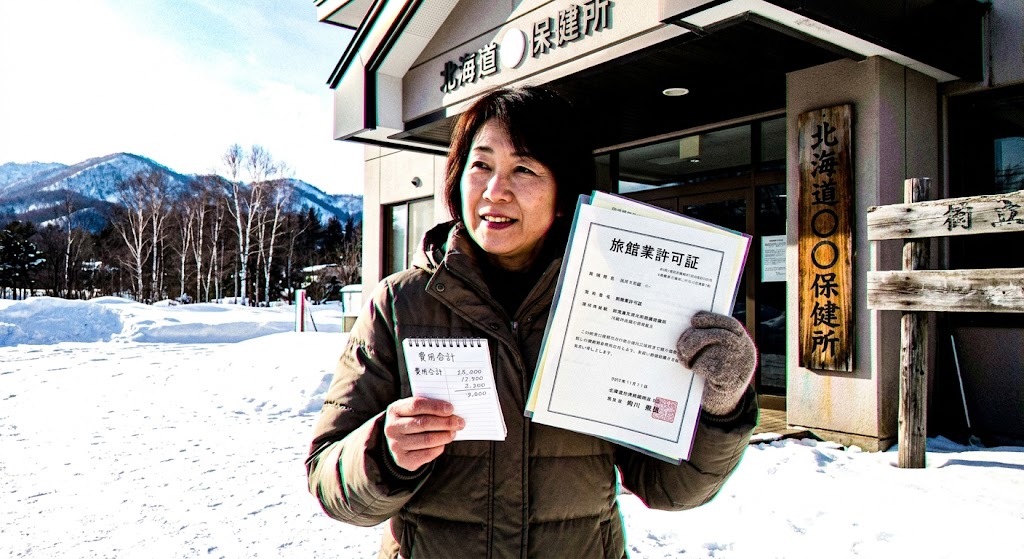
Once your facilities are ready, submit your application documents to the public health center. The application requires floor plans, a written pledge, and documentation proving the building’s structural specifications. Once you pass document review, public health center staff will conduct an on-site inspection. Here, they strictly check whether the sanitary condition of plumbing areas, the floor area of bedrooms, ventilation equipment, and other factors meet the required standards.
Cost Breakdown and Typical Price Range for Obtaining a License
Obtaining a ryokan business license involves not just administrative fees, but also renovation costs for physical infrastructure, which often make up the largest share of the expense.
First, application fees paid to the municipality typically run from 20,000 to 30,000 yen in most parts of Hokkaido. However, a much bigger burden comes from fire safety equipment installation costs. When converting a typical detached house, it’s not unusual for renovation costs to run anywhere from 200,000 to 1,000,000 yen.
Additionally, if you hire a gyoseishoshi (administrative scrivener) to handle the application process on your behalf, expect fees of around 150,000 to 400,000 yen. If a change of building use is required, you’ll also need to budget for an architect’s fee. Adding all this together, depending on the property’s condition, you should plan for at least 500,000 to 1,500,000 yen in initial costs just for license-related matters.
Comparison with General Rental and Sales Markets: Profitability Differences in Hokkaido
When comparing the accommodation business against general rental and sales markets in Hokkaido—particularly around Sapporo—the unique nature of the lodging business becomes clear.
Sale prices for condominiums and detached houses in Sapporo have been on a steady upward trend, and as a result, gross yields for general rental properties have dropped to around 4 to 6 percent. General rentals offer long-term stability once a tenant is secured, but since rent levels are tied to local income levels, you can’t expect dramatic revenue growth.
By contrast, an accommodation business operated under a ryokan business license draws its revenue directly from global tourism demand. Nightly rates can be set completely independent of local rent levels, and during peak season, aggressive pricing of tens of thousands of yen per night is entirely feasible. The potential to achieve actual yields of 10 percent or higher is a unique strength of the lodging business. That said, it’s important to understand that, unlike general rentals, you can’t simply “set it and forget it”—cleaning and management costs, along with significant seasonal fluctuation risk, require ongoing attention.
Concrete Guest Acquisition Strategies for Accommodation Businesses in Hokkaido
Once you’ve obtained your license, how efficiently you attract guests becomes the key to turning a profit.
Target Setting and Leveraging OTAs
Focus your targeting on “guests seeking a private experience that a hotel can’t provide.” Specifically, this includes families from Asia or the West traveling by rental car, or large group travelers. While major OTAs are essential channels, it’s crucial to tailor your photo selection and listing descriptions to match the user characteristics of each platform.
Dynamic Pricing Based on Seasonality
Because Hokkaido experiences extreme seasonal swings in demand, keeping a flat nightly rate year-round isn’t a wise strategy. You need a meticulous pricing strategy—maximizing rates during the winter ski season and summer tourist season, while offering long-stay discounts during the off-season. In particular, by leveraging the 365-day operation enabled by your ryokan business license, capturing remote-work demand and local tourists during slow periods can help boost overall revenue.
Honest Risks and Challenges of Operating in Hokkaido
While the accommodation business has many appealing aspects, there are also risks unique to Hokkaido.
The biggest risk is winter maintenance costs. Heating expenses and the electricity costs needed to prevent pipes from freezing can be far higher than in other regions. Operational workload also increases, with tasks like arranging snow removal and alerting guests about snowfall conditions.
Furthermore, in highly competitive areas like central Sapporo, an oversupply of accommodation facilities has emerged, and simply obtaining a license doesn’t guarantee full bookings. If your property’s concept is unclear or your cleaning quality is subpar, there’s a real risk of failing to recover your substantial initial investment, potentially earning less than you would with general rental. It’s important not to forget that the accommodation business is more akin to a genuine service industry than to real estate investment.
Leave Your Hokkaido Minpaku Launch and Management to Us
Building a stable accommodation business across the vast expanse of Hokkaido, complete with a ryokan business license, requires diverse expertise—from legal knowledge to on-the-ground operational know-how.
Stay Buddy Co., Ltd. handles everything from minpaku planning and development to construction and management on an end-to-end basis. Drawing on our extensive track record across Sapporo and throughout Hokkaido, we help owners maximize the value of their assets. From navigating complex license application procedures and installing fire safety equipment, to renovations that maximize revenue and day-to-day management that keeps guests satisfied, we support every step of the process from a professional standpoint.
Leave your minpaku launch and management in Sapporo and throughout Hokkaido to us. With deep knowledge of the harsh winter cold and region-specific regulations, we’ll bring your vision to life and work together with you to create an accommodation facility whose value won’t fade even years from now.
Whether you need a diagnosis of whether your current property can obtain a ryokan business license, or help drafting a concrete revenue plan, we welcome inquiries at any phase. Please feel free to reach out to Stay Buddy Co., Ltd. anytime. Our specialist staff will carefully propose the optimal management plan tailored to your specific circumstances. We look forward to hearing from you.