Leave Your Vacation Rental Management to Us
Completely Free Online ConsultationTerrestrial TV Is a Must-Have for Vacation Rentals Targeting Japanese Guests
In today’s accommodation market, streaming services like YouTube and Netflix have become remarkably widespread. However, when Japanese domestic travelers are your primary target, terrestrial TV remains an essential piece of infrastructure that simply cannot be skipped. Many hosts hesitate to install a television in order to cut costs or avoid NHK subscription fees, but for domestic guests, having access to terrestrial broadcasts is one of the biggest factors in maintaining satisfaction, repeat bookings, and strong reviews. Japanese travelers tend to seek the same sense of everyday comfort even while away from home, and a space without a TV runs the risk of being perceived as “incomplete” or lacking.
The Psychological and Practical Reasons Japanese Guests Expect Terrestrial TV
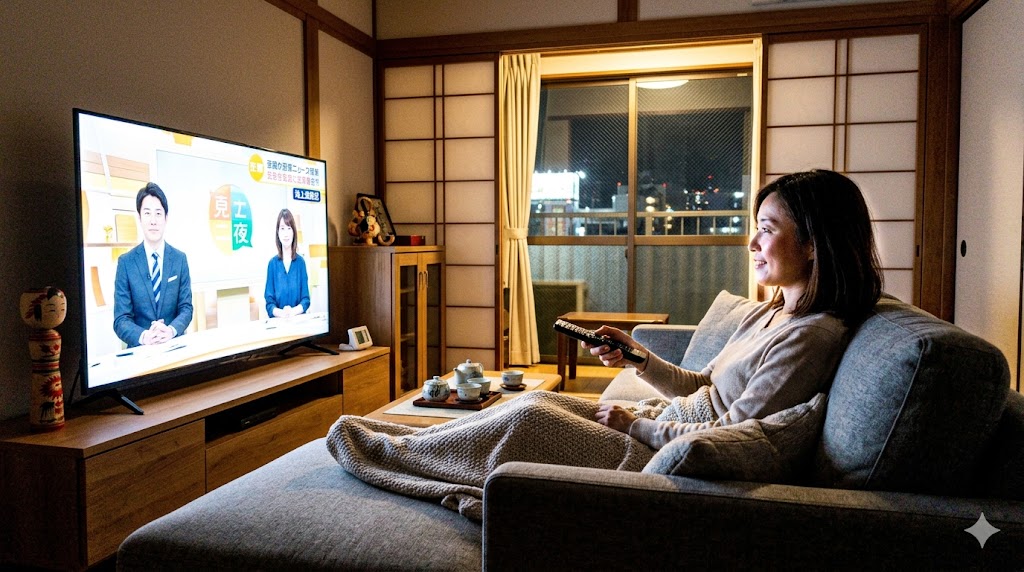
For Japanese people, terrestrial television is more than just entertainment—it’s woven into daily life. For families, older guests, and business travelers alike, being able to check the morning news and weather forecast, or having the TV on in the background after dinner, plays a major role in how comfortable a stay feels.
From a practical standpoint, Japan is prone to natural disasters, and terrestrial broadcasts are a trusted source of real-time breaking news. While online news is available, television’s ability to keep information flowing continuously on-screen offers a convenience that’s hard to replace, especially in emergencies. There’s also demand for TV as a form of “background presence” that eases the sense of isolation during a stay—many guests feel more at home when a familiar broadcast is playing, rather than sitting in total silence. Negative reviews stemming from the lack of a TV are difficult to recover from once posted, which is why installing one should be considered a worthwhile upfront investment.
Comparing Against General Rental and Sales Market Conditions
When considering vacation rental operations, it’s important to weigh the profitability of the hospitality business against general rental and property sales market conditions in the target area (here, we’ll use the Sapporo and broader Hokkaido region as an example).
In Sapporo’s general rental market, rent levels in the city center remain stable, but competition has intensified due to an oversupply of newly built condominiums. Typical investment yields fall in the 4–6% range—a stable option with reliable long-term tenancy, but not one with explosive earning potential. Additionally, in standard rental arrangements, owners generally only need to provide air conditioning and lighting fixtures, not a full suite of appliances.
Vacation rentals (hospitality operations), on the other hand, require upfront investment in a full appliance lineup—TV, refrigerator, washing machine, and more—but can potentially achieve real yields of 10–15%. Whether or not to include a terrestrial TV plays a direct role in balancing operating costs against revenue. To earn more than you would from a standard long-term rental, you need to offer guests added value that makes them feel “more comfortable than at home.” If you lose out on Japanese demand by skipping terrestrial TV, vacancy risk rises—and the resulting revenue could even fall below what a standard rental would generate. In the sales market as well, properties with a proven track record as accommodation facilities are valued more highly under the income capitalization approach, so investing generously in equipment to boost occupancy also works in your favor for an eventual exit strategy (resale).
Concrete Marketing Strategies for Vacation Rental Operations
When targeting Japanese guests, it’s not enough to simply install a terrestrial TV—you need a strategy that turns it into a genuine draw for bookings.
- Target Setting and OTA Utilization
Your primary targets are domestic families, multigenerational travelers, and group travelers. These segments tend to favor major Japanese OTAs like Rakuten Travel and Jalan, so when listing on these platforms, always check the “TV” box in the amenities section. Furthermore, explicitly noting “terrestrial broadcast available” in your property description helps differentiate your listing from competitors. It’s effective to emphasize streaming services (smart TVs) for international guests on Airbnb, while highlighting terrestrial broadcasting for domestic-facing platforms.
- Seasonal Appeal
During year-end and New Year holidays, long weekends, or major international sporting events, Japanese guests have a strong desire to “watch special programs or matches on TV.” In winter Hokkaido, for example, coming in from the cold and spending time watching TV in a warm room is a classic experience for domestic travelers. Incorporating phrases like “equipped with a large-screen TV” into your listing copy during these periods can help boost booking rates.
- Equipment Investment Tailored to Your Target Guests
Rather than simply placing a TV in the room, it’s important to choose a size appropriate to the living room’s dimensions. For properties designed for larger groups, installing a 50-inch or larger screen and positioning it so it’s easily viewable from anywhere in the dining or living area can significantly boost overall guest satisfaction.
The Honest Risks and Challenges of Vacation Rental Operations
Installing terrestrial TV comes with clear costs and risks. First, NHK subscription fees are an unavoidable business expense. There’s also the ongoing hassle of minor maintenance issues, such as TV malfunctions or lost remote controls.
Furthermore, in fiercely competitive vacation rental markets like Sapporo, simply having a terrestrial TV has become the norm—it’s no longer, on its own, going to dramatically boost occupancy. In fact, installing a terrestrial TV while neglecting internet quality or cleanliness would be putting the cart before the horse. And if your target audience is exclusively guests seeking complete quiet, or younger international travelers who only watch subscription services like Netflix, terrestrial TV may not be necessary at all. However, as long as Japanese guests are part of your target audience, the absence of terrestrial TV can count against you. In highly competitive areas, you need to secure these “table stakes” amenities first, then build further uniqueness on top of that foundation.
Leave Your Hokkaido Vacation Rental Launch and Management to Us
For property owners considering launching or managing a vacation rental in Sapporo or elsewhere in Hokkaido: bringing your ideal accommodation to life requires equipment choices that accurately reflect local demand, along with solid operational know-how.
Stay Buddy Co., Ltd. handles everything from vacation rental planning and development to construction and day-to-day operational management, all under one roof. We have deep knowledge of Hokkaido’s unique climate, tourism resources, and transportation access. What do Japanese guests want, and what kind of amenities make them feel at ease? Drawing on extensive data and hands-on experience, we propose plans designed to maximize the asset value of your property.
From infrastructure setup—including terrestrial TV installation—to strategic marketing that combines domestic and international OTAs, to round-the-clock guest support, we promise strong backup at every phase of your hospitality business. Let’s work together to achieve a highly profitable vacation rental operation and build an asset that retains its value for years to come. Leave your vacation rental launch and management needs in Sapporo and throughout Hokkaido to us. Please feel free to reach out to Stay Buddy Co., Ltd. anytime. Our specialized staff will carefully propose the optimal management plan tailored to your specific circumstances. We look forward to hearing from you.