Leave Your Minpaku Management to the Experts
100% Free Online ConsultationThe Most Critical Points on “Fire Safety Equipment” and “Building Standards Act” for Change of Use (Simple Lodging)
When trying to repurpose a vacant house or used building in Osaka City as a “simple lodging” (guesthouse or single-house hotel), one unavoidable step is the “change of use from residence to lodging facility.” This procedure isn’t simply a matter of rewriting paperwork—it means physically upgrading the building to meet the “safety standards required for lodging facilities.”
Let’s start with the conclusion of this article.
The most important aspect of changing a building’s use to simple lodging is accurately understanding the “200-square-meter wall” under the Building Standards Act and the “installation requirements for automatic fire alarm systems” under the Fire Service Act—and locking in your costs during the early design stage.
Neglecting this can lead to millions of yen in unexpected additional construction costs right before opening, or in the worst case, failure to obtain a business license—rendering your renovation investment worthless. Let’s take an expert-level dive into the regulatory points you absolutely must understand.
Building Standards Act: The “Building Performance” Required to Qualify as a Lodging Facility
A building constructed as a residence is generally considered to lack the safety performance required for use as a lodging facility. The following points are especially important.
1. Whether a Building Confirmation Application Is Required Based on the “200 Square Meter” Threshold
If the floor area subject to the change of use exceeds 200 square meters, you are required to submit a “confirmation application for change of use” to the authorities. This mandates the involvement of a licensed architect, and preparing drawings and responding to administrative guidance will take both time (several months) and money. If the area is 200 square meters or less, this “confirmation application” itself is not required—but that doesn’t mean you’re exempt from complying with the law. Even for small properties, if the building doesn’t meet the construction standards required for lodging facilities (such as fire-resistant construction and evacuation routes), you won’t be granted a hotel business license, so caution is needed.
2. Securing Evacuation Routes and Fire Compartments
Because guests are unfamiliar with the building’s layout, strict safety measures are required in case of fire.
- Walking distance limits: The distance from each guest room to an exit (staircase) must not exceed a specified limit.
- Fire compartments: Walls around stairwells and between guest rooms must be built to withstand fire (fire-resistant or quasi-fire-resistant construction). Particularly when converting a wooden house into a simple lodging facility, work such as replacing or thickening the plasterboard on ceilings and walls is often required, significantly affecting interior costs.
3. Whether a “Certificate of Inspection” Exists Can Make or Break Your Project
When changing the use of a building, whether it has a “certificate of inspection” proving it was legally constructed at the time it was built is extremely important. Without this document, verifying the building’s compliance with the law can require expensive surveys—or the change of use may be deemed impossible altogether. If you’re considering an older building in Osaka City, checking for this document should be your first step.
Fire Service Act: The “Equipment” and “Inspections” That Protect Lives
The Fire Service Act imposes even stricter requirements than the Building Standards Act. Lodging facilities are classified as “Category 5(a)” designated fire hazard buildings under the Fire Service Act, requiring equipment on an entirely different level than ordinary residences.
1. Installing an Automatic Fire Alarm System
Almost without exception, simple lodging facilities are required to install an “automatic fire alarm system.” Unlike household smoke detectors, this requires a system that alerts occupants throughout the entire building in a linked fashion. For smaller facilities, a wireless “automatic fire alarm system for small-scale specified facilities” may be permitted, which can reduce installation costs—but even this typically costs anywhere from 100,000 to several hundred thousand yen.
2. Exit Signs and Emergency Lighting
To ensure guests can find their way to evacuation routes during a power outage or in smoke-filled conditions, exit signs (the green signs) and emergency lighting must be installed. Detailed regulations govern their placement and brightness, making prior consultation with the fire department essential.
3. Use of Flame-Retardant Materials
All curtains, carpets, bedding, and similar items used in a simple lodging facility must be “flame-retardant products” certified by the fire authorities. Failing to comply means you won’t pass the fire safety inspection, and your business license won’t be granted.
The Terrifying Pitfalls of “Change of Use” You Need to Know
Taking regulations lightly and proceeding with the paperwork carelessly can lead to the following serious consequences.
The Trap of Retroactive Application
Even if you only intend to renovate part of the building, a change of use can trigger a requirement to bring the entire building up to “current legal standards.” This has led to numerous cases where unplanned seismic reinforcement work or large-scale fire safety equipment installations caused budgets to balloon several times over.
No License Without a Fire Code Compliance Certificate
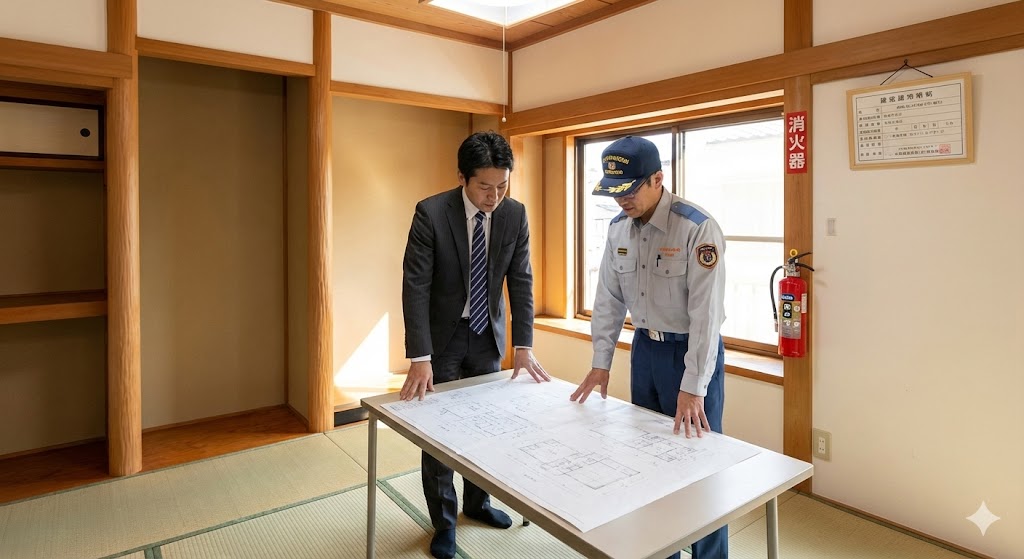
When submitting an application for a hotel/lodging business (simple lodging) license to the public health center, you must always provide a “certificate of fire code compliance” issued by the fire department. If even a single piece of required equipment is missing, or inspections haven’t been completed, the health center will not accept your application.
Penalties and Loss of Social Trust from Operating Without a License
Operating a lodging business without a license, under the assumption that “no one will find out,” is a criminal offense under the Hotel Business Act. On top of that, insurance won’t cover you if a fire occurs, and platforms like Airbnb may permanently remove your listing—inflicting damage you may never recover from.
A “Strategic Regulatory Approach” for Success in Osaka City
Osaka City, thanks to systems like the National Strategic Special Zone minpaku program, offers a wider range of lodging business options than most areas in Japan. That’s exactly why a strategic approach is essential to maximizing your property’s potential.
- Consult with authorities before purchasing or leasing a property: Bring an architect and fire safety equipment specialist to check with local government offices early on whether the building is even eligible to become a simple lodging facility.
- Judge based on total cost: Rather than being drawn in by low renovation quotes, run your profitability simulations based on the “total cost to opening,” including all regulatory compliance work.
- Design with operations in mind from the start: A design that not only clears regulatory hurdles but also balances ease of cleaning with guest satisfaction will generate long-term profit.
Conclusion: Clearing Regulations Is Your Ticket to High-Profit, Safe Operations
Changing a building’s use to simple lodging may seem like a complex and costly hurdle at first glance. However, properly clearing these requirements is a critical step in officially establishing your property as a “legally compliant lodging asset.”
- Meet the safety standards under the Building Standards Act and protect your property’s asset value.
- Install the latest equipment compliant with the Fire Service Act to protect guests’ lives and the owner’s liability.
- Leverage professional expertise to eliminate unnecessary construction work and obtain your business license via the shortest possible route.
With a solid foundation of legal compliance in place, you can focus with confidence on attracting guests—turning Osaka’s massive tourism demand into real profit.
From Complex Change-of-Use Procedures to Highly Profitable Operations, Stay Buddy Provides Complete Support
“I want to convert a building or house I own into a simple lodging facility, but the regulations are so complicated I don’t know where to start.”
“I want an accurate estimate and profitability forecast for how much fire safety equipment and construction work will cost.”
“I don’t just want to get the license—I want to entrust everything, including cleaning and ongoing operations afterward, to a professional I can trust.”
Leave all of these concerns to us.
We at Stay Buddy Co., Ltd. are a team of professionals specializing in lodging business and minpaku management within Osaka City.
We’re not just an outsourcing company.
- One-stop support for change-of-use procedures and hotel business licensing, working in partnership with affiliated architects and administrative scriveners
- Deep knowledge of Osaka City’s strict fire and building standards, allowing us to propose compliance plans that minimize costs
- Highly accurate profitability simulations based on local lodging market data
- Hotel-standard cleaning, 24/7/365 guest support, and strategic marketing operations after opening
We create an environment where owners can enjoy the fruits of “profit” with peace of mind, without being burdened by regulatory hurdles.
Let’s turn your property into the safest, most profitable, and most sought-after lodging facility in the area. Feel free to reach out first for a free property assessment and personal consultation.