Leave Your Minpaku Management to Us
Completely Free Online Consultation5 Risks You Need to Know Before Adding BBQ to Your Minpaku
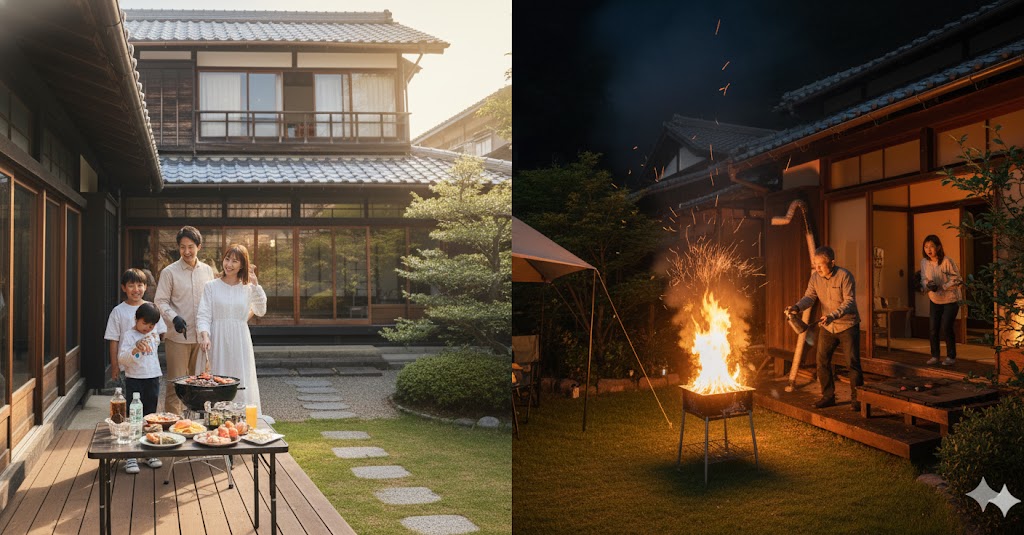
A backyard or spacious balcony where guests can enjoy a barbecue (BBQ) with friends and family.
Many hosts believe that offering this as “added value” at their minpaku property could attract a flood of bookings—especially from families and groups—while significantly raising their nightly rates.
Indeed, a BBQ feature can look stunning in OTA (booking site) photos and become an incredibly powerful “customer magnet” that sets you dramatically apart from competing properties.
However, introducing and operating this feature involves far more “pitfalls” than you might imagine. Jumping in without careful thought can lead not to profit, but to serious trouble that could ultimately break your entire business.
Let’s start with the conclusion of this article.
The key to successfully introducing BBQ at your minpaku lies in accurately understanding the five major risks (neighbor disputes, fire, cleaning and maintenance, cost, and insurance) behind that attractive return, and putting thorough countermeasures in place for each before you launch.
In this article, we’ll thoroughly explain the five risks you absolutely must know before introducing BBQ, along with concrete countermeasures, so you don’t end up with regrets.
Risk 1: [Most Critical] “Neighbor Disputes” — The Triple Threat of Noise, Smoke, and Odor
This is the single biggest and most serious risk with BBQ-equipped minpaku properties—one that can potentially lead directly to a shutdown of your business.
- Why is this so critical? No matter how much fun your guests are having, loud voices and laughter continuing late into the night (noise), and smoke or the smell of grilling meat clinging to neighbors’ laundry (odor), can become unbearable for nearby residents. The host’s logic of “please cut us some slack, it’s just the weekend” doesn’t fly in a residential community. If complaints are reported to a management association, neighborhood council, or even local government authorities, your business could be shut down on the spot.
- Countermeasures to take:
- Property selection is 90% of the battle: If you’re going to offer BBQ, choosing a **standalone house with sufficient distance from neighboring homes** is an absolute prerequisite for avoiding trouble. BBQ on an apartment balcony is prohibited by building regulations in most cases—and even where it’s allowed, smoke and odor drifting into neighboring units or upper floors makes it an extremely high-risk choice.
- Strictly enforce clear “usage time restrictions”: Set explicit time limits such as “BBQ use permitted until 9:00 PM,” include this in your multilingual house rules, and remind guests both at booking and check-in. When the cutoff time arrives, be thorough enough that the host or operations staff actually go and remind guests in person if needed.
- Physical measures: Where possible, it’s also effective to install plants or a privacy fence around the BBQ area to help block sound and smoke to some degree.
- Greet and explain to neighbors in advance: Before you begin operations, be sure to visit neighboring residents to introduce yourself and politely explain that “a BBQ facility will be installed, but usage hours will be strictly enforced and thoroughly managed to avoid causing any inconvenience.” Securing their understanding in advance will soften the severity of any complaints, should they arise.
Risk 2: [Life-Threatening] “Fire Risk” — Thorough Safety Management
BBQ involves handling open flame. A single moment of carelessness can trigger an irreversible catastrophe that puts guests’ lives at risk.
- Why is this dangerous?
- Improper fire management: Risk of fire spreading to the building or surrounding area due to improperly extinguished charcoal or sparks scattered by strong wind.
- Gas appliance accidents: When using a gas-canister-type stove, the risk of gas leaks or explosions caused by improper canister installation or deterioration.
- Carbon monoxide poisoning: The risk of carbon monoxide poisoning from insufficient ventilation when charcoal is used in a semi-enclosed, roofed space.
- Countermeasures to take:
- Consult your local fire department in advance: Discuss the location and type of BBQ equipment with your local fire department beforehand, confirming it doesn’t violate fire prevention ordinances and getting guidance on necessary safety measures.
- Install and inspect proper fire extinguishing equipment: Always place a ready-to-use fire extinguisher and a bucket filled with water right near the BBQ area. Don’t forget regular inspection of the fire extinguisher, too.
- Strictly enforce a “no flammable items nearby” rule: Clearly instruct guests to never place flammable materials (paper, cloth, branches, etc.) near the BBQ grill.
- Create a safety instruction manual: Develop an easy-to-understand manual—using photos and illustrations—that explains how to safely light charcoal, extinguish fires properly, and correctly install gas canisters, and always keep it together with the BBQ set.
- Regular inspection of gas appliances: If you install a gas grill, always have it regularly inspected and maintained by a professional service provider.
Risk 3: [Operational Reality] The Time and Cost of “Cleaning and Maintenance”
After guests finish enjoying their BBQ, the space gets dirtier than you might expect. Cleaning and maintaining it demands a level of time and cost that’s incomparable to standard interior cleaning.
- Why is this so demanding?
- Grease and burnt residue: Scrubbing off stubborn grease stains and burnt-on residue from grills and grates.
- Charcoal disposal: Safely disposing of used charcoal and preparing a dedicated disposal container (such as a fire-extinguishing pot) for it.
- Trash sorting and volume: Large amounts of food waste, empty cans, and combustible trash are generated, requiring proper sorting and handover to your contracted waste collection service.
- Equipment wear and damage: Items like grills, grates, and tongs are consumables that need periodic replacement. Damage from guest carelessness can also occur.
- Countermeasures to take:
- Create a detailed cleaning manual: Develop a manual that specifies exactly how to clean the BBQ grill, the procedure for handling charcoal, and trash sorting rules, and make sure your cleaning staff follow it thoroughly.
- Negotiate with your cleaning contractor in advance: If you outsource cleaning to an external contractor, BBQ cleanup is typically treated as “special cleaning” outside of standard service, incurring an additional fee. Be sure to confirm pricing in advance and include it in your contract.
- Choose durable equipment: Even if the initial cost is somewhat higher, choosing a rust-resistant, easy-to-clean, durable stainless-steel grill will lead to lower costs over the long term.
Risk 4: [The Cost Trap] “Equipment Investment” and Ongoing Expenses
Introducing a BBQ feature doesn’t simply mean buying a grill. Creating an environment where guests can comfortably enjoy themselves requires a variety of upfront investments and ongoing costs.
- Initial investment:
- Cost of purchasing a BBQ stove/grill (from tens of thousands to hundreds of thousands of yen)
- Cost of installing outdoor tables and chairs
- Cost of installing a roof, tarp, or parasol to protect against rain and sun
- Cost of installing lighting equipment for nighttime use
- Ongoing costs (variable expenses):
- Consumables such as charcoal, firelighters, grates, aluminum trays, tongs, and gloves
- Gas canister costs (for gas-type grills)
- Additional fees for cleaning contractors
- Countermeasures to take: It’s essential to calculate all of these costs precisely and run a rigorous profit-and-loss simulation to determine how much of a rate premium and occupancy boost the BBQ feature can realistically deliver. Your pricing strategy also matters here—will you charge a separate “BBQ usage fee,” or bundle it into the room rate?
Risk 5: [Preparing for the Worst] Confirming Your “Insurance” Coverage
Fire, guest injuries, food poisoning… BBQ carries a variety of accident risks. Carrying insurance to prepare for these worst-case scenarios is an absolute obligation for you as the owner.
- Why is this necessary?
- If a guest suffers a burn during BBQ use
- If food poisoning occurs from ingredients you provided (if you do provide them)
- If improperly extinguished fire causes damage to the building or a neighboring property—In all of these cases, you, as the owner, bear the full liability for damages.
- Countermeasures to take:
- Urgently check the terms of your fire insurance and property liability insurance policies, and clearly ask your insurance company whether accidents related to BBQ (fire, guest injury, food poisoning, etc.) are covered.
- In many cases, standard plans don’t cover this, and you may need to add a special rider or take out a separate policy such as event insurance. Be prepared for the premium to be higher than usual as well.
- Clearly stating a disclaimer in your house rules—such as “Use of the BBQ facility is at the guest’s own risk, and the property assumes no responsibility for any accidents, injuries, or food poisoning occurring during use”—is also part of risk management, but understand that its legal enforceability has limits.
Summary: BBQ Is a “Double-Edged Sword”—Never Introduce It Without Proper Risk Management
Depending on how it’s used, a BBQ feature can become a powerful weapon that transforms your minpaku property into a uniquely appealing destination, unlike anything your competitors offer.
However, introducing and operating it comes with a wide range of serious risks, spanning neighbor disputes, fire, hygiene management, cost, and insurance.
Do you truly understand all of these risks, have you put thorough countermeasures in place for each, and are you prepared—the “resolve”—to manage them on an ongoing basis? Ask yourself honestly, and only once you can genuinely answer YES will you be able to wield the double-edged sword that is BBQ safely and effectively. A careless launch is something you should absolutely avoid.
Why Not Leave That “Risk Management” to Us Professionals?
“I don’t want to give up the appeal of BBQ, but I’m not confident I can manage all these risks on my own…”
“How do I even choose the right safety measures or a trustworthy contractor?”
“Just thinking about what might happen if a neighbor files a complaint keeps me up at night.”
Please feel free to bring these concerns to us.
Here at Stay Buddy Inc., our experience operating numerous uniquely concept-driven minpaku properties throughout Osaka City has given us deep familiarity with the risks that come with “value-added amenities” and how to manage them.
We will:
- ① Diagnose your property’s situation, objectively assessing the feasibility of introducing a BBQ feature and the accompanying **risks (particularly neighbor disputes and fire)**.
- ② Work alongside our partner specialists to provide recommendations on optimal safety measures (fire prevention equipment, soundproofing/odor control, etc.), and support you through every step needed to operate your BBQ-equipped minpaku with confidence—including reviewing your insurance coverage in preparation for worst-case scenarios.
- ③ Protect you from day-to-day risks, such as noise complaints and equipment issues, through rigorous house management and round-the-clock support once operations begin.
Supporting bold, “offensive” investments that boost guest satisfaction with rock-solid “defensive” measures.
That’s our professional approach to risk management. Why not work with us to design the optimal strategy for maximizing your property’s value while minimizing risk?
We look forward to hearing from you.