Trust Us With Your Minpaku Management
Free Online ConsultationTurning Vacant Homes into Foreign Guest Magnets: Keys to Minpaku Success
An “akiya” (vacant house) that simply sits there still racks up property taxes and maintenance costs. Older homes in rural or suburban areas, in particular, often become “negative assets” simply because no one can figure out what to do with them.
But what if that very same vacant home could become **a place inbound tourists visiting Japan from all over the world would gladly pay to experience**?
Let’s start with this article’s conclusion.
Against the backdrop of historically weak yen and travelers’ growing appetite for “experiential” (koto-shohi) consumption, Japan’s vacant houses—especially traditional kominka—are now perfectly positioned to be transformed into “hidden gold mines” that far outperform conventional rental income, simply by converting them into minpaku aimed at international guests.
In this article, we’ll walk you through the concrete keys to success for reviving your vacant home into a popular guesthouse that draws visitors from around the globe.
Why Japan’s “Vacant Houses” Resonate So Strongly with International Guests Right Now
Why do the very houses we tend to see as “old” or “inconvenient” hold such powerful appeal for inbound tourists? The answer lies in their values and expectations.
1. An Overwhelming Desire to Experience “Authentic Japan”
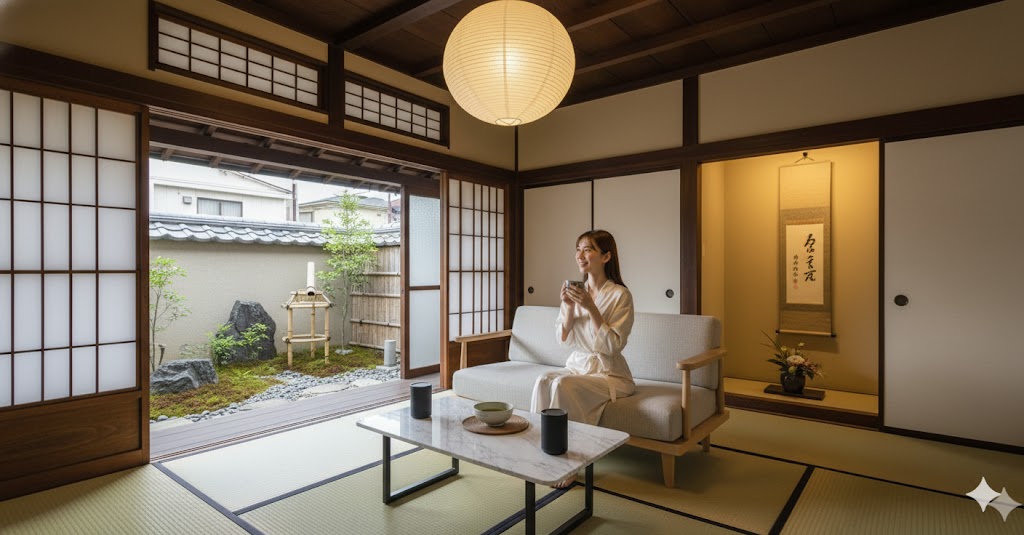
Most international travelers aren’t coming to Japan to stay in a generic business hotel—they’re coming to experience “the real Japan.” Sleeping on tatami mats, gazing out at a garden from the engawa veranda, spending time in a space with an earthen-floored doma or an irori hearth… The very lifestyle embodied by traditional kominka—something we might dismiss as ordinary or outdated—is, for them, one of the most exciting and valuable cross-cultural experiences available.
2. The Value of Extraordinary Space—and Its Instagram Appeal
Gleaming dark wooden beams, intricately carved ranma transoms, beautiful shoji and fusuma sliding doors—the distinctive architectural beauty and wabi-sabi atmosphere of a kominka represent the truly extraordinary for foreign guests, and simply being in that space becomes a kind of status symbol. Photos taken there get shared across the world via Instagram and other social media, becoming the ultimate word-of-mouth advertising that draws in the next wave of guests.
3. Demand for “Private Space” Among Groups and Families
Inbound tourists frequently travel in relatively large groups—families or friends together. For them, renting an entire house to enjoy uninterrupted private time is a far more appealing and practical choice than splitting up into separate cramped hotel rooms. A whole-house rental minpaku hits exactly this need.
[5 Keys to Success] Essential Points for Converting Vacant Homes into Minpaku for International Guests
To seize this enormous opportunity and transform a vacant house into a profitable minpaku, you need strategic preparation that centers on the perspective of international guests—an approach quite different from operating for domestic travelers.
Key 1: [The Foundation for Revenue] Aim for a Ryokan Business (Simple Lodging) License
- Why: While inbound demand does have seasonal fluctuations, it exists year-round. To maximize your revenue opportunities, the 180-day annual operating cap under the Private Lodging Business Act (the “new minpaku law”) represents far too much lost potential.
- What to do: If you’re serious about generating real business revenue, plan from the outset to obtain a **Ryokan Business Act (Simple Lodging) license, which allows 365-day operation.** This requires clearing strict standards around zoning (generally not permitted in exclusively residential zones), fire safety regulations, and building codes—but the legal stability and profitability you gain in return are on an entirely different level.
Key 2: [Space Design] Blending “Japanese Charm” with “Modern Comfort”
- Why: International guests want “authentic Japan,” but that’s not the same as putting up with inconvenience or a lack of cleanliness. Striking a balance between traditional charm and comfort is the key to earning glowing reviews.
- What to do:
- What to preserve (Japanese charm): Beams, pillars, the earthen doma floor, engawa verandas, ranma transoms, and tatami mats—all the distinctive character of a kominka should be preserved and restored to the fullest extent possible.
- What to modernize (modern comfort): ①Plumbing (bath, toilet, sink), ②HVAC, ③insulation. These three areas directly impact guest comfort, so install the latest equipment and pursue comfort relentlessly. Cold winters, in particular, can lead to serious complaints, making insulation renovations and double-glazed windows essential investments.
Key 3: [Functionality] Equip the Property with Non-Negotiable Amenities
This is about building the infrastructure that lets international guests “live” comfortably—just as well as, or even better than, they would at home.
- 1. High-Speed, Reliable “Fixed-Line Wi-Fi”: This is now essentially the fourth utility, alongside electricity, gas, and water. Relying “solely” on a pocket Wi-Fi router with data limits is an absolute no. Fiber-optic fixed-line internet is a lifeline for guests staying connected with home, researching their trip, and streaming video—so be sure to install it.
- 2. Easy-to-Understand Air Conditioner Controls: Japan’s high-tech air conditioner remotes are baffling “codes” to most international guests. Simply adding English labels like **”Power,” “Temp,” and “Mode (Cool/Heat)”** to the buttons dramatically cuts down on guest inquiries.
- 3. A Washer-Dryer Combo: For guests on longer stays especially, a machine that handles both washing and drying is extremely valuable. It lets guests pack lighter, which significantly boosts satisfaction.
- 4. A Fully Stocked Kitchen: Demand for self-catering is high. Beyond a fridge, microwave, and induction cooktop, be sure to include a rice cooker, electric kettle, knives, cutting boards, frying pans, pots, and a generous supply of dishware and cutlery.
- 5. A Washlet (Heated Bidet Toilet): This is one of Japan’s world-renowned hospitality features. Many guests come to Japan specifically anticipating this level of comfort, making it essential.
Key 4: [Information] A Flawless Multilingual Guide That Breaks Down Language Barriers
- Why: Anxiety is the gateway to complaints. How effectively you can anticipate and resolve the uncertainty guests feel in an unfamiliar country where they don’t speak the language is where a great host truly shines.
- What to do:
- Check-in Guide: Create a guide—using photos and short videos—detailed enough that anyone can navigate from the station to your property and figure out how to unlock the door without confusion. (Japanese and English are essential; Chinese and Korean are a bonus.)
- In-Room Manual: Post clear, illustrated, multilingual instructions inside the property covering how to operate appliances, Japan’s notoriously complex trash-sorting rules, and neighborhood etiquette (especially regarding noise).
- Futon-Laying Guide: If you provide futon sets in a tatami room, you’d be surprised how many guests simply don’t know how to lay them out. Leaving an illustrated how-to guide is a thoughtful touch.
Key 5: [Operations] Round-the-Clock Guest Support
- Why: Inbound minpaku operations face unpredictable events around the clock, 365 days a year—middle-of-the-night inquiries from guests in far-away time zones, midnight check-ins caused by delayed flights, or sudden mid-stay troubles (like no hot water).
- What to do:
- Rapid Message Response: You need a system that can respond to guest inquiries quickly (ideally within an hour), regardless of time zone differences.
- Emergency Response: You need to be able to respond (or dispatch someone) even in the middle of the night for emergencies like equipment malfunctions or lost keys.
- [A Realistic Approach]: Handling all of this yourself as an owner is simply not feasible, especially if this is a side business. Outsourcing all of this complex operational work to a trusted minpaku management company is the wisest business decision for keeping your operation running smoothly and sustainably.
In Summary: A Vacant House Is a “Stage” for Sharing Japan’s Charm with the World
Turning a vacant house into minpaku for international guests isn’t just a real estate investment. It’s an extraordinarily creative and rewarding undertaking—transforming your “negative asset” into a one-of-a-kind stage for showcasing Japan’s authentic culture and hospitality to the world.
Use the points covered in this article to unlock the full potential of your vacant home, and build a wonderful place that draws heartfelt gratitude from guests around the world.
Let Our Professionals Help You Build That “Stage”
“I want ideas for reviving a kominka in a way that resonates with international guests.”
“Applying for a ryokan business license or a subsidy is way too complicated for me to handle.”
“There’s no way I could manage 24-hour multilingual guest support on my own…”
If any of these concerns sound familiar, please reach out to us.
We are Stay Buddy Co., Ltd., a business development and operations team that has revitalized and managed numerous vacant houses—especially kominka—into thriving, high-revenue lodging facilities bustling with inbound guests, right in the heart of Osaka, one of Japan’s most competitive minpaku markets.
We offer:
- ① A free assessment of your vacant house’s potential, including its eligibility for a ryokan business license.
- ② End-to-end support for launching your business—from developing a concept that resonates with international guests, to subsidy-supported renovations, all the way through to funding assistance.
- ③ A complete operational system covering 24/7 multilingual guest support, OTA optimization, and high-quality cleaning management—so you can enjoy stable revenue without lifting a finger.
Turn your “vacant house” into a “revenue-generating asset” connected to the world.
Why not chart the most reliable and efficient path forward together with us? We look forward to hearing from you.