Leave Your Minpaku Management to Us
Free Online ConsultationA Clear Guide to Starting Minpaku as an Individual
“I want to put my unused room or house to work and build a new stream of income.”
“I’d like to try launching a new business while keeping my day job.”
For individuals with thoughts like these, minpaku (Japanese-style short-term rental hosting) is an incredibly appealing option—one that lets you put your own assets to work while connecting with people from around the world and earning income along the way.
That said, many people find themselves stuck before taking that first concrete step, thinking, “I’m interested, but I don’t know where to start,” or “The legal and administrative side seems too complicated.”
Let’s start with the conclusion of this article.
With the right knowledge and a carefully planned approach, minpaku is a business that individuals can succeed at—no special qualifications or massive capital required.
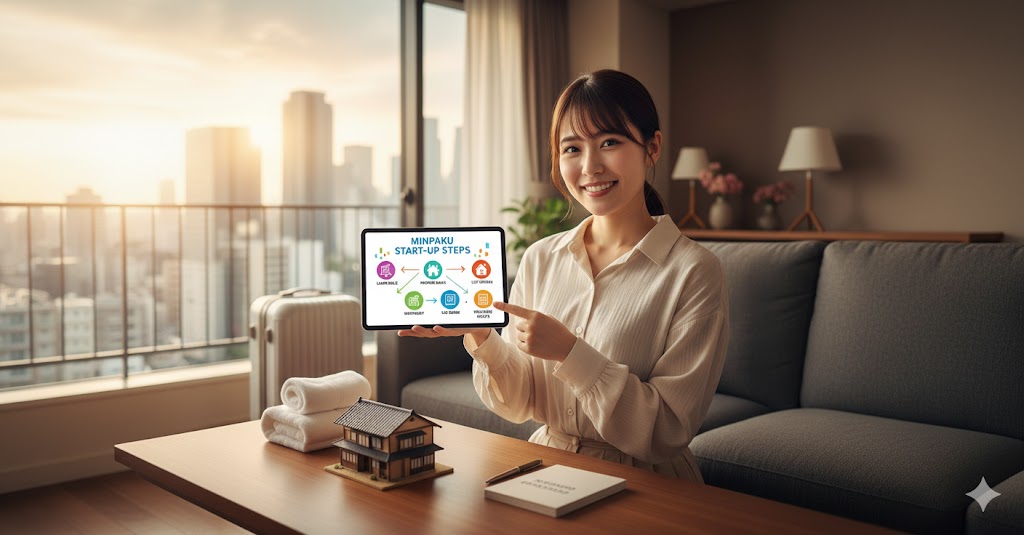
In this article, we’ll walk you through everything an individual needs to know to launch a minpaku business from scratch and build it into a stable source of income. We’ve broken the process down into 7 clear stages, explained in a way that’s easy for beginners to follow.
Why Does “Individual” Minpaku Hold So Much Potential Right Now?
In a minpaku market where major hotel chains and real estate companies are also competing, how can an individual hold their own? The answer lies in advantages that only individuals possess.
- 1. Low-cost startup: By using a spare room in your own home or renovating a small used property yourself, you can launch your business with a level of low initial investment that companies simply cannot match.
- 2. The added value of “hospitality with a human face”: Unlike large operators, whose services tend to feel standardized, hospitality that reflects the owner’s own personality and interests creates a warm, unique experience—and that alone becomes a powerful point of differentiation. It’s entirely possible to build a devoted fanbase of guests who say, “I’m staying here because I want to see you.”
- 3. Flexible, fast decision-making: The ability to respond instantly to market changes and guest needs—without waiting for anyone’s approval—is a major weapon unique to individual operators.
[7 Steps to Launch] The Complete Roadmap for Individuals Starting a Minpaku Business
STEP 1: Define the Core Concept and Operating Style of Your Business
Everything begins with clarifying your own vision.
- Concept design: First, define the core of your business—”who” you want to serve and “what kind of experience” you want to offer. By narrowing your target down to something specific—such as “couples who want to escape the city bustle for quiet time,” “international families who want to experience authentic Japanese home cooking,” or “business travelers who need to focus on work while on the road”—the direction for your property choice and interior design will become much clearer.
- Choosing your operating style:
- Host-occupied type: The lowest-risk style, using a spare room in your own home. Recommended for those who also enjoy interacting with guests.
- Host-absent type: Operating a separate property from your home (either purchased or rented). This offers guests more privacy but comes with increased management effort and cost. For individuals starting small—especially as a side business—we strongly recommend beginning with the lower-risk “host-occupied type,” or a “host-absent type” property close enough to your home that you can respond quickly if needed.
STEP 2: [Most Important] Check the Property Rules and Legal Requirements
This is the most critical step—confirming whether your plan is even feasible in the first place. Skipping this step can render all your other efforts meaningless.
- For condominiums: Thoroughly review the building’s “management regulations”—essentially its constitution. Make sure there’s no clause prohibiting minpaku, such as “exclusive-use sections may not be used for residential lodging business purposes.” Even if no such clause exists, consulting with the management association beforehand is essential to avoid future trouble.
- For rental properties: Since operating minpaku in a rented space effectively means subletting, you absolutely must obtain clear written consent from the landlord (such as a “sublease consent form”). Doing this without permission is a serious violation that can lead to termination of your lease—and eviction.
- Checking laws and ordinances: For individuals starting small, operations will generally fall under the “Private Lodging Business Act” (the minpaku law), which caps annual operating days at 180. However, some municipalities have their own stricter “add-on ordinances” that go beyond national rules (for example, banning weekday operations). Always check the latest ordinances on your local municipality’s website or with the relevant department (such as the public health center) for the area where your property is located.
STEP 3: Build a Data-Driven Business Plan and Financial Plan
Now it’s time to draw up a “blueprint” for success as a real business, not just a hunch.
- Calculating initial costs: List out exactly what you’ll need to spend before opening, and how much. The main categories are:
- Fire safety equipment costs: After consulting with the fire department, installing fire alarms, extinguishers, evacuation route diagrams, etc. (rough estimate: from ¥50,000, depending on the property).
- Furniture and appliance costs: Beds, bedding, tables, Wi-Fi routers, minimal appliances, etc. (rough estimate: from ¥300,000).
- Supplies and consumables: Towels, sheets, amenities, locks (smart locks recommended), etc. (rough estimate: from ¥100,000).
- (For the host-absent type) Property acquisition costs: Initial costs for purchasing or renting the property.
- Other: Costs for licensing application support (if using a certified administrative scrivener), insurance premiums, etc.
- Revenue and cost simulation: Research data from nearby competing facilities (rates, occupancy) to forecast realistic annual revenue. From there, subtract all annual operating expenses (rent, cleaning fees, utilities, OTA commissions, consumables, etc.) to calculate how much annual profit you can expect to keep.
- Fundraising: If your own funds fall short of the calculated initial costs, consider financing options such as the Japan Finance Corporation’s “New Business Startup Loan Program,” which is designed to be friendly to new entrepreneurs. Your business plan document will be key to passing the loan review process.
STEP 4: Obtaining Permits—Administrative Procedures for Legal Operation
This process is essential for protecting your guests’ safety and complying with the law.
- Pre-consultation with the fire department: Once your plan is finalized, be sure to bring the property’s floor plan and visit your local fire department to discuss your intention to start a “Private Lodging Business (minpaku).” They will give you specific guidance on the types of fire safety equipment required and where to install them.
- Installing fire safety equipment: Based on the fire department’s guidance, install fire alarms, extinguishers, evacuation route diagrams, and other required equipment.
- Filing with the public health center: Gather all required documents—including the “Certificate of Compliance with Fire Service Laws” issued by the fire department—and file your “Private Lodging Business” notification with the local public health center (or relevant municipal department). An increasing number of municipalities now allow this process to be completed online.
STEP 5: Creating a Space That Welcomes Guests
Based on your concept, create a space that makes guests think “I want to stay here!” and that they can enjoy comfortably throughout their stay.
- Cleanliness is non-negotiable: The cleanliness of your water areas (bathroom, toilet, sink) and bedding has the single biggest impact on guest satisfaction. Clean thoroughly and provide fresh, clean linens.
- Add a touch of the extraordinary: Expensive furniture isn’t necessary. By keeping your target guest’s “world” in mind, you can create an appealing space through photogenic accent walls, well-chosen lighting, or thoughtfully selected artwork.
- Essential equipment and supplies: High-speed Wi-Fi, air conditioning, and clean, comfortable bedding are the “three sacred treasures” of any good stay. Don’t forget towels, basic amenities, a hairdryer, and an electric kettle as well.
STEP 6: The Key to Attracting Guests—Creating Your OTA Listing and Preparing to Operate
Now it’s finally time to prepare for attracting guests.
- Registering with OTAs (booking platforms): Start by registering with Airbnb, the world’s largest platform.
- Photos are everything: Hiring a professional photographer is the most effective way to fully showcase your property’s appeal. If budget doesn’t allow, tidy the room completely and shoot carefully with a smartphone during daytime hours when natural light fills the space.
- Tell a story in your description: Write words that resonate with guests’ hearts—describe your property’s concept, recommend nearby spots, and include a brief introduction of yourself as the host.
- Building your operating structure: Decide who will handle daily cleaning and how (whether you’ll do it yourself or outsource it to a company or individual), and secure a reliable partner. This is critical for sustaining operations long-term.
STEP 7: Welcoming Your First Guests and Earning Reviews—Your Most Powerful Asset
Your first few guests are extremely important—they can shape the future of your entire minpaku business.
- Your first reviews are the key: In the early days, focus all your energy on securing bookings and gathering positive reviews—even if that means pricing slightly below market rate. Once you’ve collected five or more positive reviews, guest trust in your listing rises dramatically, and bookings tend to come more easily.
- Hospitality from the heart: Prepare a welcome message card, share recommendations for great local restaurants—go beyond the manual and communicate with genuine warmth that’s uniquely yours. This kind of care is what moves guests and leads to the best reviews.
3 Mindsets for Individual Success in Minpaku
- Be a “business owner,” not just a “host”: Move beyond the mindset of simply renting out a room, and instead adopt the perspective of a business owner—one who constantly analyzes the numbers, studies the market, and continually improves.
- Treat reviews as your “most powerful asset”: The reviews guests leave are an irreplaceable asset for your property. Approach every single booking with sincerity, and build up positive reviews one at a time.
- Don’t chase “perfection”—keep “improving”: Listening genuinely to guest feedback and making small daily improvements is the only path to growing your property into a place loved by everyone.
Conclusion: Minpaku Is a Business Model Where Individuals Can Shine
Minpaku is far more than a real estate strategy. It’s a truly modern business model—one that lets you turn your own personality, experience, and spirit of hospitality directly into value.
Manage risk with the right knowledge, and approach guests with genuine passion. With that mindset alone, even as an individual, you can absolutely succeed in this exciting market. We hope this article serves as the first step toward your own wonderful new challenge.
We’ll Walk That First Step With You, as Professionals
“I understand the steps to getting started, but I’m not confident I can pull it off entirely on my own…”
“My main job keeps me too busy to handle complicated legal research and administrative procedures.”
If that sounds like you, please come talk to us.
Stay Buddy Inc. is a **”business launch partner”** for individual owners hoping to start a minpaku business.
We don’t just manage properties on your behalf.
- We listen to your dreams and goals, and work together with you to build the optimal business concept and plan.
- From advice on finding a property, to navigating complex licensing applications, to drafting a business plan for securing financing, we provide complete support as minpaku professionals through the most difficult and most important **”first steps”**—until you’re ready to stand on your own as a business owner.
All you need to bring is your business idea and your passion.
We’ll help turn that vision into a sustainable “business.” Please reach out to us as you take your first step toward realizing your dream.