
Leave Your Vacation Rental Management to the Experts
Completely Free Online ConsultationTurning a Vacant Countryside Home into a Profitable Minpaku: Secrets to Success and the Art of Attracting Guests
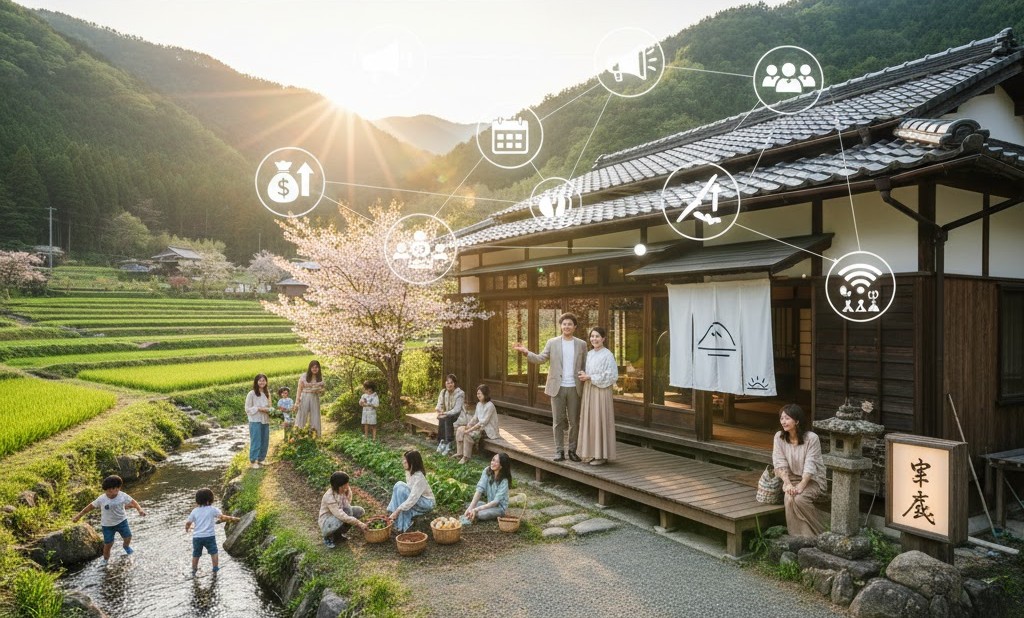
Leaving the hustle and bustle of the city behind to run a minpaku in a nature-rich rural area, using a vacant house as your base—it’s an incredibly appealing choice, one that lets you contribute to the local community while living life on your own terms. That said, many people find themselves wrestling with pressing questions and worries: “Will this actually turn a profit?” and “How on earth do I even attract guests in the first place?”
“It’s the countryside, so surely nobody will come unless the price is rock-bottom…”
“I’ve never touched social media, and I can’t imagine being able to attract guests…”
Let’s cut to the conclusion of this article right away.
The key to building a “profitable system” with a countryside vacant-house minpaku isn’t competing on the city’s usual battlegrounds of “price” and “convenience.” Instead, it’s about polishing the unique “story” and “experiential value” that only that land and building can offer, and cultivating “fans” who resonate with it.
In this article, we’ll thoroughly break down the concrete “secrets to profitability” and “art of attracting guests” needed to transform your vacant house from a mere lodging facility into a “destination” that leaves a lasting impression on guests while generating stable revenue.
Why Does a “Vacant House in the Countryside” Hold the Potential for High Profitability?
Before diving into strategies for success, it’s important to understand why, right now, an old vacant house in a rural area can represent such a significant business opportunity.
- 1. A Craving for “Experience”: Today’s travelers aren’t satisfied with simply sightseeing—they’re seeking “authentic experiences” that let them dive deep into the culture and daily life of a place. Staying in a traditional Japanese farmhouse or connecting with local residents is precisely the kind of content that answers this need.
- 2. The Value of the “Extraordinary”: Silence, breathtaking nature, a sky filled with stars, and a richness found in inconvenience—things you simply can’t get in the city. For people worn down by our information-saturated modern society, these represent an “extraordinary” experience worth paying for.
- 3. The Possibility of Online “Discovery”: Charming rural inns that were once known only to a select few can now be “discovered” by potential guests around the world through social media and personal blogs. If you keep sharing compelling content, you can overcome the disadvantage of location.
[Secrets to Profitability] Three Strategies for Escaping the Price War
Secret 1: Sell a “One-of-a-Kind Experience,” Not Just a Room
This is the absolute governing principle for profiting from a countryside minpaku.
- Sharpening Your Concept: Think exhaustively about “who” you want to reach and “what experience” you want them to have in this specific place. Concepts like “savoring the luxury of doing nothing beneath a sky full of stars,” “gathering around an irori hearth to learn regional home cooking from a local grandmother,” or “a digital-detox reading retreat with no cell signal”—the sharper and more distinctive your concept, the more you free yourself from price competition.
- Planning and Offering Experience Content: Create experiences that only your property can provide. Harvest experiences in partnership with nearby farmers, guided treks through the forest, pottery workshops held on the earthen floor of a traditional farmhouse—this kind of “accommodation plus something extra” value justifies a higher price point.
- Elevating “Food”: If possible, offering meals made with vegetables grown on your property or local seasonal ingredients becomes an extremely powerful asset. Something like an “irori-cooking experience” combined with a hands-on activity can dramatically boost guest satisfaction.
Secret 2: Optimize Your Cost Structure to Achieve “High Profit Margins”
Achieving both strong revenue and a lean cost structure is what leads to stable “profit.”
- Reducing Initial Investment: Actively incorporate DIY renovations and take full advantage of **”vacant house renovation subsidies”** offered by national and local governments to reduce your initial borrowing burden. Rather than insisting on expensive new furniture for the interior, incorporate secondhand items or furniture crafted by local artisans—this holds down costs while enhancing the property’s “storytelling” appeal.
- Streamlining Operations: Thoroughly review and eliminate waste in your day-to-day operating costs—introduce self-check-in via smart locks, standardize your cleaning manuals while leveraging local labor (such as senior workers), and buy consumable supplies in bulk.
- Cutting Energy Costs: Insulation renovations and double-glazed windows funded through subsidies are a critically important investment—not only do they improve guest comfort, but they also lead to substantial reductions in heating and cooling costs. Installing a wood-burning stove can also be effective.
Secret 3: Lower Costs Through “Mutual Prosperity” with the Local Community
A good relationship with the local community isn’t just risk management—it’s a vital business strategy that also helps cut costs.
- Skill Exchanges (Bartering): If you’re skilled at building websites, for example, you might build a site for a nearby farmer in exchange for their vegetables. Or you could help a neighbor with the harvest in exchange for them helping you with simple carpentry repairs at your property. This kind of mutual support within the community leads to cost savings without any cash changing hands.
- Joint Purchasing: By partnering with nearby restaurants or shops to jointly source linen supplies and consumables, you may be able to lower your per-unit purchasing costs.
- Word-of-Mouth Referrals: If local residents become “champions” for your property, they’ll refer friends and relatives—generating the most trustworthy form of word-of-mouth marketing (essentially free advertising).
[The Art of Attracting Guests] Three Strategies for Building a “Fanbase” Without Relying Solely on OTAs
The Art of Attraction 1: Weave a “Story” on Social Media That Sparks Genuine Connection
For a countryside inn, social media is your single most powerful tool for attracting guests.
- Captivate Visually (Instagram): The beautiful details of a traditional farmhouse, the stunning view through a window, a delicious home-cooked meal, the smiling faces of local residents… Photos and short videos speak more eloquently than words ever could, intuitively conveying your property’s unique atmosphere and the appeal of the time spent there. Use hashtags strategically too (e.g., #TraditionalJapaneseHouse #CountrysideLiving #ExperientialTravel).
- Draw People In Through Storytelling (note, Blogs): Why did you decide to start an inn in this particular place? How did the old farmhouse come back to life? What do you feel in your day-to-day life in the community? By carefully putting your own “feelings” and “story” into your own words, you go far beyond a simple property listing—you spark deep resonance and cultivate devoted fans.
The Art of Attraction 2: Grow “Direct Bookings” Through Your Own Reservation Channels
The fees you pay to OTAs (booking platforms)—roughly 15% of revenue—represent a substantial cost.
- A Compelling Website of Your Own: Rather than just offering a booking function, build out rich content that dives deeper into the property’s unique appeal and the charm of the local area—things you can’t fully convey on social media. Create a website compelling enough that guests think, “I want to book through this site” (this can be built with tools like Wix or WordPress).
- Directing Traffic from Social Media: Place a link to your own website in your Instagram bio or at the end of your note articles to encourage direct bookings. Offering “direct-booking perks” (such as a welcome drink or late checkout) can also be effective.
- Repeat-Guest Strategy: For guests who’ve stayed with you before, offer a discount code they can use for their next direct booking, building a relationship that bypasses the OTA entirely.
The Art of Attraction 3: Use the “Local Area” Itself as a Media Channel
Sharing the appeal of the “entire local area”—not just your own property—ultimately increases interest in your property as well.
- Partnering with Local Media: Reach out to local newspapers, free community papers, and regional information websites, encouraging them to feature your property or upcoming events.
- Working with Influencers: Offering a stay to micro-influencers—people with smaller follower counts but strong influence within a specific niche—who have a natural affinity for themes like “countryside living” or “traditional Japanese houses,” and having them share the experience on social media, is also an effective strategy.
- Hosting Events: Regularly hosting events at your property that local residents can also join—such as markets, live music, or workshops—raises awareness of your inn and generates a flow of people both from within and outside the local area.
In Summary: A Countryside Minpaku Turns a Profit Through “Passion” and “Strategy”
Running a minpaku out of a vacant house in the countryside is more than just achieving a slow-life dream. It’s a dynamic venture—one where you rediscover the value of the land, pour in your own original ideas and passion, and create new value while maintaining a clear-eyed, strategic business mindset.
The result of “profitability” is something that will absolutely follow once you steadily and diligently put these “secrets” and this “art” into practice.
Let Us, the Professionals, Implement That “Secret” and That “Art” for You
“I don’t even know where to start with developing a concept or planning experiences…”
“Social media posting, building my own website—it all seems so difficult…”
“I don’t have anyone to consult about subsidies, legal matters, or operations…”
Please, bring us your concerns.
We at Stay Buddy Inc. possess the operational know-how that has helped guide numerous minpaku properties to success in urban Osaka, along with the business-development capability to build data-driven “profitable systems.”
We apply that expertise to your **”vacant house in the countryside”**—a stage brimming with limitless possibility.
- ① We develop a “business concept” and “financial plan” that draws out the maximum potential of your vacant house and its local area.
- ② From leveraging subsidies to cost-effective renovations and operations that minimize running costs, we optimize your business’s overall cost structure.
- ③ From social media strategy to building your own website and coordinating with OTAs, we build and execute the ideal **”guest-attraction system”** for your property.
Please focus on living life in this place and providing wonderful hospitality to your guests.
Leave the business side—building a “profitable system” and handling day-to-day “guest acquisition”—to us professionals. We’ll propose a concrete plan to help grow your dream into a sustainable business.