Special Zone Minpaku vs. Ryokan Business License in Osaka City: A Detailed Guide to Legal Regulations and Future Outlook
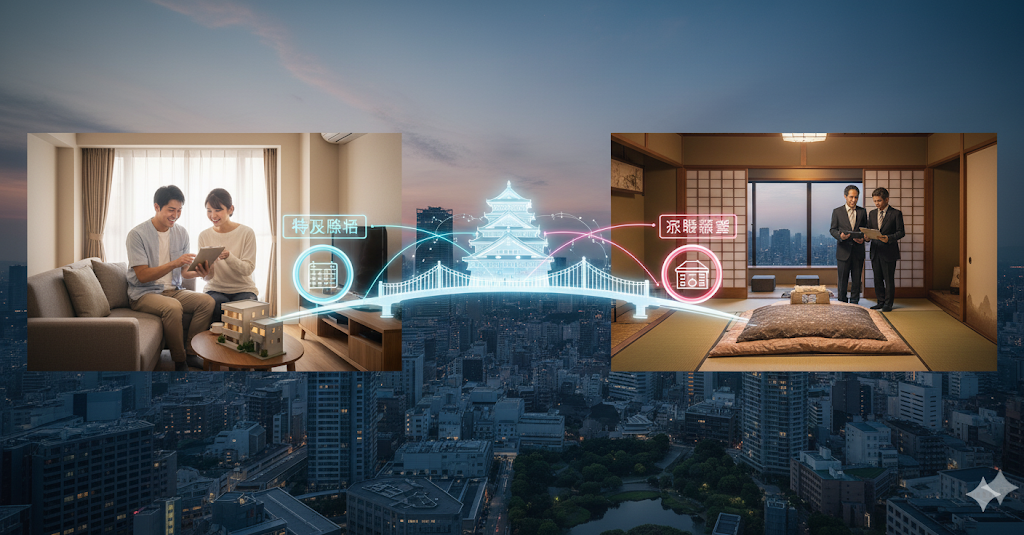
With the 2025 Osaka-Kansai Expo on the horizon, all eyes—both domestic and international—are on Osaka’s booming accommodation market. Within this massive market, two primary legal licenses make 365-day operation possible: **”Special Zone Minpaku”** and **”Ryokan Business License (Simple Lodging).”**
“If both allow 365-day operation, what’s actually different between them?”
“Which option is the best fit for my property and business plan?”
Let’s start with the conclusion of this article.
Choosing between the two is an extremely important management decision that determines the very core of your business strategy—including the scale of your initial investment, your target customer base, and the long-term stability of your business.
- Want to keep initial hurdles low and gain an advantage under specific conditions → “Special Zone Minpaku”
- Want to target a broader customer base and build a lasting business foundation → “Ryokan Business License”
For all operators aiming for success in the minpaku business in Osaka City, this article provides a thorough professional comparison—from the legal differences between these two systems, to their respective advantages and disadvantages, and even the future outlook beyond the Expo.
Why Is It “This or That” in Osaka, Rather Than the Minpaku New Law?
First, as a fundamental premise, it’s important to understand why the “Private Lodging Business Act” (Minpaku New Law), with its 180-day annual cap, isn’t even on the table as an option.
Osaka City has established a **”supplementary ordinance”** for the Minpaku New Law that is strict even by national standards—for example, prohibiting weekday operation within 100 meters of school grounds. This further cuts into the already-limited number of operating days, making profitability as an investment extremely difficult. As a result, for anyone aiming for serious business operations in Osaka, the choice effectively comes down to just two options: “Special Zone Minpaku” or “Ryokan Business License.”
[Thorough Comparison] Special Zone Minpaku vs. Ryokan Business License – 7 Key Perspectives
1. Legal Basis and “Stability”
- Special Zone Minpaku: A system based on the “National Strategic Special Zones Act,” part of the government’s national growth strategy. It is a **”special law”** that relaxes rules under an existing law (the Ryokan Business Act) for a specific purpose, meaning it inherently carries the possibility of future revision as government policy shifts.
- Ryokan Business License: A **”fundamental law”** that has formed the backbone of Japan’s lodging industry since 1948. It is deeply embedded as social infrastructure, and its legal stability is incomparable. If “permanence” is your top priority, the Ryokan Business License provides the most solid foundation.
2. Differences in Operating Rules: The “Minimum Stay” Restriction
- Special Zone Minpaku: 365-day operation is possible, but Osaka City requires a **minimum stay of “2 nights, 3 days.”**
- Ryokan Business License: 365-day operation is possible with absolutely no restrictions on length of stay.
- [Strategic Implications]: This difference has a direct impact on your target customer base. With a Ryokan Business License, you can capture **”single-night” business travelers and short domestic weekend travelers**—guests who would be missed under Special Zone Minpaku—significantly expanding your revenue opportunities.
3. [Most Important] Property Requirements: Restrictions on “Zoning Districts”
This is the first, and most significant, physical dividing line when choosing between the two systems.
- Special Zone Minpaku: Under Osaka City ordinances, operation may be permitted in certain “residential-only zones” if specific conditions are met. This is a major advantage when it comes to expanding your options for finding a property.
- Ryokan Business License: In principle, permits **cannot be obtained in “residential-only zones,”** such as Category 1 and 2 low-rise exclusive residential zones or Category 1 and 2 mid-to-high-rise exclusive residential zones—the same zones where hotels and ryokan cannot operate. Properties are limited to commercial districts and neighborhood commercial districts, among others.
4. Facility Equipment Standards
- Front Desk (Reception):
- Special Zone Minpaku: No obligation to install one.
- Ryokan Business License: Generally required, but in Osaka City, alternative measures using **ICT devices (such as video-call identity verification combined with smart locks)** are widely accepted, making unmanned operation possible.
- Reception Area / Room Floor Space:
- Special Zone Minpaku: Guest rooms must have a floor area of **at least 25㎡**.
- Ryokan Business License (Simple Lodging): The total floor area of guest rooms must be **at least 33㎡** combined (relaxed to “3.3㎡ per person” for fewer than 10 guests).
- Fire Safety Equipment: Compliance with fire safety regulations is mandatory under both systems, but the Ryokan Business License generally tends to require stricter fire safety equipment (for example, in the scope of automatic fire alarm installation). This is a major factor affecting initial investment costs.
5. Obligation to Explain to Neighbors
- Special Zone Minpaku: Before applying for certification, operators are required to **hold a “prior explanatory meeting”** with nearby residents to explain the business, and to submit the meeting minutes.
- Ryokan Business License: There is no legal obligation to hold an explanatory meeting. However, voluntary communication such as greeting neighbors is essential for smooth business operations.
6. Procedural Difficulty and Timeline
- Special Zone Minpaku: Requires “certification” from the local government.
- Ryokan Business License: Requires “permission” from the government authorities, with stricter review standards applied. In general, obtaining a Ryokan Business License permit tends to be more difficult and time-consuming.
7. Accepting Foreign Guests
- Special Zone Minpaku: Given the purpose of the system, facilities are required to be “suitable for foreign travelers.” This means providing facility guidance in foreign languages and setting up a system for providing information in emergencies.
- Ryokan Business License: There are no requirements specifically limited to foreign guests, but given market demand, multilingual support is effectively essential.
Future Outlook: What Will Happen to Osaka’s Minpaku Market After the Expo?
The 2025 Osaka-Kansai Expo represents the biggest tailwind for Osaka’s accommodation market, but there are also concerns about the potential backlash afterward.
- Risk of Oversupply: The surge of accommodation facilities built for the Expo could result in oversupply once it ends, potentially triggering intense price competition.
- Possibility of Stricter Regulations: If disputes between minpaku facilities and local residents increase during the Expo period, public opinion could shift toward stricter regulation. In that case, the Special Zone Minpaku system—being an exceptional measure—would be the most likely target for review.
Looking ahead at this uncertain future, obtaining a Ryokan Business License—with its greater legal stability and ability to capture single-night business demand—can serve as a stronger business foundation for surviving beyond the Expo.
Summary: Which License Is Best Suited to Your Business Strategy?
- Cases Where Special Zone Minpaku Is a Good Fit:
- You want to make use of a property in a residential-only zone.
- You want to keep your initial investment as low as possible.
- Your main target is inbound guests staying 2 nights or more.
- Cases Where a Ryokan Business License Is a Good Fit:
- You want to prioritize long-term business permanence and legal stability above all else.
- You want to capture single-night business travelers and domestic tourists to maximize revenue opportunities.
- You want to hedge against the risk of future regulatory changes.
Both systems are powerful licenses that make 365-day operation possible in Osaka. Making the right choice by comprehensively considering your business goals, your property’s potential, and your future outlook is the first step toward success.
Let Our Professionals Help You Find the Right Answer for That Decision
“Which is more likely to work for my property—Special Zone Minpaku or a Ryokan Business License?”
“I’d like advice on a long-term business strategy that accounts for the period after the Expo.”
“I’m worried about trying to interpret all these complex laws and ordinances on my own…”
Please feel free to bring these concerns to us.
At Stay Buddy Inc., we are specialists in this field, having provided one-stop support—from property sourcing to obtaining both Special Zone Minpaku and Ryokan Business License permits—in the fiercely competitive minpaku market of Osaka City.
We will carefully assess your business plan and your property’s potential to provide:
- Strategic advice on which option—Special Zone Minpaku or Ryokan Business License—is best suited to your business
- A concrete roadmap to obtaining your permit (or certification) along with a calculation of the necessary investment
- Full support—including handling the tedious and complex negotiations with government authorities and the complete application process on your behalf—to maximize your chances of business success.
Why not make sure you get this critical—and most difficult—first decision right, together with us?
Because we know the Osaka market inside and out, we can offer value that others simply can’t. We look forward to hearing from you.