Leave Your Vacation Rental Management to Us
Completely Free Online ConsultationIs Vacation Rental Trash Industrial Waste? A Complete Guide from Finding a Waste Collector to Avoiding Neighbor Complaints
When running a vacation rental, alongside daily cleaning and guest support, one issue you simply cannot avoid is “waste disposal.”
“Can’t I just throw out my guests’ trash along with my own household garbage?”
If you’ve been thinking this way, it’s an extremely risky assumption that could lead to legal violations and serious disputes with your neighbors.
Let’s get straight to the conclusion of this article.
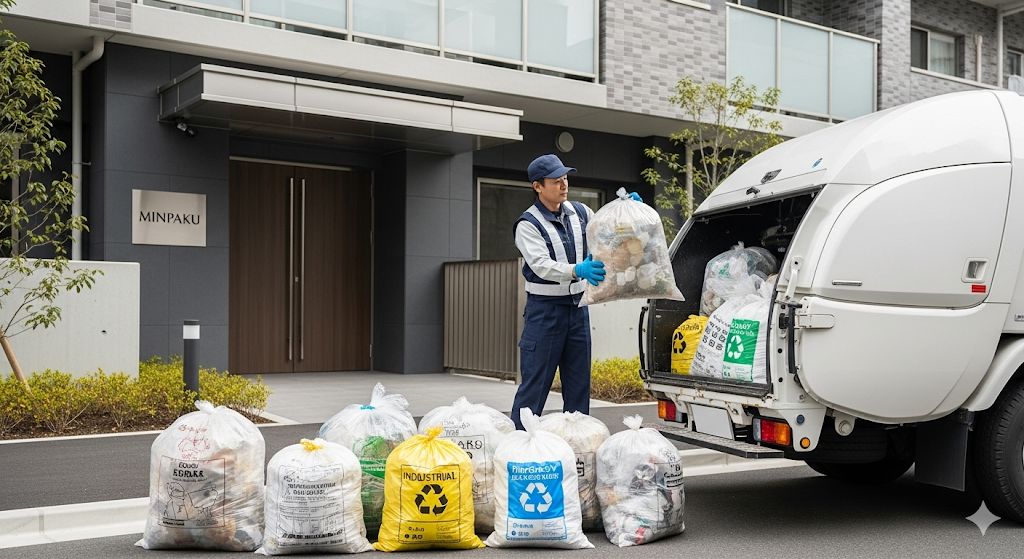
Waste generated from a vacation rental business is legally classified as “commercial general waste,” and as a rule, it cannot be disposed of at your local household garbage collection point.
Understanding this rule correctly and contracting with a professional waste collector licensed by your local municipality for proper disposal—this is the absolute first step toward operating a clean, law-abiding vacation rental and becoming a business trusted by the local community.
In this article, we’ll thoroughly explain everything from the legal basics of vacation rental waste, how to find a reliable waste collector, to the most important topic of all: concrete methods for completely avoiding complaints from your neighbors.
Not “Industrial Waste,” but Not “Household Garbage” Either: The Correct Classification of Vacation Rental Waste
First, let’s accurately understand the terminology. Under Japan’s Waste Management Act, waste is broadly classified into three categories.
- 1. Household Garbage (General Waste): Waste generated from the daily life of ordinary households. Municipal collection services are a resident service that covers this household garbage.
- 2. Industrial Waste: This is limited to 20 specific categories defined by law—such as ash, sludge, waste oil, and waste plastics—that arise from business activities. These are mainly generated by construction work or specific factories, and waste from typical vacation rental operations does not fall into this category.
- 3. Commercial General Waste: This category covers waste generated by business activities—such as from restaurants, offices, or stores—that isn’t classified as industrial waste. Since vacation rentals provide a paid service (accommodation fees), the waste they generate falls under this “commercial general waste” category.
Why Can’t It Be Put Out as Household Garbage?
Article 3 of the Waste Management Act stipulates that “business operators must properly dispose of waste generated from their business activities under their own responsibility.” In other words, vacation rental owners, as “business operators,” have an obligation to dispose of waste generated by their business at their own expense and responsibility.
[Practical Guide] How to Find a Commercial Waste Collection Company and Key Points for Contracting
So what should you actually do? The answer is to contract with a professional waste collector licensed by your local municipality.
1. Compile a List of Licensed Collectors
Collecting and transporting commercial general waste requires a permit from the mayor of the municipality. Search the website of the city or ward where your property is located for a page titled something like “List of Licensed General Waste Collection and Transport Companies.” The companies listed there are legally authorized to collect waste in your area.
2. Get Quotes from Multiple Companies
From your list, select a few companies that serve the area where your property is located, contact them, and request quotes. Pricing structures vary by company.
- Fixed Monthly Rate: A set fee each month regardless of your property’s size or waste volume.
- Volume-Based Pricing: A fee per 45-liter garbage bag, for example, with charges varying based on how much waste you generate. Share your property’s occupancy rate and expected waste volume with each company, and compare which pricing structure works best for you.
3. Key Points to Confirm When Signing a Contract
- Collection Frequency and Timing: How many times per week, on which days, and around what time will collection occur? Check whether this aligns with your cleaning staff’s schedule.
- Sorting Rules: In addition to municipal regulations, some collectors have their own sorting rules (for example, allowing cans and bottles in the same bag). Confirm the details in advance.
- Waste Storage Location: Where will waste be stored until the next collection day? Especially for apartment/condo properties, check in advance whether you can use the shared trash storage area.
- Bulky Waste Handling: It’s reassuring to confirm in advance whether the company can handle bulky waste—such as a broken suitcase a guest left behind or a malfunctioning appliance—and what the fees would be.
[Avoiding Complaints] 5 Golden Rules to Prevent Waste-Related Disputes with Neighbors
Contracting with a proper waste collector is just the starting point. To prevent disputes with neighbors, thorough day-to-day management is essential.
Rule 1: Provide Guests with a “Perfect Waste Disposal Guide”
Japan’s complex waste sorting system is especially difficult for international guests to understand.
- Set Up Sorting Bins: Place multiple bins inside the unit, each labeled with illustrations and text in multiple languages (Japanese, English, Chinese, Korean, etc.), such as “Burnable,” “Cans,” “Bottles,” and “PET Bottles.”
- Illustrate the Rules: Create a guide with plenty of photos and illustrations showing specific sorting examples (e.g., remove caps and labels from PET bottles) and any prohibited actions, and post it near the trash bins.
Rule 2: Thorough “Final Check and Collection” by Cleaning Staff
No matter how carefully you provide guidance, guests will inevitably make sorting mistakes. Never simply trust that guests have sorted correctly—make it a standard operating procedure that your cleaning staff perform a final check on all waste after checkout, re-sort it correctly, and move it to the designated storage area. Enforce this as a strict part of your manual.
Rule 3: Maintain Strict Hygiene at the Waste Storage Area
The temporary storage area where waste sits until collection day can become a source of foul odors and pests, leading directly to complaints.
- Airtight Containers: Always use large waste containers (like sealed bins) with lids that close securely.
- Crow and Pest Prevention: If storing waste outdoors, take measures such as placing weights on containers or covering them with crow-proof netting to prevent them from being disturbed.
- Regular Cleaning: Regularly wash and disinfect the floor, walls, and the waste containers themselves to keep the storage area consistently clean.
Rule 4: [For Apartment/Condo Properties] Prior Consultation with the Management Association
Since collection companies will need to enter the building’s premises and use the shared trash storage area, always report to and consult with the management association or management company before starting operations. Discuss matters such as where and when collection vehicles can park and the rules for using the trash storage area in advance, and obtain formal approval—this will prevent future disputes.
Rule 5: Ensure “Transparency” with Neighbors
During your greeting rounds before starting operations, clearly state: **”Regarding waste disposal, separate from household garbage, we have contracted with a professional collection company licensed by the city, and we handle it properly as part of our business responsibility.”** This one statement resolves neighbors’ biggest concern—that the neighborhood might be spoiled by improperly disposed waste—and provides them with significant peace of mind.
Important Considerations When Outsourcing Waste Collection to a Cleaning Company
Some cleaning companies offer waste collection as a bundled option alongside their daily cleaning services. This can be extremely convenient for hosts, but there’s one thing you absolutely must confirm.
That is whether the cleaning company itself holds a “general waste collection and transport” license from the municipality. If you outsource waste disposal to an unlicensed company, you (the host), as the waste generator who commissioned the work, could also be penalized under the law. Always verify that they hold a proper license.
Conclusion: Proper Waste Disposal Is Proof of a Trustworthy Business
Waste disposal in vacation rental operations is not simply a cleanup task. It’s an extremely important responsibility for fulfilling your social obligations as a business operator: complying with the Waste Management Act, protecting the local community’s hygiene, and building good relationships with your neighbors.
Properly executing this “basic expectation” as a professional is exactly the kind of attitude that becomes the unshakeable foundation for earning your community’s trust and long-term appreciation for your vacation rental.
Let Us Professionals Handle That “Behind-the-Scenes Management” for You
“How do I even go about finding a reliable waste collection company?”
“I want a partner I can trust to handle both cleaning and waste collection as a one-stop solution.”
“I just don’t have the bandwidth to handle guest guidance and day-to-day management on top of everything else…”
Bring your concerns to us.
As vacation rental management professionals, we at Stay Buddy Inc. **fully systematize this troublesome yet critically important “waste disposal issue”** as part of our operational workflow.
- Together with our trusted partner licensed general waste collection and transport companies, we design the optimal waste collection plan for your property.
- Our trained cleaning staff take full responsibility for the final sorting and collection of guests’ waste, and for storing it properly in the designated location.
- We thoroughly educate guests on proper waste disposal etiquette through the multilingual house rules we create.
You’ll never have to worry about waste management again.
Why not build a clean, law-abiding vacation rental operation trusted by the local community together with us? That **”behind-the-scenes management”** is exactly what we professionals do best. Please feel free to reach out for a consultation anytime.