Leave your vacation rental management to us
100% Free Online Consultation10 Essential Soundproofing Measures for Vacation Rentals | From Free Fixes to Professional Solutions
When it comes to running a successful vacation rental business, there’s one critical challenge you simply cannot avoid: soundproofing.
Noise from guests’ daily activities can trigger complaints from neighbors, while noise seeping in from outside can lead to negative reviews from guests. This two-way sound problem strikes at the very foundation of your business’s reputation and long-term viability.
Let’s start with the bottom line.
Effective soundproofing doesn’t necessarily mean expensive construction work. By smartly combining simple, “free” or “low-cost” fixes you can implement right now with “paid” professional solutions that ensure long-term peace of mind, you can maximize your results.
In this article, we’ve carefully selected 10 concrete measures—organized by cost—to protect your vacation rental from noise-related trouble.
Why Soundproofing Is an “Investment,” Not a “Cost”
Don’t think of soundproofing expenses as a mere “cost.” They’re an extremely important “investment” in protecting and growing your business’s future.
- Defensive investment (risk management): Prevents neighbor disputes before they happen and avoids risks like administrative guidance or, in the worst case, having your operation shut down. Think of it as insurance to ensure your business’s long-term sustainability.
- Offensive investment (revenue growth): Blocks out external noise and provides guests with a quiet, comfortable sleep environment. This leads to glowing reviews like “I slept so well,” ultimately boosting your occupancy rate and nightly rate.
[Free & Low-Cost Edition] 5 Basic Soundproofing Measures You Can Start Today
Let’s start with basic measures you can implement today, without spending a significant amount of money.
Measure 1 (Free): Arrange Furniture Strategically
Sound travels through walls to neighboring rooms. A slight adjustment to your furniture layout can reduce sound transmission.
- Keep noise sources away from walls: Place TVs, speakers, and bed headboards at least a few centimeters away from walls shared with neighboring units.
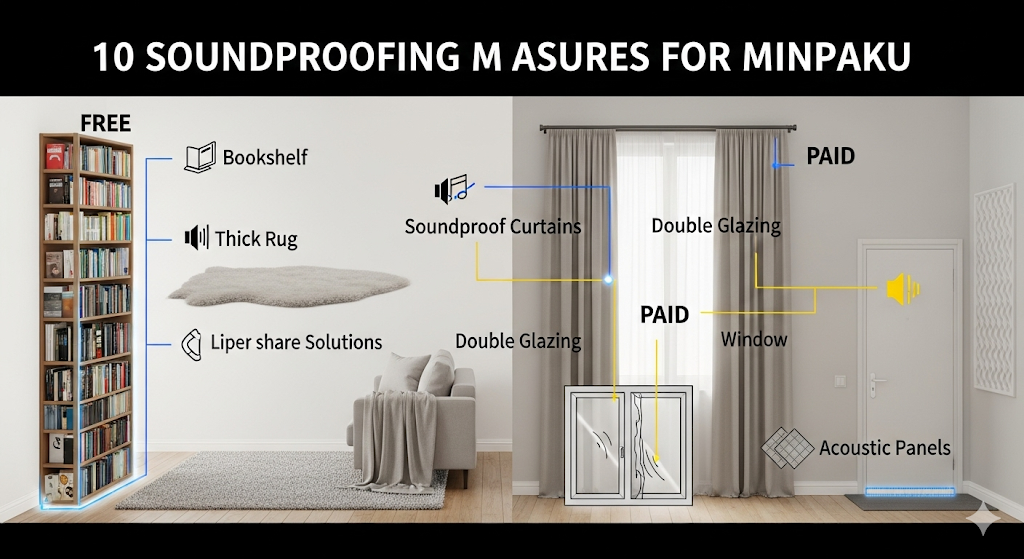
- Turn furniture into a “sound barrier”: Placing tall, dense furniture—like a bookshelf packed with books or a closet full of clothes—against a wall can serve as a simple sound barrier.
Measure 2 (Free): Create and Post Strict House Rules
Control noise caused by guest behavior through clear rules.
- Spell out specific prohibitions: Create multilingual rules with concrete language, such as: “Parties, gatherings, loud conversations, and playing music are strictly prohibited from 10 PM to 8 AM” or “Please refrain from using washing machines or vacuum cleaners late at night or early in the morning.”
- State penalties clearly: Noting that “violations will result in a penalty fee of ¥XX and immediate eviction” strengthens compliance with the rules.
Measure 3 (Low Cost): Apply Weatherstripping Tape to Doors and Windows
Since sound is essentially air vibration, it can easily leak through even the smallest gaps.
- Improve airtightness: Sponge-based “weatherstripping tape,” available at home improvement stores for just a few hundred yen, can be applied to gaps around entrance doors and window frames to improve airtightness and significantly reduce sound leakage. It’s an easy DIY fix with an excellent cost-to-benefit ratio.
Measure 4 (Low Cost): Attach Felt Pads to Furniture Legs
The screeching sound of dining chairs being pulled out, or the noise of a table being moved, travels through the floor and is especially disruptive to units below.
- Eliminate dragging noise: Simply attaching felt pads—available even at a dollar store—to the legs of every chair and table completely solves this problem. This is a must for every host.
Measure 5 (Low Cost): Install Thick Carpets or Sound-Blocking Curtains
Floors and windows are major sources of sound reflection and transmission.
- Absorb footstep noise: Laying a thick, cushioned carpet or rug over hardwood flooring effectively absorbs the sound of footsteps in slippers or light objects being dropped (light-impact floor noise).
- Block sound from windows: Installing heavy-weave “sound-blocking curtains” or “soundproof curtains” reduces noise from outside, like passing cars, while also helping prevent conversation from inside the room from leaking out.
[Paid & Professional Edition] 5 Solutions for Long-Term Peace of Mind
If free and low-cost measures aren’t enough, or if you’re aiming for a more fundamental solution, consider professional-grade interventions.
Measure 6: [Most Important] Install Secondary (Interior) Windows
This is the single most cost-effective renovation, delivering powerful results against both outside noise and internal sound leakage.
- Air gap blocks sound: Installing a second window inside your existing window creates an air gap between the two that dramatically cuts down on sound transmission.
- Major secondary benefits: Beyond soundproofing, insulation performance also improves dramatically, boosting heating and cooling efficiency and reducing your annual utility costs. Installation is quick and easy too—about an hour per window.
Measure 7: Install Soundproofing Mats or Sound-Blocking Sheets Under Flooring
If you’re targeting families with children, addressing footstep noise (heavy-impact floor noise) is essential.
- Reduce vibration to units below: Installing a rubber soundproof mat or an asphalt-based sound-blocking sheet beneath the flooring material reduces the transmission of heavy impact noises to units below. This requires renovation work, but it’s an extremely effective, fundamental solution for footstep noise.
Measure 8: Install Sound-Absorbing Material or Sound-Blocking Sheets on Walls
Consider this option if you’re concerned about voices or TV sound leaking into neighboring units.
- Strengthen wall soundproofing: Installing a sound-reflecting “sound-blocking sheet” and sound-absorbing material (such as glass wool) behind the plasterboard can significantly reduce the amount of sound that passes through walls.
Measure 9: Choose Quiet-Operating Appliances
Appliance noise is a surprisingly easy factor to overlook.
- Consideration for guests and neighbors: When it’s time to replace appliances that may run at night—washing machines, refrigerators, air conditioners, and even the vacuum cleaner used for cleaning—choose “quiet-design” models. This benefits both your guests’ sleep quality and your neighbors’ peace and quiet.
Measure 10: Install a Noise Sensor
A technological solution that serves as your ultimate weapon for preventing trouble before it happens.
- Real-time detection of anomalies: Installing a vacation-rental-specific noise sensor like Minut in the unit automatically sends a notification to your smartphone whenever noise exceeds a set threshold for a sustained period.
- Address issues before complaints arise: This allows you to gently and remotely ask guests to “please keep it down a bit” before frustrated neighbors reach their breaking point and file a complaint.
Conclusion: Combining Free Measures with Paid Solutions Is the Key to Success
No single measure will make your vacation rental’s soundproofing perfect on its own.
Start by implementing every free measure available—strategic furniture placement, thoroughly enforced house rules, and so on. Then, identify your property’s specific weak points (for example, severe window noise or a structure prone to footstep sound) and consider paid solutions—like secondary windows or floor renovations—to reinforce those exact spots.
This **cost-conscious combination of measures** is the smartest, most realistic approach to protecting your vacation rental from noise-related trouble.
Let Our Professionals Diagnose Your “Sound Risk”
“Which measures would be most effective for my property?”
“I want to hire a trustworthy contractor for cost-effective renovations.”
“I want to be able to spot low-noise-risk properties from the start, during the property-selection stage.”
Whatever your concern, we’d love for you to reach out to us.
At Stay Buddy Inc., a vacation rental management company, we’ve operated properties across a wide range of locations and building structures throughout Osaka. Drawing on that extensive experience, we’re professionals at accurately diagnosing the noise risks specific to each property and proposing the optimal combination of soundproofing measures.
Based on your budget, we’ll clearly sort out which measures are essential and which are optional, then work with our partner specialists to develop the most cost-effective renovation plan. Once operations begin, we handle day-to-day risk management too—from enforcing house rules to leveraging noise sensors—all as a single, seamless service.
Get maximum peace of mind without wasting money on unnecessary costs.
Let’s find the ideal solution together. Take the first step toward stress-free vacation rental management, free from noise worries—get in touch with us today.