Leave Your Vacation Rental Management to Us
100% Free Online ConsultationVacation Rentals Above Restaurants: Why Floor Soundproofing Is a Must
Outstanding access from the station, surrounded by restaurants and eateries… A building with restaurants or shops on the ground floor offers guests unbeatable convenience. For vacation rental operators, this might seem like the perfect location.
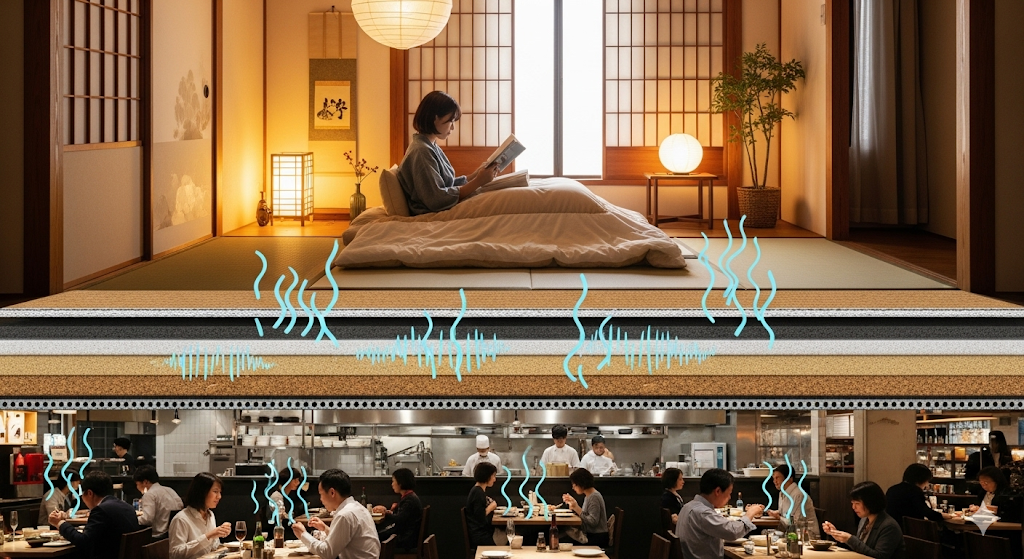
But lurking beneath that attractive location is a massive pitfall that could threaten the very survival of your business. It’s the “noise” that travels down from your property to the floor below—specifically, the serious risk of complaints from restaurant owners over guests’ footsteps.
Let us give you this article’s conclusion upfront.
To succeed with a vacation rental business in this type of property, professional “floor soundproofing” designed to keep everyday guest noise from reaching the floor below isn’t optional—it’s an essential investment that serves as your business’s lifeline.
In this article, we’ll thoroughly explain why this countermeasure is indispensable, starting with the underlying acoustic properties involved, all the way through to specific soundproofing construction methods.
Why Properties “Above a Restaurant” Are High-Risk, High-Reward
First, let’s accurately understand both the “light” and “shadow” sides of this type of property.
- The High-Reward Side (Benefits):
- Often located near stations or in entertainment districts, giving you a major advantage in attracting guests.
- The ground-floor shop serves as a landmark, making it easy for guests to find your property.
- The area stays bright and populated even at night, giving female guests in particular a sense of safety.
- The High-Risk Side (Drawbacks):
- The biggest enemy is “footsteps”: Unlike residential apartment buildings, the ceilings of restaurants and shops are often built with simple structures that don’t account for soundproofing (such as a single ceiling board), meaning sound from the floor above can travel down far more than expected.
- A mismatch in operating hours: Restaurants often stay open late into the night and continue cleanup afterward—right when tired guests are settling in for the night and expecting quiet. Even minor sounds that would normally go unnoticed can become a major source of stress for staff working below, easily escalating into complaints.
“But They’re Just Walking…” Why Footsteps Cause Trouble: The Basics of Sound
Before diving into countermeasures, let’s understand that there are two types of sound that travel through floors.
- Light Impact Sound (LL): Relatively light, high-pitched sounds like the “clink” of a dropped spoon or the “pat-pat” of someone walking in slippers. These can be reasonably mitigated with carpets or soundproofing mats.
- Heavy Impact Sound (LH): The “thud-thud” of children running or jumping, or the heavy, low-pitched “thump, thump” of an adult walking heel-first. This type of sound travels by vibrating not just the floor but the entire building structure, so surface-level measures do almost nothing—fundamental construction work is required. Heavy impact sound is typically what causes trouble with restaurants below.
[Pro Tips] Three Levels of Floor Soundproofing Methods
Here are three specific floor soundproofing measures—ranked by effectiveness and cost—that will help minimize disturbance to the floor below and let you operate with peace of mind.
Level 1: [Minimal DIY Fix] Soundproofing Mats and Carpets
This is a low-cost option you can implement right away.
- Effectiveness: Highly effective against light impact sound (slipper noise, dropped objects, etc.).
- Limitations: However, its effect on the most problematic issue—heavy impact sound (footsteps)—is limited. It’s a “better than nothing” measure, not a fundamental solution.
- Estimated Cost: Tens of thousands of yen up to around ¥100,000.
- Tip: You can boost effectiveness by layering—lay a thick, highly cushioned soundproof/sound-insulating mat directly on the flooring, then add a thick carpet on top of that.
Level 2: [Recommended Standard Measure] Dry Double Floor (Raised Floor) Construction
If you’re running this as a serious business, you should consider this level of countermeasure as a minimum.
- Effectiveness: Can significantly reduce heavy impact sound.
- Method: Support legs fitted with vibration-dampening rubber are installed on top of the existing concrete floor slab, and a new floor is built on top using particleboard or plywood. Think of it as floating the floor—by creating an “air layer” between the floor and the building’s structural frame, vibrations are significantly blocked from reaching the floor below.
- Estimated Cost: Roughly ¥15,000–¥30,000 per square meter (e.g., ¥300,000 and up for a 20㎡ studio).
- Tip: In many cases, this can be installed directly over the existing floor without removing it, making for a relatively short construction period (a few days to about a week). However, since the floor height will rise by a few to several centimeters, be mindful of potential issues with door clearance and reduced ceiling height.
Level 3: [Ultimate Solution] Wet Floating Floor Construction
This method is for when you need the highest possible level of sound insulation.
- Effectiveness: Delivers the highest level of sound insulation performance, comparable to what’s used in music studios or home theaters.
- Method: A thick cushioning/sound-absorbing material such as glass wool is laid over the concrete slab, covered with a waterproof sheet, and then concrete (or mortar) is poured on top—effectively floating the floor itself.
- Estimated Cost: Expensive, with a longer construction period (from ¥30,000 per square meter and up).
- Tip: This involves large-scale renovation and may require structural calculations for the building, so for most vacation rental properties, Level 2 (dry double floor construction) provides more than sufficient performance.
3 Operational Measures to Pair with Floor Soundproofing
Alongside physical construction work, let’s further reduce risk through smart operational practices.
1. Strict House Rules and Clear Warnings
Post clear, multilingual rules such as “Please always wear the provided slippers indoors” and “After 10 PM, please be especially mindful of footstep noise and keep quiet”—both on your booking site and inside the unit.
2. Provide Thick Slippers as an Amenity
As a practical way to help guests follow the rules, keep slippers with thick, soft soles on hand for every guest—these produce much less “pat-pat” noise.
3. Build a Good Relationship with the Restaurant Below
This is the single most important key to preventing trouble before it starts. Before you begin operations, be sure to visit the restaurant’s owner or manager in person. Let them know that you’ll be running a vacation rental, that you’re taking every possible precaution against noise and thoroughly briefing guests, and that you want them to contact you immediately if any issue arises—then give them your emergency contact information. This sincere gesture will go a long way toward softening the severity of any complaint, should one ever occur.
Conclusion: Investing in Your Floor Is “Insurance” Against Future Complaints
A property with a restaurant on the floor below is a “double-edged sword”—offering great earning potential alongside significant complaint risk. To wield that sword safely and keep generating stable revenue, attention to and investment in the invisible factor of “sound” matters more than any other equipment investment you could make.
Floor soundproofing isn’t just a renovation expense. It’s the wisest possible “insurance policy”—one that preserves your good relationship with the shop below, safeguards the long-term sustainability of your business, and, most importantly, frees you from the constant anxiety of “when will the next complaint come?”
Let a Professional Assess the Risk in Your Property
“Does this property actually need soundproofing work?”
“I’m not sure which level of construction offers the best cost-performance.”
“How do I even find a reliable renovation contractor?”
Bring these questions to us.
At Stay Buddy Inc., a vacation rental management company operating primarily in Osaka’s entertainment districts, we have extensive experience transforming challenging properties—including many with tenants on the floor below—into highly profitable operations.
We do more than just manage your property for you. From the very contract stage, we professionally assess the noise risk of a property, and together with our partner renovation specialists, we propose the optimal floor soundproofing solution tailored to your budget and goals.
We don’t just tell you “how much this construction will cost”—we look at things from an owner’s perspective, helping you understand “how much return you can expect from that investment,” so you can make confident, informed decisions.
Turning a high-risk property into a premium asset that generates stable, long-term income—that’s the power of our production expertise.
Why not take that difficult first step together with us? Please feel free to reach out for a consultation anytime.