Leave Your Vacation Rental Management to the Experts
Free Online Consultation20 Noise Countermeasures for Vacation Rentals: A Complete Guide from Property Selection to Interior Renovation and Amenities
In vacation rental management, there’s one troublemaker that occurs more frequently than any other—and once it escalates, it can threaten the very survival of your business. That troublemaker is “noise.”
- Noise made by guests can trigger complaints from neighbors.
- Noise from outside the building can disturb guests’ sleep and lead to negative reviews.
This two-way noise problem is a critically important management challenge that every host of a vacation rental must confront.
Let’s start with the conclusion of this article.
The key to successful noise management isn’t a quick fix—it’s a multi-layered strategy executed with careful planning: (1) eliminate the root cause of risk through smart property selection, (2) physically block sound through interior renovation, and (3) address the human element through thoughtful operational practices.
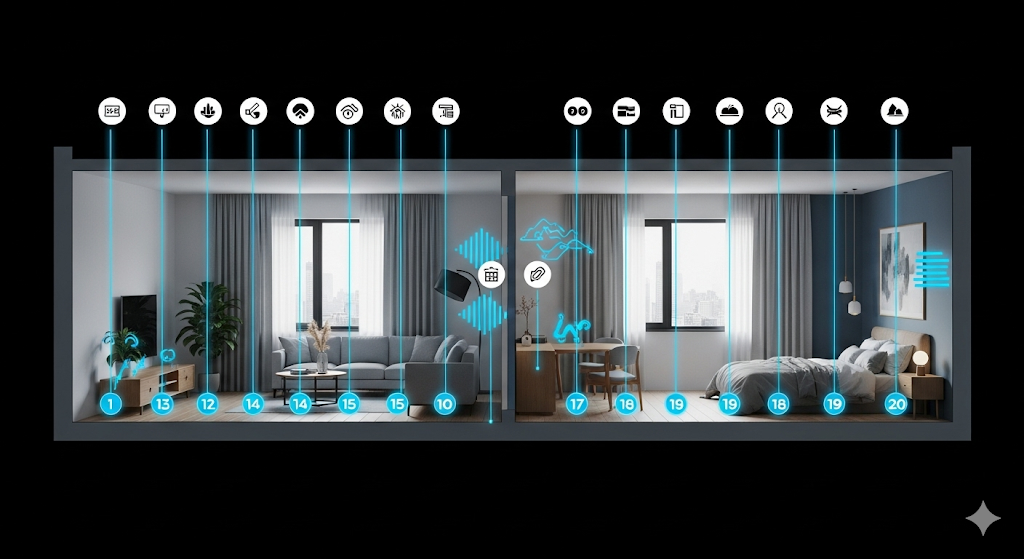
In this article, we’ll provide a comprehensive breakdown of concrete measures—20 in total—to protect your vacation rental from the nightmare of noise-related trouble.
Why Should Noise Management Be Approached from Both Offense and Defense?
Noise management has two distinct sides.
- Offense (Boosting Guest Satisfaction): Measures that protect guests from outside noise—traffic, neighboring households, and the like—so they can enjoy a quiet, comfortable night’s sleep. This helps you earn positive reviews.
- Defense (Avoiding Neighbor Trouble): Measures that prevent everyday sounds made by guests—conversations, footsteps, TV noise, etc.—from leaking outside, helping maintain good relationships with neighbors. This safeguards the long-term sustainability of your business.
Only when both offense and defense are firmly in place can you create an environment where you can operate with true peace of mind.
[Phase 1: Property Selection] 5 Measures to Eliminate Noise Risk at the Source
Noise management begins the moment you start searching for a property. Making the right choice here is the single most effective way to minimize headaches down the road.
- Measure 1: Prioritize the building’s structure above all else (RC construction > steel-frame > wood-frame). A building’s structural material has the single biggest impact on soundproofing performance. **Reinforced concrete (RC) buildings**, with their dense walls and floors, generally offer the best sound insulation. Wood-frame apartments, on the other hand, tend to transmit sound easily between adjacent and upper/lower units, so extra caution is needed when running a vacation rental in such a building.
- Measure 2: Choose a corner unit or top-floor unit. In apartment buildings, the fewer adjoining units a room has, the lower the risk of noise-related trouble. A “corner unit,” which only shares a wall with one neighbor, or a “top-floor unit,” which never has to worry about footsteps from above, are both highly advantageous when it comes to noise control.
- Measure 3: Choose a floor plan where the bedroom wall doesn’t border a neighboring unit. Even within the same corner unit, you should avoid floor plans where the bedroom wall is shared with a neighbor’s living room. Check the floor plan carefully and look for units where closets or plumbing areas act as a buffer zone between your unit and the neighbor’s.
- Measure 4: Even in busy entertainment districts or along main roads, check the “window orientation.” Highly convenient locations are appealing, but you need to consider their positioning relative to noise sources. Even within the same building, a room facing the main street and one facing a quiet back alley can differ dramatically in terms of quietness.
- Measure 5: For standalone houses, prioritize “distance from neighboring homes” above all else. Standalone houses offer more freedom, which unfortunately also means guests are more prone to letting loose. To prevent noise complaints from BBQs or parties, always confirm there’s ample distance between the property and neighboring homes.
[Phase 2: Interior Renovation] 10 Measures to Physically Block Sound
Once you’ve settled on a property, the next step is controlling sound through interior design and renovation.
《Blocking Outside Noise》
- Measure 6: [Most Important] Install double-glazed windows (secondary interior windows). This is the single most effective countermeasure against outside noise. By installing a second window inside the existing one, the air gap created between the two dramatically reduces sound transmission. It also boosts insulation and cuts down on utility costs—an investment with an outstanding return.
- Measure 7: Install curtains with high sound-blocking performance. Choose thick, tightly woven “sound-blocking curtains” or “soundproof curtains.” For maximum effectiveness, pick a size that fully covers the window and extends all the way to the floor.
- Measure 8: Attach soundproof hoods or filters to ventilation openings. Even with the windows closed, sound can still seep in through wall vents (air intakes). Installing a soundproof hood on the exterior side, or a dedicated soundproof filter on the interior side, can significantly reduce noise intrusion.
《Preventing Noise from Escaping the Unit》
- Measure 9: Apply sound-absorbing materials and soundproofing sheets to walls. Installing a soundproof sheet (which reflects sound) on the interior side of the wall shared with a neighboring unit, topped with a sound-absorbing board (which absorbs sound), is a highly effective form of full-scale soundproofing.
- Measure 10: Lay down soundproof mats or sound-insulating mats on the floor. This is effective against footstep noise (heavy impact sound) traveling to the floor below—such as the sound of children running around. Mats designed to be installed underneath flooring can be especially effective.
- Measure 11: Apply weatherstripping tape to doors to improve airtightness. Gaps around entrance doors and interior doors are a surprisingly common source of noise leakage. Simply applying weatherstripping tape—available at any hardware store—can improve airtightness and reduce sound leakage.
- Measure 12: Lay down a thick carpet or rug to muffle footsteps. A thick carpet or rug absorbs footstep noise (light impact sound) and the sound of dropped objects far better than bare flooring alone.
- Measure 13: Attach felt pads to furniture legs. The screeching sound of a dining chair being pulled out is especially noticeable to the unit below. Simply attaching felt pads—available even at 100-yen shops—to the bottom of every chair leg can eliminate this unpleasant noise entirely.
- Measure 14: Choose quiet appliances (washing machine, refrigerator, air conditioner). This is especially important for appliances that may run at night—opt for models with quiet-operation designs. Placing an anti-vibration mat under the washing machine is also effective.
- Measure 15: Position the bed’s headboard away from any wall shared with a neighboring unit. Small details matter—positioning the bed slightly away from a shared wall helps prevent conversations in bed or the sound of the headboard knocking against the wall from carrying through to the neighbor’s unit.
[Phase 3: Operations & Amenities] 5 Measures to Shape Guest Awareness
Alongside physical measures, soft measures that encourage guest cooperation are equally essential.
Measure 16: [Most Important] Draft Strict House Rules and Secure Guest Agreement
Create clear, strict rules in multiple languages—such as “Parties, loud conversations, and music after 10 PM are strictly prohibited. Violations may result in a fine and immediate eviction”—and always obtain guest agreement to these rules at the time of booking.
Measure 17: Post “Please Be Quiet” Reminders in Multiple Locations Around the Unit
Post simple, easy-to-understand reminders—such as “Please be quiet at night”—on well-designed cards or signs in spots guests are likely to notice, such as the entryway, living room, and bedroom.
Measure 18: Offer Earplugs as a Welcome Amenity
If your property is in a location prone to outside noise, simply placing a set of free earplugs by the bedside, along with a note like “For a more comfortable sleep, please feel free to use these,” conveys thoughtful hospitality and helps prevent complaints before they arise.
Measure 19: Provide slippers to reduce indoor footstep noise. Especially in winter, having guests wear soft-soled slippers rather than walking barefoot on hardwood floors can reduce footstep noise traveling to the unit below.
Measure 20: [Ultimate Weapon] Install a noise sensor to detect abnormalities. Installing a noise sensor such as Minut in your unit automatically sends an alert to your smartphone whenever sound levels exceed a preset threshold for a sustained period. This allows you to catch noise issues from parties and similar disturbances at an early stage and warn guests before things get out of hand.
Conclusion: Thorough Noise Management Protects a Host’s “Peace of Mind”
It’s no exaggeration to say that whoever masters noise management masters vacation rental business itself.
The 20 measures introduced here are more than just tactics for avoiding complaints. They are the ultimate insurance policy for your business’s long-term sustainability—delivering an outstanding stay to your guests, peace of mind to your neighbors, and above all, “peace of mind” to you, the host.
Let Our Professionals Diagnose and Manage Your “Noise Risk”
“I don’t know which measures my property actually needs.”
“I want to hire a trustworthy contractor for cost-effective interior renovations.”
“I’m tired of worrying about noise trouble 24 hours a day…”
If any of these concerns sound familiar, let us help.
Stay Buddy Inc., a vacation rental property management company, has built up practical know-how for anticipating, avoiding, and managing “noise risk” through years of experience operating properties across a wide range of locations—from bustling entertainment districts to quiet residential neighborhoods in Osaka.
We thoroughly assess noise risk starting from the very first step of your business—property selection. If needed, we’ll work with our partner specialists to propose optimal interior solutions, such as installing double-glazed windows or full soundproofing renovations. And once your rental is up and running, we combine strict house rules with the latest noise sensor technology to protect your property from trouble, 24 hours a day, 365 days a year.
From noise management consulting to full-scale operational management, we offer everything as a complete one-stop solution.
We promise to build a rock-solid environment that lets you operate your rental with total peace of mind.