Leave Your Vacation Rental Management to Us
Completely Free Online ConsultationIf you run a vacation rental, you’ve probably received a sudden message from a guest saying, “The lights went out” or “The breaker tripped.” This tends to happen especially when guests staying in a room for the first time use many appliances at once, or run high-wattage devices like air conditioners, microwaves, and irons simultaneously, overloading the breaker until it trips.
While this trouble might seem minor, it can be quite stressful if it happens at night, leaving guests anxious in complete darkness. It’s also common for guests visiting from overseas to panic because they “don’t know how to operate the breaker.” If you don’t respond quickly and accurately, it can lead to negative reviews or complaints—so as a host, it’s wise to know both how to handle this issue and how to prevent it in advance.
In this article, we’ll focus on “how to respond when a guest reports that the breaker has tripped, and how to prevent it from happening in the first place,” covering everything from guest support during an incident to a fundamental review of your electrical capacity. Please read through to the end.
1. Why Does the Breaker Trip?
1-1. Exceeding Total Power Consumption
A breaker is a safety device designed to trip whenever the power draw exceeds the amperage specified in your electricity contract. For example, if you’re on a 30-amp (A) contract and a guest uses an air conditioner, microwave, and hair dryer at the same time, the instantaneous power demand exceeds 30A, causing the breaker to trip and cut off the electricity.
Vacation rental guests especially tend to use appliances the same way they would at home, which makes simultaneous use and the resulting power overloads more likely. This is a particular concern for larger properties with multiple rooms and lots of equipment, such as standalone houses or family-oriented rentals.
1-2. When the Earth Leakage Breaker Trips
Exceeding your contracted amperage isn’t the only reason a breaker can trip. If electrical leakage occurs somewhere in the wiring, the earth leakage breaker will activate to cut off the power and prevent fires or electric shocks.
Electrical leakage can be caused by aging wiring or water leaking from appliances located near plumbing fixtures, and this type of issue requires a different response than a simple power overload.
If a guest reports that “the power went out even though I wasn’t using any appliances,” this strongly suggests an electrical leakage issue.
2. What to Do When a Guest Reports the Breaker Has Tripped
2-1. Guide the Guest Through the Basic Steps
When a guest contacts you saying, “All the lights went out!”, the most important thing is to respond calmly. In most cases, the issue can be resolved using the following steps:
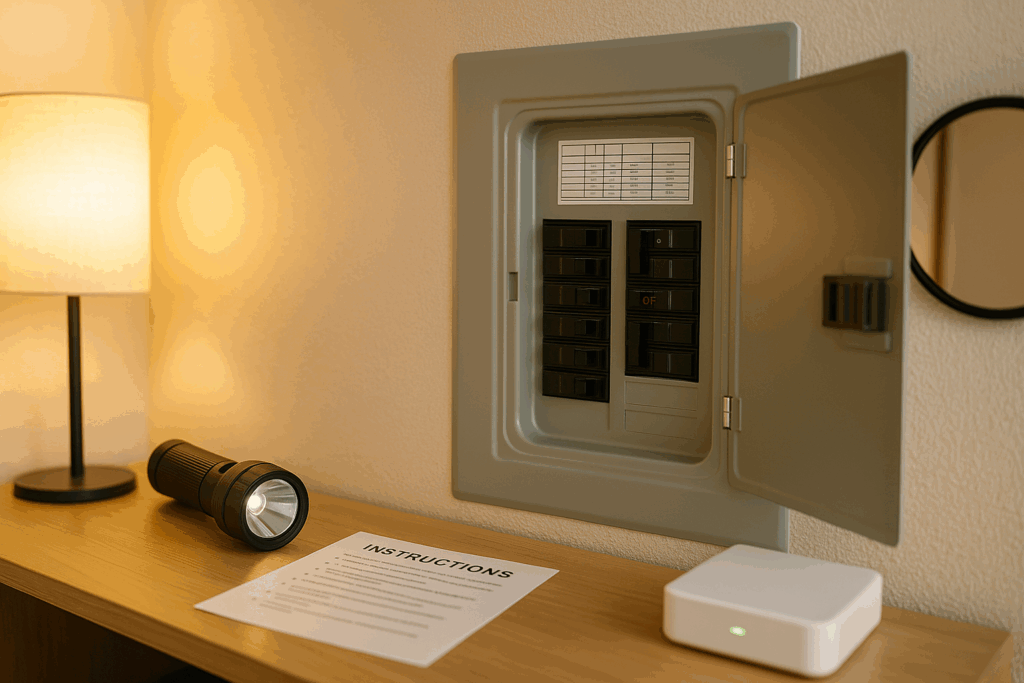
- Have the guest locate the breaker box: Its position varies by property—it might be beside the entrance, in the kitchen, or high up in a hallway—so be sure to provide its location in advance
- Check the position of the main breaker, amperage breaker, and earth leakage breaker: Have the guest check the switch positions (typically “up” means ON and “down” means OFF)
- If the amperage breaker has tripped: Have the guest turn off other appliances, then flip the amperage breaker back up
- If the earth leakage breaker has tripped: Check whether any appliance got wet or is malfunctioning. If the cause is unclear, contact a professional immediately
Preparing a multilingual manual with photos covering these steps makes it much easier for guests to resolve the issue themselves, even late at night or when the host isn’t available.
2-2. If the Power Isn’t Restored Even After the Guest Tries
If the guest resets the breaker several times but it keeps tripping right away, this suggests an equipment malfunction or electrical leakage. In this case, don’t ask the guest to keep trying—instead, contact staff or an electrician who can respond even at night and arrange for an on-site inspection as soon as possible. Since there’s a risk of fire from an electrical leak or short circuit, resolving the issue quickly should be the top safety priority.
If the guest is on a long-term stay and the repair is going to take time, you may also need to consider additional measures, such as arranging alternative accommodation.
3. How to Prevent the Breaker from Tripping
3-1. Review Your Contracted Amperage
The most direct solution is to increase the contracted amperage with your power company. Upgrading from 30A to 40A or 50A allows more appliances to be used simultaneously, making the breaker far less likely to trip. That said, plans with higher amperage come with higher base rates, so you’ll need to weigh the cost against the benefits.
If you anticipate multiple guests staying together and using high-load appliances—like air conditioners, microwaves, and hair dryers—at the same time, contracting for sufficient amperage in advance can prevent the vast majority of these issues.
3-2. Distribute Appliances Across Circuits
If your property is older, or wiring limitations make it difficult to change your amperage contract, another option is to spread appliances across multiple circuits. For example, putting the kitchen microwave on a separate circuit makes it much less likely that a single circuit will be overloaded when an air conditioner, microwave, and hair dryer are used together.
Small adjustments—like placing hair dryers in each bedroom instead of concentrating them in one bathroom—can also help prevent load from concentrating on any single circuit.
3-3. Give Guests a Heads-Up
Simply letting guests know that “using multiple appliances at once can trip the breaker” can surprisingly reduce a lot of trouble. Overseas guests in particular may be unfamiliar with Japan’s electrical setup (100V, amperage-based contracts) and might use high-power appliances simultaneously out of habit, just as they would back home.
Including simple tips in your guest manual—such as “lower the AC setting while using the microwave” or “avoid using the hair dryer at the same time as other appliances”—may encourage guests to follow these practices.
4. The Benefits of Preventing Breaker Trips and Their Impact on Revenue
4-1. Improved Guest Satisfaction and Repeat Bookings
Guests fumbling around in the dark after a trouble occurs, or having to call the host in the middle of the night—this kind of stress can seriously damage the travel experience. Since a tripped breaker means “the electricity stops working,” it’s a serious issue that often directly affects review ratings.
Conversely, properties that are set up from the start with sufficient amperage and well-planned circuits, and that rarely experience this kind of trouble, tend to earn positive feedback like “easy to use” and “felt safe and comfortable.” This can lead to positive effects such as repeat guests and increased bookings through word-of-mouth.
4-2. Reducing Late-Night Response and Refund Risks
Breaker trips often happen to occur at night, which not only increases the burden on owners and staff but can also lead to requests for refunds if the guest is on a tight schedule during their stay.
By implementing solid preventive measures, you can reduce the costs of handling incidents and compensation claims, leading to more efficient vacation rental management. Ultimately, this contributes to both cost savings and maintaining a healthy occupancy rate—benefits that are well worth the effort.
5. Real Examples: Success and Failure Stories from Implementing Measures
(*The following are general, illustrative examples.)
- Success story: Before opening the property, the owner consulted with the power company and upgraded the contracted amperage from 40A to 60A. Although initial costs increased slightly, the breaker no longer tripped even when multiple guests used air conditioners and microwaves at the same time, eliminating trouble-related incidents entirely. Reviews consistently praised the “stress-free stay,” and occupancy rates improved
- Failure story: A small standalone house opened with the amperage still set at 30A. During the summer, the breaker tripped frequently whenever guests used the air conditioner, microwave, and hair dryer at the same time, resulting in nighttime calls and repeated reset instructions. Guest satisfaction dropped, reviews described the stay as “inconvenient,” and bookings declined
As these examples show, taking steps to prevent breaker-related trouble may involve some short-term cost, but it’s a critical investment that pays off through long-term profitability and stable operations.
6. Conclusion: Preventing Breaker Trips Is a Must—Eliminate Trouble and Earn Great Reviews
In vacation rental management, equipment malfunctions are among the most common causes of complaints. A tripped breaker in particular causes major stress for guests by cutting off their power, and if the response is slow, it can quickly lead to negative reviews like “this place was inconvenient” or “the host’s response was poor”—making it one of the more troublesome issues hosts face.
However, by taking preventive measures in advance—such as securing sufficient amperage and distributing electrical loads across circuits—you can dramatically reduce the likelihood of trouble occurring. Additionally, preparing simple guidance for guests (such as not using multiple appliances at once) and a troubleshooting manual for when issues do arise will allow you to handle the situation smoothly if it ever happens.
By avoiding breaker trips, you can reduce late-night emergency responses and give guests greater peace of mind for a more comfortable stay. This, in turn, can lead to higher review ratings and more repeat bookings, contributing to stable revenue for your vacation rental business. Setting your amperage too low just to save on costs may end up backfiring, causing frequent trouble during peak seasons and resulting in even greater losses.
Take this opportunity to review your property’s electrical setup and provide your guests with a stress-free stay.