Leave Your Vacation Rental Management to Us
Completely Free Online ConsultationGuests coming from overseas often don’t know basic information, such as where to buy daily necessities or groceries. Especially for travelers from abroad who are unfamiliar with the area and face a language barrier, knowing in advance the location, business hours, and product features of nearby convenience stores and supermarkets can help them enjoy their stay with peace of mind.
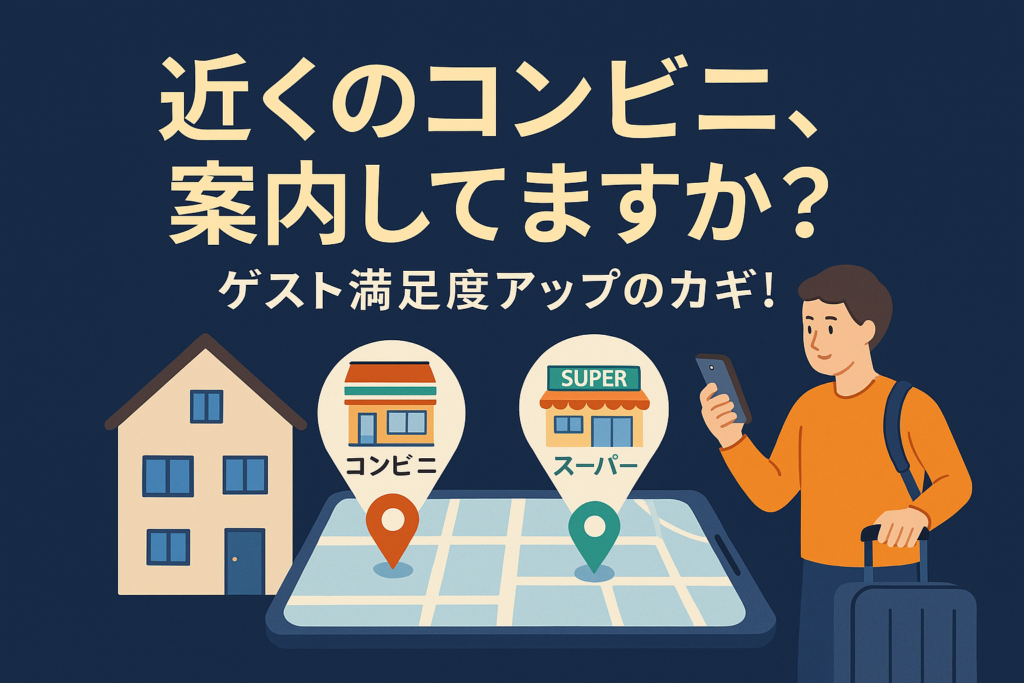
This article is written around the theme of “In vacation rentals, send guests information about nearby convenience stores and supermarkets in advance.” We’ll cover specific ways to communicate this information, tips and tricks, and hints for boosting guest satisfaction. We hope this will be useful both for those starting a vacation rental business and for those already operating who want to further improve their guest service.
1. Why You Should Send Information in Advance
When guests book a vacation rental, they typically check the property’s location, room photos, and pricing, but rarely research in detail what the shopping environment near the property will actually be like during their stay.
Especially in areas with few restaurants open late, or when guests arrive after the last train, they often find themselves confused about how to get food or where to go if they’re missing essential daily items.
1-1. Relieving Guest Anxiety
Travelers, especially international guests, tend to experience stress due to differences in language, transportation, and culture. If they know in advance whether there’s a convenience store nearby—particularly when checking in late at night—they’ll feel reassured knowing they can buy food and drinks right after arrival. Providing an environment where guests can enjoy their stay without unnecessary stress is a major responsibility for hosts.
1-2. Saving Time and Improving Efficiency
For vacation rental owners and managers, responding to guest inquiries one by one takes considerable time and effort.
By sending important information in a summarized form in advance, you can reduce questions from guests such as “Is there a convenience store nearby?” or “What time does the supermarket close?”—easing the burden on operators. Guests, in turn, won’t waste time and can start enjoying a comfortable stay right after check-in.
1-3. Appealing to Guests at the Booking Stage
Location details like “X minutes on foot from the station” or “X minutes by bus to major tourist spots” are commonly provided, but proximity to convenience stores and supermarkets can also be a strong selling point.
In areas with few restaurants or places requiring a car, simply noting “There’s a 24-hour convenience store just a 5-minute walk away” or “A popular local supermarket is two blocks from here” can significantly increase the chances that guests will feel, “I can stay here without any inconvenience.”
2. How to Convey Convenience Store Information
Convenience stores are one of Japan’s proud service infrastructures, and international travelers highly value their 24-hour operation and extensive product selection. More stores now offer foreign language support, and many ATMs accept credit cards issued overseas. To make the most of these benefits, be sure to smoothly convey accurate convenience store information to your guests.
2-1. Location Information and Landmarks
When sending a map, it’s helpful to include not just a simple Google Maps link, but also the walking route and travel time from the property to the store, along with recognizable landmarks (traffic lights, intersections, signs, etc.). This is especially useful for reducing the risk of guests getting lost in unfamiliar surroundings at night or during snowy weather.
2-2. Business Hours and Available Services
Most convenience stores in Japan operate 24 hours a day, but some locations close late at night or have restocking times in the early morning. Depending on the store, there may be eat-in areas, multilingual ATMs, and package delivery services—so it’s helpful to briefly list the features guests are likely to appreciate.
2-3. Payment Methods and Store Features
For international guests, it’s useful to share whether credit cards are accepted and whether the store supports e-money or QR code payments. It can also be interesting to mention store-specific features, such as a wide selection of hot snacks (fried chicken, croquettes, etc.), eat-in spaces, or popular original products unique to that convenience store.
3. How to Convey Supermarket Information
Supermarkets are important places for guests to buy larger quantities of groceries and daily necessities at affordable prices, making them especially valuable for guests staying multiple nights or those who enjoy cooking for themselves. Families and long-term guests in particular often rely more on supermarkets than convenience stores.
3-1. Location and Business Hours of the Nearest Supermarket
The first thing guests want to know is basic information: “Where is it located?” and “What time does it close?”
Be sure to explain the store’s character, including whether it’s a major chain or an independently run store known for fresh local produce. While some supermarkets now operate 24 hours or stay open late, many stores in rural areas close as early as 8 or 9 p.m., which can confuse guests without prior notice.
3-2. Recommendations for Fresh Produce and Local Specialties
Supermarkets often offer affordable local vegetables, fruits, and seafood, so providing specific advice can leave a great impression on guests who enjoy cooking during their stay. For example, simply adding practical tips like “This supermarket’s vegetable corner featuring direct-from-farm produce is popular” or “There’s a discount time for sashimi in the evening” can boost guest satisfaction significantly.
3-3. Store Etiquette and Rules
Japan has unique store customs and rules, such as prohibitions on in-store photography, how to use shopping carts, and paid plastic bags, so it’s considerate to provide a brief explanation for international guests. As more stores promote eco-bags or require guests to bring their own bags, advance notes such as “bags are charged for—do you need one?” can be very helpful.
Leave Your Vacation Rental Management to Us
Completely Free Online Consultation4. Timing and Methods for Sharing Information
When providing guests with information about nearby convenience stores and supermarkets, it’s important to consider the best timing and method. If it’s shared too late, guests may already have gone shopping and encountered difficulties; if shared too early, they might forget about it.
4-1. After Booking Confirmation and Before Check-in
An effective approach is to send a link or PDF file summarizing “information about the area around the property” via message or email between booking confirmation and check-in. This allows guests to receive the information before arrival and plan their itinerary accordingly. Especially for guests arriving late at night or early in the morning, some may want to buy food and drinks beforehand, so early notification will be greatly appreciated.
4-2. In-Room Guidebooks and Digital Guides
Setting up a system that guests can check immediately after check-in—such as a printed guidebook or a tablet/QR code that provides “local area information”—allows them to reference it whenever needed. Compiling a map and list of business hours for nearby convenience stores and supermarkets alongside the Wi-Fi password and tourist information makes it convenient and user-friendly for guests.
4-3. Multilingual Support Tips
If your property attracts many international guests, consider preparing information not just in English but also in languages such as Chinese or Korean, depending on demand.
While translation apps and online translation services can handle this to some extent, technical terms and place names are sometimes mistranslated, so it’s reassuring to have native speakers or professionals review at least the key points. Using maps and photos extensively is also effective for making the information visually clear.
5. Tips for Boosting Guest Satisfaction
5-1. Include Restaurant and Takeout Information Too
In addition to convenience store and supermarket information, providing details about nearby restaurants, cafes, and takeout shops can help guests feel that “this property makes it easy to find food.” Even for restaurants with only Japanese menus, if the host prepares an English menu with photos, guests will find it much easier to use.
5-2. Coupons and Collaborations with Local Shops
Partnering with local shopping streets and restaurants to offer coupons or discounts is another interesting initiative. International travelers tend to enjoy shopping at small local supermarkets and convenience stores, so being able to shop at a discount using coupons can significantly enhance guest satisfaction. For owners, this also deepens community ties and can be positively received as a contribution to the local economy.
5-3. Instagram-Worthy Spots and Social Media Sharing
Japanese convenience stores and supermarkets are unique to international guests, and many carry Instagram-worthy products such as limited-edition snacks or original drinks. Providing an “Instagram-worthy spot map” or a “recommended convenience store dessert ranking” in the property can encourage guests to take photos and share them on social media. This can, in turn, help promote the property and the local area.
6. Conclusion: A Key to Improving Guest Experience and Preventing Trouble
Vacation rentals offer a level of freedom and local experience that hotels can’t match, but if hosts fail to provide the information guests need, it can lead to complaints such as “I couldn’t find anywhere to shop” or “I couldn’t get any food.” Accumulated dissatisfaction can lower review scores, which in turn affects occupancy rates and revenue.
This is why the key lies in sending guests information about nearby convenience stores and supermarkets in advance.
By providing this information in a way guests can use right after booking, before check-in, or immediately after arrival, you can significantly reduce guest anxiety and inquiries. Furthermore, adding details about store features, services, and culturally sensitive support—not just maps and business hours—will greatly enhance guest satisfaction.
When guests can stay with peace of mind, it reduces the workload for hosts and management companies, ultimately leading to positive reviews and repeat guests. We encourage you to apply the points covered in this article and provide detailed, guest-focused information.
For All Vacation Rental Matters, Contact Stay Buddy Inc.
If you feel that “we’re not providing guests with proper advance guidance or local area information,” “we want to strengthen our communication in English or other languages,” or “we want to leave overall vacation rental management to professionals,” please don’t hesitate to contact Stay Buddy Inc.
Our team, with extensive experience and know-how, provides comprehensive support—from launching your property to guest communication, cleaning management, and handling neighborhood issues. Beyond simply sharing convenience store and supermarket information, we’re happy to consult with you on ways to highlight local attractions and recommended spots, all aimed at achieving even higher guest satisfaction. We look forward to hearing from you.