
Leave Your Minpaku Management to the Experts
Free Online ConsultationFire Safety Equipment Requirements for Minpaku: How Use Type and Floor Area Change the Rules
The fire safety equipment required for a minpaku property depends heavily on which law you’re operating under—the Private Lodging Business Act (the “minpaku law”) or the Hotel Business Act—as well as the property’s total floor area, structure, and designated use. In practice, it’s surprisingly common for operators to assume “it’s a house, so it’s fine as is,” only to be hit with demands for additional construction work at the fire inspection stage during the licensing process. This article breaks down the legal basis and realistic cost ranges from a practitioner’s perspective.
The Legal Basis: How the Fire Service Act Relates to Minpaku Regulations
Fire safety equipment requirements stem from the Fire Service Act and its enforcement order. While the minpaku law and the Hotel Business Act each provide the legal basis for operating a lodging business, fire safety equipment rules under the Fire Service Act apply regardless of which operating framework you use. What changes based on your operating format is the “use classification” of the building—and that classification is what determines which equipment is required.
Appendix 1 of the Fire Service Act Enforcement Order breaks building uses down into detailed categories. Facilities licensed under the Hotel Business Act fall under Category (5)-i (hotels, ryokan, etc.), while properties operating solely under a minpaku law notification may be classified as Category (5)-ro (apartment buildings, dormitories, etc.) or as mixed-use under Category (16). This difference in classification directly determines the gap in equipment requirements.
Fire Safety Requirements for Properties Registered Under the Minpaku Law
Under a 2018 joint notice from the Ministry of Land, Infrastructure, Transport and Tourism and the Fire and Disaster Management Agency, properties registered under the minpaku law may, in some cases, retain their existing use classification as a single-family house or apartment building when filing their notification. In such cases, since the use classification under fire regulations doesn’t change to Category (5)-i, the full suite of equipment required for hotels and ryokan isn’t necessarily mandatory. That said, certain conditions still must be met.
Automatic Fire Alarm Systems and Residential Smoke Alarms
For properties registered under the minpaku law, residential smoke alarms are generally required as a baseline. However, depending on the floor area and structure, a full automatic fire alarm system may also be necessary. Specifically, wooden buildings with a total floor area of 300 square meters or more, mixed-use buildings, or properties large enough to require a Hotel Business Act license may find that smoke alarms alone aren’t sufficient. Checking with your local fire department in advance is essential.
Emergency Exit Lights and Evacuation Equipment
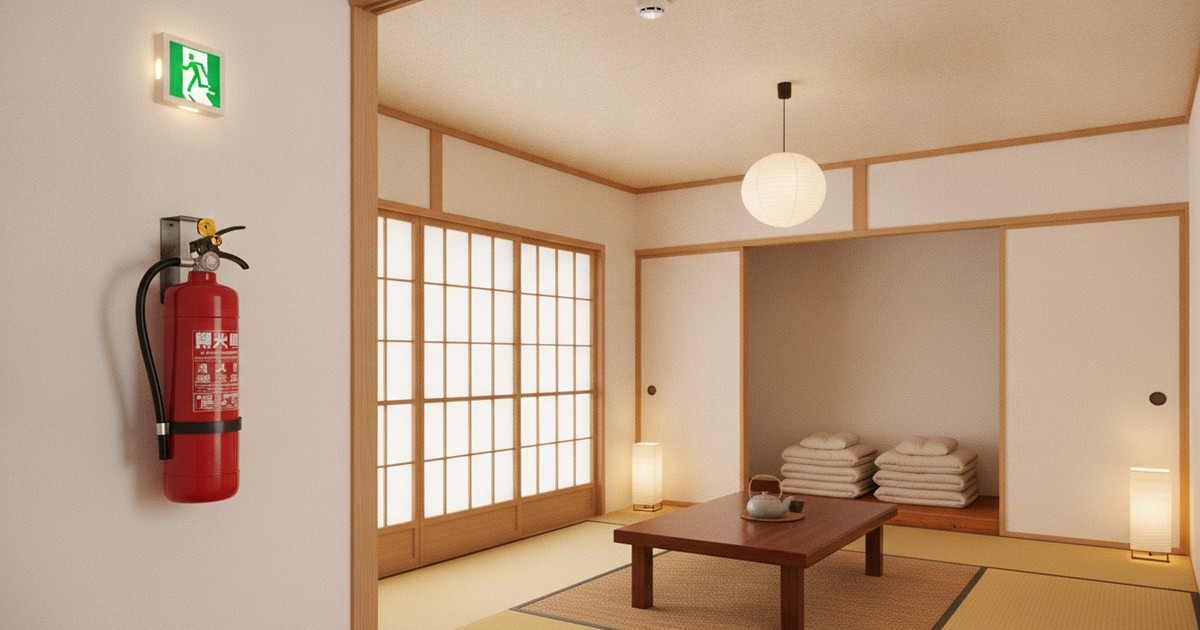
If a property falls under Category (5)-i, emergency exit lights become mandatory. Even if the total floor area is under 300 square meters, installation may still be required depending on the number of floors and the building’s structure. Evacuation equipment—such as descending life lines or rescue chutes—is often required when guest rooms are located on the third floor or higher, though the final determination is made by the fire department on a case-by-case basis.
Fire Safety Requirements for Hotel Business Act Licensed Properties, by Floor Area
Facilities licensed under the Hotel Business Act are classified as Category (5)-i. For this use category, the equipment requirements set out in the Fire Service Act Enforcement Order are considerably stricter. Depending on total floor area, occupant capacity, and structure, properties face a tiered set of obligations covering automatic fire alarm systems, sprinklers, emergency broadcast systems, exit lights, fire extinguishers, and evacuation equipment.
Sprinkler Systems
Under Article 12 of the Fire Service Act Enforcement Order, Category (5)-i facilities are generally required to install sprinklers once total floor area reaches 6,000 square meters or more—though this threshold drops for buildings with floors on the 11th level or above, or those with certain structural features. Most small-scale ryokan and minpaku properties fall well under 6,000 square meters and are therefore typically exempt. That said, local ordinances or specific building characteristics can tighten these standards, so it’s never safe to assume sprinklers are simply “not required.”
Automatic Fire Alarm Systems and Occupant Capacity
For Category (5)-i properties, automatic fire alarm systems are mandatory once total floor area reaches 300 square meters or more, or occupant capacity reaches 30 people or more (Article 21 of the Fire Service Act Enforcement Order). Even small properties can exceed the 30-person threshold depending on how occupant capacity is calculated, so this figure needs to be worked out carefully at the design stage.
Cost Estimates: A Wide Range Depending on Equipment Type and Scale
Based on properties we’ve been directly involved with, installing or upgrading smoke alarms and exit lights in a small single-family home (around 100 square meters total floor area) has typically run anywhere from several tens of thousands to around 200,000 yen. Where a full automatic fire alarm system needed to be newly installed, costs ranged from roughly 500,000 to 1.5 million yen, depending on the property’s size and the condition of existing wiring. For properties large enough to require sprinklers, installation costs alone can run into the millions of yen. In every case, the final figure depends heavily on the building’s structure, the state of existing equipment, and the judgment of the local fire department—so always arrange an on-site inspection with a licensed fire equipment engineer or inspection firm before budgeting.
One thing that’s easy to overlook is the ongoing cost of maintenance after installation. Under Article 17-3-3 of the Fire Service Act, fire safety equipment must be inspected regularly and the results reported to the fire department. Inspection costs vary depending on the type and quantity of equipment, but typically range from tens of thousands to several hundred thousand yen per year. This needs to be factored into your ongoing operating budget from the start.
A Real Case From the Field: Equipment Deficiencies Discovered Right Before a Fire Inspection
At one property we took over management of—one that already held a Hotel Business Act license—the exit lights installed under the previous owner turned out to be an outdated model that no longer met current standards. It was only after the handover to the new owner, when we reviewed the paperwork ourselves, that we discovered the mandatory periodic fire equipment inspection reports hadn’t been filed in years. Because the old exit lights needed replacing under revised fire regulations, resolving both the equipment upgrade and the backlog of inspection reports ended up taking about two months. Whenever you’re acquiring or taking over a property, checking the current state of its fire safety equipment and its inspection history is an essential step for avoiding headaches once operations are underway.
Free Consultation With Stay Buddy Inc.
Because fire safety equipment obligations depend on an interplay of use classification, total floor area, structure, and occupant capacity, the right answer differs from property to property. To pin down exactly what your specific property needs, the standard approach is to consult your local fire department and arrange an on-site inspection with a licensed fire equipment engineer—but understanding the overall operational picture beforehand is often the fastest path to getting your license approved.
Stay Buddy Inc. is a full-service management company that handles everything from supporting minpaku law notifications and Hotel Business Act license applications, to coordinating with fire equipment contractors, through to post-launch cleaning, guest support, and revenue management. By consulting with us as early as the property survey stage—before you’ve even secured your license—you can build the equipment installation schedule and costs directly into your opening plan from the outset.
In your first free consultation, we’ll ask about your property’s intended use, scale, and current condition, then walk you through the full picture of what needs to happen and in what order. Whether you’re already operating and have concerns about your fire safety equipment, or you’re just starting to consider getting licensed, we’d be glad to talk it through with you.
Please reach out via the contact form on our website. A member of our team will review your inquiry and get back to you within two business days.