Leave Your Vacation Rental Management to the Experts
Free Online ConsultationChoosing between a simple lodging registration and a full ryokan licence is one of the first decisions that shapes everything downstream — your occupancy ceiling, your cost base, and how much operational complexity your management company has to absorb on your behalf. This simple lodging vs ryokan licence comparison matters more than many overseas owners realise at the point of purchase, because the licence type you hold determines which rules bind you, not which rules you prefer.
What Each Licence Actually Permits
Simple lodging — minpaku — operates under the Housing Accommodation Business Act (住宅宿泊事業法), enacted in June 2018. Registration is handled at prefecture level. The defining constraint is a hard annual cap of 180 nights per calendar year, applied nationally. Some municipalities impose stricter local limits on top of this; certain residential zones in Kyoto, for example, restrict operation to specific seasons. If your property is idle for more than half the year by law, the revenue ceiling is structural, not a market problem.
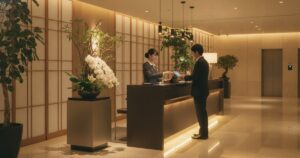
A ryokan business licence under the Hotel Business Act (旅館業法) carries no operating-day cap. Once granted, you can receive guests every night of the year. The trade-off is substantially higher entry requirements: fire prevention facilities under the Fire Service Act (消防法), minimum floor-area standards per guest, a dedicated front-desk obligation in most cases (with some prefecture-level relaxations for small properties), and a formal inspection by the public health authority before the licence is issued. In major urban prefectures, the process from application to approval typically runs several months to over a year.
A third route — tokku minpaku under the national strategic special zone framework — allowed longer operating periods in designated zones by bypassing the 180-day cap. As of 29 May 2026, Osaka City has permanently closed new applications for tokku minpaku. Existing certified facilities may continue, but if you are considering a new property in Osaka, tokku is not on the table. The operative options are minpaku registration or a full ryokan licence.
The Simple Lodging vs Ryokan Licence Comparison on Costs and Complexity
Minpaku registration fees are set by prefecture and are relatively modest — typically in the range of a few tens of thousands of yen for filing, though this excludes any fit-out required to meet safety standards (smoke detectors, fire extinguishers, emergency exit signage under the Fire Service Act). The bigger cost is the 180-day cap’s effect on revenue: at full occupancy within that window, you are working with roughly half the gross potential of an unlicensed property operating year-round.
Ryokan licensing costs vary significantly by property size, age, and prefecture. Structural modifications to meet fire and sanitation standards in an older building can run into the millions of yen. Application fees themselves are typically minor relative to fit-out. The ongoing compliance burden — annual reporting, public health inspections, maintenance of licensed facilities — also needs to be priced into your operational model. For a non-resident owner, this means your management company must be equipped to handle these renewals and inspections on your behalf, with documented authority to act. That is not a given.
What This Looks Like on the Ground
We manage a property in a semi-residential ward in Osaka. It holds a minpaku registration, not a ryokan licence. In the lead-up to the operating-day limit each year, we face a recurring judgement call: as the 180-night ceiling approaches in autumn, do we block the high-demand end-of-year period to stay compliant, or did we distribute operating days well enough earlier in the year to absorb it?
One year, a cleaning vendor handover error — a same-day turnover where the outgoing crew marked the unit as complete before the incoming guest’s linen had been restocked — led us to delay check-in by two hours. That guest had flown in from overseas. The apology and partial refund came from our operational budget, not the owner’s, because the error was ours. The owner, based in Australia, knew nothing about it until the monthly report. This is the reality of remote oversight: outcomes land before you can be consulted. Your management company’s error-handling protocols matter as much as their booking rates.
A ryokan licence would not have prevented that incident, but it changes the operating model in ways that affect how often similar situations arise. With no day cap, you have more scheduling flexibility. With a front-desk requirement, you may have on-site staff who catch problems faster. The operational risk profile is genuinely different, not just the paperwork.
Tax and Remittance for Non-Resident Owners
This is where overseas owners are most consistently underprepared. Under Japanese tax law, rental income earned in Japan by a non-resident individual is subject to Japanese income tax. If you appoint a Japanese property management company as your domestic agent, they are typically required to withhold 20.42% of gross rental payments before remitting to you — this is the non-resident withholding obligation under the Income Tax Act (所得税法). The net amount you receive is after this deduction, and you must file a Japanese tax return to reconcile actual tax liability against amounts withheld.
Consumption tax (消費税) is a separate consideration. If your annual taxable sales through the property exceed the threshold at which consumption tax registration is required (currently ¥10 million in the base period under the Consumption Tax Act, though this threshold is subject to legislative change), your management company or tax agent needs to manage this registration and filing.
JPY payouts to overseas accounts also carry currency conversion costs and, depending on your home country, may trigger local tax reporting obligations. None of this is Japan-specific complexity that disappears with one licence or the other — it applies to both — but it is routinely underestimated.
Choosing and Supervising a Management Company Remotely
Management fees in Japan’s short-term rental sector typically run in the range of 10–25% of gross revenue, depending on the scope of services, property type, location, and the company involved. A company handling cleaning coordination, guest communication, regulatory compliance, tax documentation, and monthly owner reporting at the higher end of that range is providing a meaningfully different service from one that handles bookings and little else at the lower end. The fee percentage alone tells you nothing about whether they are equipped to manage your specific licence type.
Questions worth asking before signing:
- Do you hold a registered real estate or lodging management qualification, and can you document your compliance role under the Housing Accommodation Business Act or Hotel Business Act on our behalf?
- How do you track operating days against the 180-night cap, and what is your process when the limit approaches?
- How are withholding tax deductions calculated, documented, and reported to us monthly?
- What is your protocol when a guest complaint or incident occurs — and when do you contact the owner versus handle it internally?
- Can you provide evidence of how you have managed licence renewals or public health inspections for existing clients?
A company that struggles with these questions operationally — not just in their sales pitch — is a risk that a non-resident owner is poorly placed to catch late.
Which Licence Suits Which Owner
Minpaku registration suits owners who want lower upfront cost and simpler compliance, accept the 180-day cap as a structural constraint, and are working with a property that either does not meet ryokan facility standards or would require disproportionate investment to bring up to them. For markets with strong seasonal demand concentrated within roughly six months — ski areas, cherry blossom corridors, summer coastal towns — the day cap may impose less practical constraint than it appears on paper.
A ryokan licence makes sense where year-round occupancy is realistic, the property can meet or be adapted to meet the facility standards without disproportionate cost, and the owner can support the longer licensing process and ongoing compliance overhead through a capable management partner. The revenue ceiling disappears, but the operational and compliance demands are permanently higher.
Neither licence is automatically superior. The right answer depends on the property, the location, the owner’s risk tolerance, and — critically — the competence of whoever is running it on the ground.
Work With Stay Buddy
We operate licensed properties across Japan on behalf of overseas owners and handle the regulatory, operational, and tax reporting elements that make remote ownership viable. If you are evaluating a property or reviewing an existing management arrangement, contact us to discuss how the licence type interacts with your specific situation.
Leave Your Vacation Rental Management to the Experts
Free Online ConsultationShuhei Makigi
Representative Director, Stay Buddy Co., Ltd.
Registered Housing Accommodation Management Business — Ministry of Land, Infrastructure, Transport and Tourism No. F03862. Stay Buddy operates short-term rentals and licensed hotels across Japan, supporting overseas investors with compliant, high-performing properties.
Written by the Stay Buddy Japan team. This content was produced with AI assistance and reviewed for accuracy.