Leave Your Vacation Rental Management to the Experts
Free Online ConsultationWhy Remote Ownership in Japan Is Harder Than It Looks
Owning short-term rental property in Japan from abroad is genuinely attractive: strong inbound tourism, a weaker yen making acquisition more accessible for foreign buyers, and a cultural reputation for cleanliness and hospitality that guests reward with positive reviews. But the operational complexity is front-loaded and largely invisible to owners who are not physically present. Licences expire. Municipal rules change by ward. Guests check in at midnight. A broken water heater on a Saturday becomes a crisis before you have even had your morning coffee in your home time zone.
This article is for owners who are already managing — or seriously evaluating — a portfolio of properties in Japan from outside the country. It addresses the compliance framework you are operating inside, the specific dashboards and reporting tools that allow genuine visibility without a site visit, and the questions you should ask any management company before handing over the keys.
The Compliance Layer Every Absentee Owner Must Understand
Before talking about dashboards and reporting, it is worth being precise about the legal environment, because your oversight tools are only meaningful if they are tracking the right things.
Standard Minpaku: The 180-Day Cap
Under the Housing Accommodation Business Act — commonly called the Minpaku Law — properties operating as simple short-term rentals without a full inn licence are capped at 180 nights per calendar year. This is a national ceiling, not a target. Many municipalities apply additional restrictions on top of it. In central Kyoto, for example, several wards effectively limit operation to certain days of the week or exclude residential zones entirely, reducing practical availability well below 180 nights. In parts of central Tokyo, certain residential districts restrict operation to weekends and national holidays only, pushing annual available nights below 100 even before a single booking is confirmed.
The implication for absentee owners is significant: your revenue potential is structurally capped, and that cap varies by the precise postcode of your property, not just the city. Any management company that quotes you a revenue projection without referencing the ward-level rules for your specific address is not being thorough enough.
Ryokan Business Licences: A Different Path
Properties that obtain a Ryokan Business Licence (旅館業法 — Ryokan Gyōhōhō) operate outside the 180-day cap entirely. A licensed ryokan or minshuku can host guests every night of the year. The licence requires meeting specific structural criteria — minimum room size per guest, sanitation standards, a front-desk or equivalent reception arrangement — and it is issued by the prefectural government, not the national government. Processing times and requirements vary by prefecture and even by the local public health centre (hokenjo) responsible for your address.
For properties designed or converted to meet these standards, a ryokan licence transforms the revenue model. It also changes the compliance monitoring requirements: annual reporting to the prefecture, health inspections, and stricter guest-record-keeping obligations become ongoing responsibilities that a remote owner cannot personally manage.
Special Zones (Tokku Minpaku)
A third category — National Strategic Special Zones, or tokku — allows certain designated areas to operate short-term rentals with a minimum stay of two nights (down from the standard six nights applied in some interpretations) and without the 180-day ceiling, in exchange for meeting zone-specific registration criteria. Osaka City was historically a prominent example. However, the boundaries and conditions of special zones change through government review, and an absentee owner should not assume that a special-zone status at the time of purchase will persist indefinitely. Your management company should flag regulatory changes in real time.
Tax Obligations for Non-Resident Owners
Japanese tax law treats rental income earned by non-resident individuals as Japanese-source income subject to withholding tax. When a property management company remits your net proceeds, it is typically required to withhold a percentage at source — the applicable rate depends on whether Japan has a tax treaty with your country of residence and whether you have appointed a tax representative (zeirishi) in Japan. Failing to appoint a tax representative and file an annual return is a common compliance gap among absentee owners. Consumption tax (JCT) obligations can also arise once revenues cross the relevant registration threshold. These are not matters a property manager can handle informally; they require a qualified tax professional.
What a Genuinely Useful Dashboard Should Show You
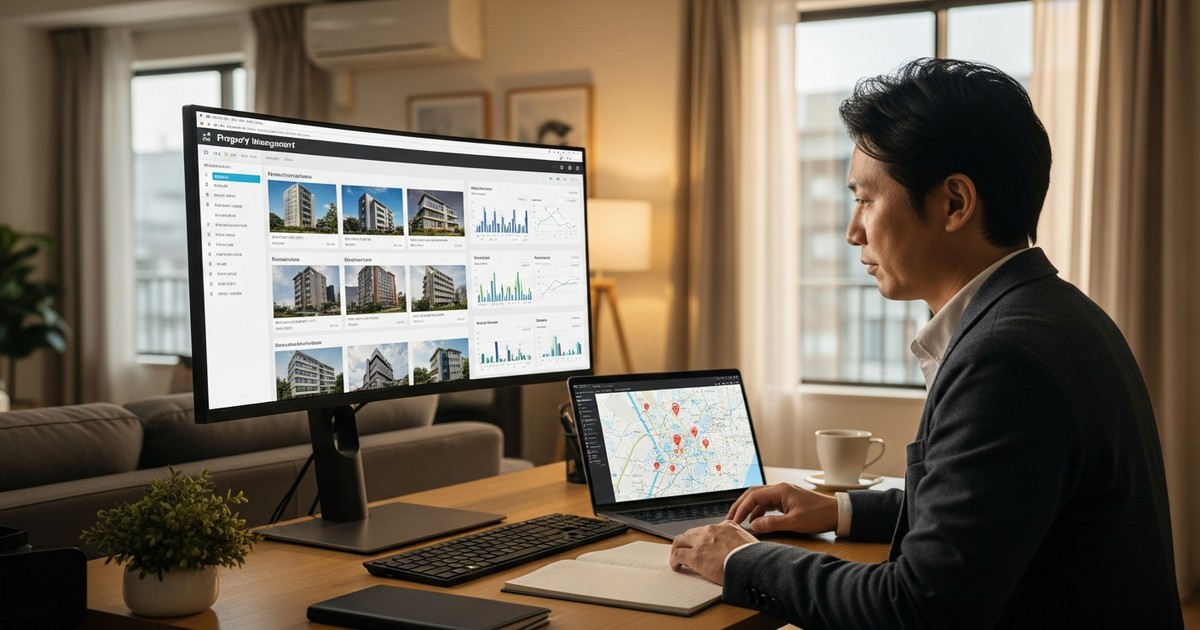
The word “dashboard” is used loosely in this industry. Some operators send a monthly PDF. Others provide a login to a shared spreadsheet. A small number offer real-time, structured reporting environments. For an absentee owner, the difference is not cosmetic — it determines whether you are managing a business or simply receiving a bank transfer and hoping for the best.
Here is what a dashboard built for remote oversight should contain, broken into operational, financial and compliance layers.
Operational Visibility
- Occupancy calendar with booking source: You should be able to see, at a glance, which nights are booked, which are blocked, and which OTA (Airbnb, Booking.com, Rakuten Travel, etc.) generated each booking. A blocked night that was not your instruction is a question that needs an answer.
- Cleaning and turnover logs: Each completed clean should generate a timestamped record, ideally with photographic confirmation of the property condition post-clean. For a remote owner, photos are not optional extras — they are your eyes.
- Maintenance ticket history: Every reported issue, its status, the contractor used, and the cost should be traceable. A good system allows you to see open tickets and receive alerts when a ticket is raised above a certain cost threshold, so you are not surprised by a deduction from your remittance.
- Guest communications summary: You do not need to read every message, but you should be able to see review scores by stay, flagged complaints, and any incidents that triggered a policy response.
- Check-in and check-out confirmations: For compliance and security, the management company should be recording guest identity per Japanese law. You should have confidence this is happening, even if you never see the data itself.
Financial Reporting
- Gross revenue per booking, per property, per month: Before any deductions. This lets you independently verify that the OTA rates being applied match what was agreed.
- Itemised deductions: OTA platform fees (typically ranging from around 3% to 15% depending on the platform and your pricing tier), management fees, cleaning fees, maintenance costs, and consumables should each appear as separate line items — not bundled into a single “expenses” figure.
- Net owner disbursement with withholding tax shown separately: If tax is being withheld before remittance, that amount must appear explicitly. You will need it for your home-country tax return as a creditable foreign tax.
- Year-to-date summaries: Across all properties if you own more than one. The ability to compare performance across a portfolio — not just look at each property in isolation — is the point at which oversight becomes genuine management.
Compliance Tracking
- Minpaku day-counter: For properties operating under the standard minpaku registration, how many of the permitted 180 days have been consumed year-to-date, property by property. This should update with every booking confirmed, not every booking completed.
- Licence and registration expiry alerts: Minpaku registrations typically require periodic renewal. Ryokan licences involve annual filings. You should receive advance notification, not discover the issue when a booking is rejected.
- Municipal rule change log: This is less common but genuinely valuable: a record of any regulatory changes that affect your property’s permitted operation, communicated in plain language.
Comparing Operational Structures for Multi-Property Absentee Owners
The table below compares the main operational arrangements available to absentee owners managing multiple properties in Japan. Each has trade-offs that become more significant the further you are from the property.
| Arrangement | Owner Involvement Required | Typical Cost Structure | Compliance Responsibility | Suitability for Absentee Multi-Property Owner |
|---|---|---|---|---|
| Self-managed with local cleaner only | High — owner handles bookings, pricing, guest comms, maintenance coordination | Low fixed cost; variable cleaning fee per turnover | Entirely with owner | Poor — not viable without significant time and language ability |
| OTA co-host arrangement | Medium — owner still manages decisions; co-host handles physical tasks | Co-host fee typically a percentage of revenue; OTA platform fee additional | Primarily with owner | Limited — co-hosts vary widely in capability; no structured reporting |
| Property management agent (listing only) | Medium — agent lists and communicates; owner still approves decisions | Listing fee or low percentage; maintenance billed separately | Primarily with owner | Moderate — better than self-managing but compliance gaps remain |
| Full-service operator (licenced, end-to-end) | Low — operator handles all operational and compliance functions; owner reviews reports | Higher percentage of revenue; typically all-in or clearly itemised | Operator takes operational responsibility; owner retains legal ownership obligations | Strong — designed for this use case; quality varies by operator |
Fee Structures: What Is Normal and What Should Prompt Questions
Management fees in Japan’s short-term rental sector are not standardised, and the range is wide. Understanding the components helps you evaluate whether a quote is genuinely competitive or simply structured to look low on headline percentage while recovering costs elsewhere.
OTA Platform Fees
Each booking platform charges a host service fee, typically deducted before the management company receives the revenue. These range from the low single digits to mid-teens as a percentage, depending on the platform, whether you are on a basic or preferred listing tier, and your cancellation policy setting. A transparent operator will show you gross booking value and OTA fee separately so you can see the real starting point.
Management Fees
Full-service operators in Japan typically charge a management fee expressed as a percentage of net revenue (after OTA fees) or occasionally gross revenue. The range is meaningful: operators working primarily in high-demand urban areas with strong pricing power can justify different structures than those in rural or seasonal markets. What matters is what is included: if the base percentage excludes guest communications, maintenance coordination, or compliance monitoring, the effective cost is higher than the headline figure suggests.
Cleaning Fees
Cleaning in Japan is treated with notable seriousness — guests expect a high standard, and reviews will reflect any shortfall. Cleaning fees are typically passed through to the guest as a separate line item on the OTA booking, but the structure of who bears cleaning cost when a booking is cancelled, or for very short stays, varies. Confirm how your operator handles cleaning costs in these edge cases — they affect your net position more than owners typically expect.
Consumables and Small Maintenance
Toiletries, linens, kitchen consumables, and minor repairs are ongoing costs that should appear in your itemised reporting. A common arrangement is a small monthly allowance for consumables with maintenance above a threshold requiring owner approval. Make sure you understand the approval threshold: too low and you receive constant small decisions to make across time zones; too high and you may discover significant expenditure without prior notification.
Questions to Ask a Management Company Before Signing
For an absentee owner, the due-diligence conversation with a prospective management company is the moment to test whether their operational claims are real. Here are the questions that separate substantive answers from marketing language.
- Can you show me an example of the monthly owner report for an existing client? A redacted version is acceptable. If they cannot produce one, the reporting does not exist in the form they implied.
- How do you track the 180-day minpaku count, and how will I see it? The answer should involve a specific system, not a general assurance.
- What is your process when a maintenance issue arises above your pre-approved threshold? The answer should describe communication channels, response times, and how decisions are made across time zones.
- Who holds the minpaku or ryokan licence — you, or the owner? This is a legal and liability question. The answer affects what happens if the operator relationship ends.
- How do you handle non-resident owner withholding tax obligations? The answer should include whether they work alongside a tax representative and what documentation they provide for your annual filing.
- What OTA channels do you list on, and can I see your current average review scores across your managed portfolio? Review performance is an operational outcome, not a marketing claim. An operator confident in their results will share it.
- How do you communicate regulatory changes — for example, ward-level restriction updates — and how quickly? Japan’s municipal landscape does change. You need to know you will not be the last to find out.
Building a Scalable Oversight System Across Multiple Properties
Owners with a single property and owners with five or six face qualitatively different challenges. A single property is a management task. Multiple properties in different wards — potentially under different licence types, on different OTA mixes, with different seasonal demand curves — is a portfolio management problem.
Effective multi-property oversight from abroad requires consolidation: one reporting environment that spans all properties, with the ability to drill down by property or view aggregated performance. It also requires clear escalation paths — if property A has a maintenance issue and property B has a compliance calendar event in the same week, you need a single point of contact who understands both, not separate conversations with separate teams.
If your properties are spread across cities — say, one in Kyoto, one in Osaka, one in a rural onsen town in a different prefecture — your operator needs both the local knowledge to manage ward-specific compliance and the systems infrastructure to give you a unified view. These two requirements are not automatically bundled together, and it is worth asking explicitly how a prospective operator handles geographic spread within their managed portfolio.
For properties operating under a ryokan licence, the oversight layer is deeper. Guest records, sanitation standards, and periodic prefecture inspections create compliance events that must be tracked and executed reliably, not reactively. A management company that is strong on minpaku operations but inexperienced with licensed ryokan properties is a mismatch — one worth identifying before, not after, the licence application process.
What Good Oversight Actually Feels Like
The goal of a well-designed oversight system is not to replicate the experience of being on-site. It is to give you the information and confidence to make decisions, ask the right questions, and trust that the operation is running as agreed when you cannot check personally.
Good oversight feels like receiving a monthly report that raises no questions you cannot answer, because it pre-empts them. It feels like knowing that your minpaku day count is being managed before you approach the limit, not after. It feels like understanding exactly where your revenue came from, exactly what was deducted and why, and exactly what condition your property was in after the last clean.
It also means having a management partner who treats the operation as their own professional responsibility — not merely as a service they are providing on your behalf when asked, but as something they are accountable for in their own right. That distinction, between a passive agent and an active operator, is the one worth examining most carefully when you are making decisions from thousands of kilometres away.