Leave Your Vacation Rental Management to the Experts
Free Online ConsultationOwning a vacation rental or ryokan in Japan while living abroad is a genuinely viable investment strategy, but it rests on a foundation of trust. You cannot walk through the front door to check on things. You cannot spot a broken shoji screen, a guest behaving carelessly, or a cleaner who rushed the job. What you can do is build a layer of remote oversight so thorough that your physical absence becomes largely irrelevant — provided you combine the right technology with the right local partner and understand the legal environment in which your property operates.
This article explains how remote CCTV, smart home devices and structured reporting work together to give overseas owners genuine visibility, and what questions you should be asking any management company before you hand over the keys.
Understanding the Legal Framework Before You Install Anything
Remote oversight technology does not exist in a vacuum. Before you mount a single camera or configure a smart lock, you need to understand which regulatory category your property falls into, because that determines your operational constraints and, in turn, what your monitoring infrastructure needs to cover.
The Minpaku Law (Housing Accommodation Business Act)
Japan’s Minpaku Law, which came into force in June 2018, created a national framework for short-term residential rentals. Under this framework, a standard minpaku licence allows a property to be let to guests for a maximum of 180 nights per calendar year. This is not a target — it is a hard ceiling, and many municipalities enforce far stricter limits through local ordinances. In certain wards of Kyoto, for example, restrictions limit short-term letting to specific months of the year. In some Tokyo wards, the practical operating window is considerably shorter than the national 180-day cap once local rules are applied.
The 180-day constraint has a direct bearing on your monitoring requirements. Because your property will sit empty for a significant portion of the year, remote devices serve a dual function: guest oversight during operational periods and security monitoring during vacancy. A management company operating under the Minpaku framework should be providing you with clear records of operating days used against the annual allowance. If they cannot tell you exactly where you stand against the 180-day limit at any point in the year, that is a serious governance gap.
Ryokan Business Licences and Special Zones
If your property holds a ryokan business licence (旅館業法 — Ryokan Gyouhou) rather than operating under the Minpaku framework, the 180-day cap does not apply. A ryokan licence allows year-round operation but requires compliance with more demanding structural and service standards, including minimum room sizes, sanitation requirements and, in practice, a higher level of on-site management. This is one reason many overseas owners prefer to partner with an operator rather than attempting to self-manage.
A third category — tokku minpaku, or special zone minpaku — applies in designated National Strategic Special Zones such as parts of Osaka and Chiyoda Ward in Tokyo. These zones allow for short-term letting with somewhat different licensing requirements and, in some cases, longer effective operating windows. The rules in these zones are set at both the national and municipal level and are subject to change, so your management company needs to be actively tracking regulatory updates, not merely responding to them after the fact.
Why Remote Oversight Is Non-Negotiable for Overseas Owners
Japan’s short-term rental market has characteristics that make remote oversight particularly important for non-resident owners. Guest turnover can be rapid, especially in urban properties near transit hubs or cultural attractions. Properties styled as traditional machiya townhouses or ryokan-style accommodations often contain irreplaceable fixtures — tokonoma alcoves, tatami flooring, antique ceramics — that are expensive and sometimes impossible to replace if damaged. And because you are operating within a legal framework that requires documented compliance, you need a paper trail that would satisfy not only you but also a local authority inspector.
There is also the question of trust in your management company itself. A good operator welcomes scrutiny because transparency protects both parties. If a management company discourages you from installing remote monitoring or is vague about reporting, that tells you something important.
CCTV in Japan Rentals: What the Law Permits
Japanese law does not prohibit the use of security cameras in rental properties, but it does impose meaningful constraints rooted in privacy legislation, particularly the Act on the Protection of Personal Information (APPI). The practical rules for a short-term rental are as follows.
- Exterior cameras are generally unproblematic. Cameras covering entrances, car parks and common outdoor areas are widely used and accepted, provided guests are notified of their presence.
- Interior cameras in living spaces, bedrooms and bathrooms are prohibited. This is both a legal requirement and an absolute condition of every reputable OTA’s (online travel agency’s) terms of service. Airbnb, Booking.com and similar platforms require hosts to disclose any interior cameras and ban them entirely in sleeping areas and bathrooms.
- Disclosure is mandatory. Any camera, whether interior or exterior, must be disclosed to guests before booking. Your OTA listing and your house rules document should state clearly where cameras are located and what they record.
- Data handling must comply with APPI. If your system stores video footage, you need a clear retention and deletion policy. Your management company should have this documented.
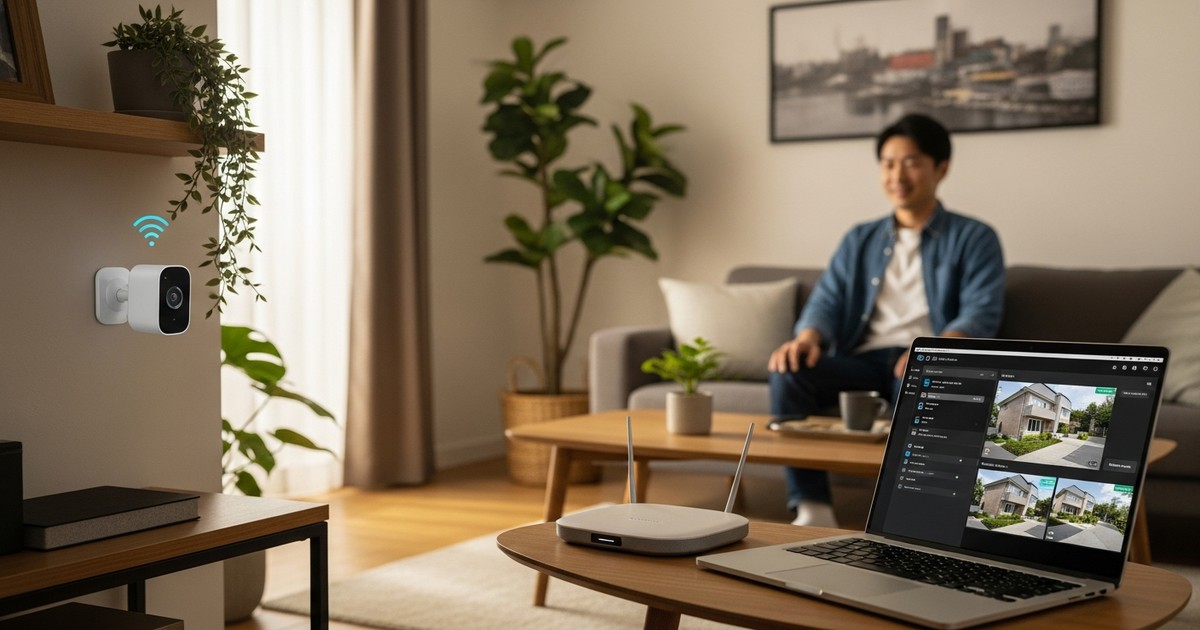
In practice, most well-configured Japan vacation rentals use exterior cameras at the entrance (often combined with a video doorbell) and, where layout permits, in the genkan (entrance hall) — an area that is functionally a threshold space rather than a living area. This gives you meaningful oversight of who enters and exits and when, without compromising guest privacy.
Smart Devices That Actually Add Value
Beyond CCTV, a range of smart devices can give an overseas owner genuine operational visibility. The key word is genuine — there is a tendency to over-engineer these systems with devices that generate noise rather than signal. The following are the categories that consistently deliver useful data.
Smart Locks
A keypad or app-controlled smart lock is arguably the single most important piece of technology in a remotely managed Japan rental. It eliminates the need for physical key handover (a logistical challenge when you cannot be present), generates an entry log that timestamps every access event, and allows your management company to issue and revoke access codes for each guest stay, each cleaning visit and each maintenance call. That entry log is your primary tool for verifying that check-in and check-out happened as recorded and that no unauthorised access occurred during vacancy periods.
When evaluating a smart lock for a Japanese property, ensure it is compatible with Japanese door furniture, which often differs from European and American standards, and that it has a battery-low alert function. A lock that fails during a guest stay is an operational crisis that falls on your management company to resolve — ask them how they handle it before it happens.
Noise Monitoring Devices
Noise monitors measure ambient sound levels in decibels without recording audio content, which means they are legally and ethically distinct from microphones or listening devices. In Japan’s densely populated urban neighbourhoods — the very neighbourhoods where short-term rentals perform best commercially — neighbour relations are critically important. An unaddressed noise complaint can escalate to a municipal authority notification and jeopardise your licence. A noise monitor that alerts your management company when decibel levels exceed a set threshold at an unusual hour allows for rapid intervention before a complaint is filed.
Environmental Sensors
Temperature, humidity and CO₂ sensors are particularly relevant in Japan, where summer humidity can cause rapid mould growth in properties that are not properly ventilated between stays. A sensor that logs environmental conditions gives you a continuous record, helps your management company identify ventilation or air-conditioning issues early, and protects the fabric of the building. In older machiya or traditional properties, this kind of monitoring is especially important because the building materials — wood, washi paper, natural plaster — are sensitive to humidity fluctuations.
Smart Electricity and Water Monitoring
A smart meter or circuit-level energy monitor allows you to verify that utilities are being used within expected ranges. An unexpectedly high electricity reading during a vacancy period may indicate that air conditioning or heating has been left running — a cost issue and potentially a maintenance signal. Unusually high water consumption during a guest stay that extends beyond normal usage patterns is worth querying. These data points are not accusations; they are prompts for your management company to investigate and report back.
Comparing Remote Oversight Approaches
Different configurations of technology suit different property types and risk tolerances. The table below summarises the most common approaches and their trade-offs.
| Approach | Devices Involved | What It Covers | Main Limitation | Best Suited To |
|---|---|---|---|---|
| Entry-only monitoring | Smart lock, video doorbell | Check-in/out verification, access log | No insight into interior condition or noise | Lower-value urban apartments, newer builds |
| Entry plus environmental | Smart lock, noise monitor, humidity/temp sensor | Access log, neighbour risk, building condition | No visual record of exterior area | Mid-range properties in residential neighbourhoods |
| Full perimeter monitoring | Smart lock, exterior CCTV, video doorbell, noise monitor, environmental sensors | Comprehensive access and condition record | Higher installation cost; requires robust data policy | High-value traditional properties, ryokan, multi-unit buildings |
| Full perimeter plus utility monitoring | All of the above plus smart electricity/water meter | Full operational picture including running costs | Most complex to manage; requires integrating data streams | Premium ryokan, investors with multiple Japan properties |
What Good Reporting Looks Like From a Management Company
Technology only adds value if the data it generates is translated into clear, actionable reports. An overseas owner should be receiving structured reporting from their management company on a regular cycle. If you are currently receiving nothing more than a monthly revenue transfer and an informal message, you are operating with inadequate visibility.
A well-run Japan rental management operation should provide you with, at minimum, the following on a monthly basis.
- Booking and occupancy summary: Nights booked, nights vacant, operating days used against the annual minpaku allowance (if applicable), and average daily rate achieved versus the rates listed.
- Revenue and fee breakdown: Gross revenue received from OTAs, OTA commission deducted (typically in the range of ten to twenty percent depending on platform and property type), management fee deducted, cleaning fees collected and cleaning costs incurred. These should be presented as separate line items, not as a single net figure.
- Maintenance log: Any issues identified during cleaning or reported by guests, action taken, cost incurred and, where relevant, photographic evidence.
- Smart device summary: A readable digest of any alerts triggered — noise events, unusual utility readings, access outside scheduled periods — and how each was resolved.
- Guest review summary: A compilation of new reviews posted during the period, with a note on any recurring feedback themes that may warrant action.
Quarterly reporting should additionally cover your cumulative financial position, including any Japanese consumption tax considerations. Non-resident property owners in Japan are subject to Japanese withholding tax on rental income, typically at a rate applied to gross income above a threshold, and depending on your residency and the existence of a tax treaty between Japan and your home country, your obligations and entitlements will differ. Your management company is not a tax adviser, but they should be providing you with the raw income and expense data in a format that your accountant (or a Japanese tax specialist) can work with directly.
Questions to Ask a Management Company Before Signing
If you are evaluating management companies — or reviewing the performance of your current one — the following questions are specifically designed for the overseas owner context and for the Japan regulatory environment.
On Technology and Oversight
- Which smart devices do you currently have installed at comparable properties, and who owns and maintains them?
- Can I access smart lock entry logs directly, or do I rely on you to provide them?
- How are noise alerts handled outside business hours, and what is your documented response procedure?
- What is your data retention policy for CCTV footage, and is it compliant with APPI?
On Compliance and Licensing
- Will you confirm in writing which licensing category my property operates under, and provide copies of the relevant registrations?
- How do you track operating days against the annual minpaku allowance, and how often will you report that figure to me?
- Are you monitoring municipal-level regulatory changes in the ward where my property is located?
- What happens operationally if a regulatory change requires us to halt bookings mid-season?
On Reporting and Finances
- Will you provide itemised monthly statements showing OTA fees, cleaning costs and your management fee as separate figures?
- In what format do you provide annual income summaries for tax purposes?
- Do you have a relationship with a Japanese tax specialist who works with non-resident property owners?
- How are security deposit claims handled, and what documentation do you provide to support a claim?
The Operator Difference
There is a meaningful distinction between a management agent and a management operator. An agent lists your property, handles bookings and coordinates third parties. An operator takes responsibility for the outcome — guest experience, property condition, regulatory compliance — and has the systems and staff to back that up. For an overseas owner who cannot visit the property, this distinction is not semantic. It determines whether problems are flagged to you for resolution or resolved before they become problems at all.
Remote oversight technology — CCTV, smart locks, environmental sensors and structured data reporting — is most powerful in the hands of an operator who has already built the processes to act on what those devices reveal. The technology does not replace judgment or local knowledge. What it does is create a shared, documented reality that an overseas owner can interrogate, verify and rely upon.
Japan’s vacation rental market remains genuinely attractive for overseas investors willing to engage seriously with its legal and operational complexity. The 180-day cap, the licensing distinctions, the municipal variation, the tax obligations — none of these are insurmountable. What they require is a management partner who treats transparency as a professional standard, not as a courtesy. The right combination of remote technology and rigorous reporting means that your investment in Japan can perform for you, and be protected, regardless of which time zone you are in.