Leave Your Minpaku Property Management to Us
Free Online ConsultationRunning a Minpaku in a Nagaya (Row House)? Understand the Fire Code’s “Nagaya Special Exception”
The “nagaya” (row house/terrace house) is a building type that preserves the charm of old Japan.
Commonly found in Osaka’s old downtown districts and the back alleys of Kyoto, these buildings hold enormous potential to be transformed into highly popular accommodation facilities for inbound tourists, thanks to their unique structure and historical value.
However, when operators try to use a nagaya for minpaku (particularly for full-year, 365-day ryokan business), many of them run into a major obstacle that forces them to give up on the project. That obstacle is the **Fire Service Act**.
Let us give you the conclusion of this article up front.
The trump card for successfully launching a minpaku in a nagaya is the **”Nagaya Special Exception” (deemed-separation provision)**.
If this exception can be applied, then instead of installing expensive fire safety equipment throughout the entire building—including your neighbors’ units—you only need to install it in the section you operate. This can dramatically reduce your initial investment and make a project that once seemed impossible actually achievable.
In this article, we thoroughly break down—in plain language—the mechanics of this “special exception” that can determine the success or failure of a nagaya minpaku, along with the conditions required to qualify for it and important points of caution.
Why Is the Fire Service Act the Biggest Hurdle for Nagaya Minpaku?
To understand how valuable the Nagaya Special Exception truly is, you first need to understand how a “nagaya” is treated under the Fire Service Act.
Legally, a Nagaya Is “One Single, Large Building”
To our eyes, a nagaya looks like a row of independent houses joined together, each with its own separate entrance. However, under the Building Standards Act and the Fire Service Act, a nagaya is treated as **”one large building that shares walls.”** This is where all the problems begin.
The Terrifying “Interlocking Obligation”
Suppose you start a minpaku in one unit of a nagaya (for example, the end unit of a four-unit row house). Under the Fire Service Act, this is treated as “a portion of that building has become a lodging facility.”
Depending on the scale of the building (total floor area), you may be legally required to install an **”automatic fire alarm system” (jikaho)**.
Here’s the terrifying part: because a nagaya is treated as “one building,” you may be required—at your own expense—to install fire alarm sensors not only in your own unit, but also inside the units of your “neighbors” and even “the neighbor’s neighbor,” who have nothing to do with your minpaku business, and to wire them all together in an interlocked system.
The difficulty of negotiating access to conduct construction work inside other people’s homes, combined with the enormous construction costs involved—this is the biggest reason nagaya minpaku is said to have such a high barrier to entry.
The Game-Changing Solution: What Is the “Nagaya Special Exception”?
What rescues you from this seemingly hopeless situation is an operational framework based on a notification issued by the Fire and Disaster Management Agency of Japan (such as Notification No. 205 from the Fire Defense Bureau)—commonly known as the **”Nagaya Special Exception.”**
An Exception That Lets You “Treat Units Separately”
Put simply, this rule states: **”If certain conditions are met, then even in a nagaya, each individual unit may be deemed a completely separate, independent building for the purposes of applying the Fire Service Act.”**
If this exception is applied, your unit will be treated as an “independent, small-scale building.” As a result:
- You no longer need to install sensors in your neighbors’ units
- Instead of expensive, building-wide equipment, you can use an affordable “automatic fire alarm system for small specific-use facilities” (such as a wireless system)
This dramatically lowers both the physical hurdles and the cost of construction work. Fire safety work that was once estimated to cost several million to ten million yen can, in many cases, be brought down to just a few hundred thousand to about one million yen.
The 3 Essential Conditions Required to Qualify for the Exception
So, can any nagaya use this exception? Unfortunately, no. To qualify, the building’s structure must meet the following conditions.
Condition 1: The Unit Must Be Divided by “Fireproof-Rated Walls” with No Openings
This is the most critical hurdle.
The boundary wall between your unit and the neighboring unit must extend all the way up through the attic (roof space), and must be constructed of fire-resistant materials (equivalent to quasi-fireproof construction or better).
- Attic wall: In older nagaya, it’s common for the attic space to be connected to the neighboring unit’s attic. This allows fire to spread easily, meaning the exception cannot be applied. In such cases, construction work is needed to extend the wall up through the ceiling space and seal any gaps (known as a “partition wall” or kaikabe construction).
Condition 2: Each Unit Must Be “Independent”
Each dwelling unit must have its own entrance or back door leading directly outdoors, and must not share hallways or staircases with other units. In a typical nagaya, this condition is often already met.
Condition 3: Separation Distance for Openings (Windows, etc.)
Windows and other openings located near the boundary with the neighboring unit must be positioned in a way that minimizes fire-spread risk, or must be fitted with fire-resistant features (such as wired glass).
How Construction and Application Actually Proceed
To successfully launch a minpaku business using this exception, it’s essential to follow the correct procedure.
STEP 1: Property Inspection (Attic Check)
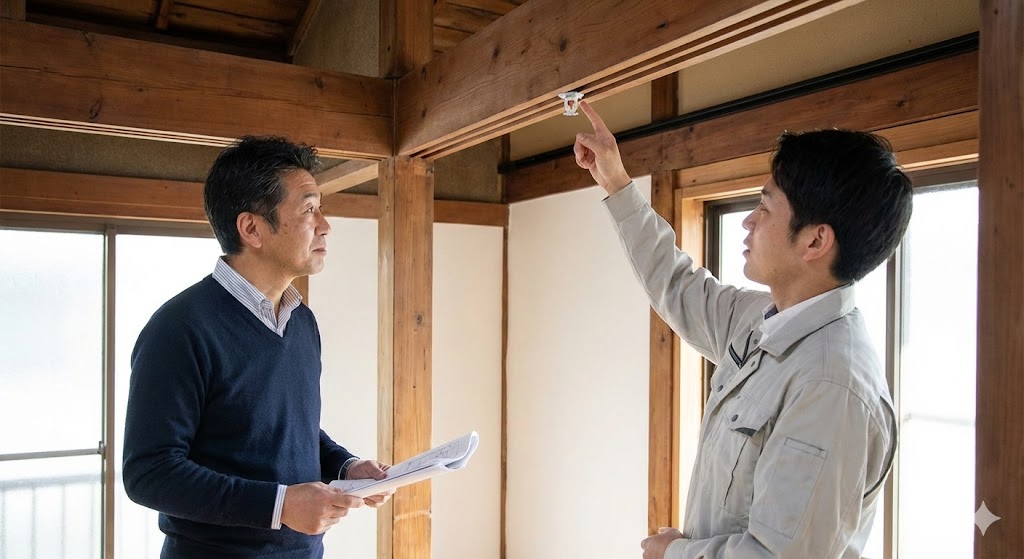
Before signing a contract for a property, always check the attic. Look inside from the storage space above a closet (tenbukuro), for example, to confirm whether there’s a solid wall between your unit and the neighboring one, with no gaps. If this space is connected, major renovation work will be required.
STEP 2: “Preliminary Consultation” with the Fire Department
Bring drawings (ideally both the current floor plan and your renovation plan) and consult with the prevention division of your local fire department. Ask specifically: “I want to operate a minpaku in this nagaya—can the special exception (deemed-separation provision) be applied?” Since interpretations and required standards can vary slightly by fire department, this step cannot be skipped.
STEP 3: Renovation Work and Installation of Fire Safety Equipment
Based on the fire department’s guidance, carry out reinforcement work on the partition wall (the wall separating you from your neighbor) and install equipment such as a fire alarm system for small specific-use facilities, emergency exit lights, and fire extinguishers.
In particular, partition wall construction also involves requirements under the Building Standards Act, so you’ll need to work with an architect or an experienced construction company.
STEP 4: Fire Inspection and Issuance of Compliance Notice
After construction is complete, an on-site inspection by the fire department will be conducted. Once you pass, a “Fire Service Act Compliance Notice” will be issued, which you’ll then use to apply for a ryokan (or minpaku) business license at the public health center.
Points of Caution and Risks When Using the Nagaya Special Exception
Don’t Underestimate the Cost of Partition Wall Construction
The construction work needed to qualify for the exception—sealing the wall between you and your neighbor all the way up to the ceiling space—can end up surprisingly expensive. In older nagaya, the wall may be made of crumbling clay (tsuchikabe), or wiring may be in the way; there are many factors you can’t know until you actually open things up. Even if you purchase a property cheaply, this construction work can easily blow your budget.
The “Noise” Problem Is Not Solved
Even if you clear the Fire Service Act requirements through the exception, this does nothing to fix the inherent structural weakness of nagaya buildings: poor soundproofing. Because you share a single wall with your neighbor, guest noise transmits directly through it. Along with fire safety construction, you should also consider soundproofing measures, such as adding sound-insulating sheets or sound-absorbing materials to the wall.
Local Government “Ordinances”
The Fire Service Act is national law, but its practical application—along with local ordinances related to minpaku (supplementary ordinances)—can vary between municipalities. For example, nagaya located deep within Kyoto’s narrow back alleys may be subject to separate, stricter standards as “areas difficult for firefighting activities.”
Summary: The Nagaya Special Exception Is a “Magic Wand”—But It Takes Expertise to Use It Properly
The Nagaya Special Exception is a powerful tool that makes nagaya minpaku achievable at a realistic investment level, in a scenario that would otherwise require enormous costs. By properly understanding and using this system, you can realize a charming old-house lodging business that’s hard for competitors to enter.
However, determining whether the exception can be applied requires an advanced level of knowledge in both building construction and fire safety law. If you move forward on a “probably fine” assumption, you could end up with an irreversible problem down the line.
Be sure to involve experts starting from the property-selection stage, and map out a solid, reliable roadmap.
Let Our Professionals Assess Your Nagaya Project
“There’s a nagaya property I’m interested in, but I’m not sure if it can clear the Fire Service Act requirements…”
“I have no way of checking the attic wall myself.”
“I want to understand the total finances, including renovation costs.”
If these concerns sound familiar, please feel free to consult with us.
Stay Buddy Inc. is a team of professionals with extensive experience launching lodging facilities in nagaya and traditional Japanese houses (kominka) throughout Osaka City.
We will:
- ① Assess whether the property you’re considering can qualify for the “Nagaya Special Exception,” including an on-site inspection.
- ② Provide cost estimates for the necessary fire safety equipment and partition wall construction, working together with our partner contractors.
- ③ Provide one-stop support, from preliminary consultations with the fire department through the complex application process.
Turn your old nagaya into a legally sound, highly profitable asset.
We’ll guide you along the shortest path to get there. It’s fine to reach out even while you’re still searching for a property—please feel free to contact us at any time.