The Big Picture: What You Need to Know About Turning a Vacant Home in Asahikawa Into an Accommodation Facility
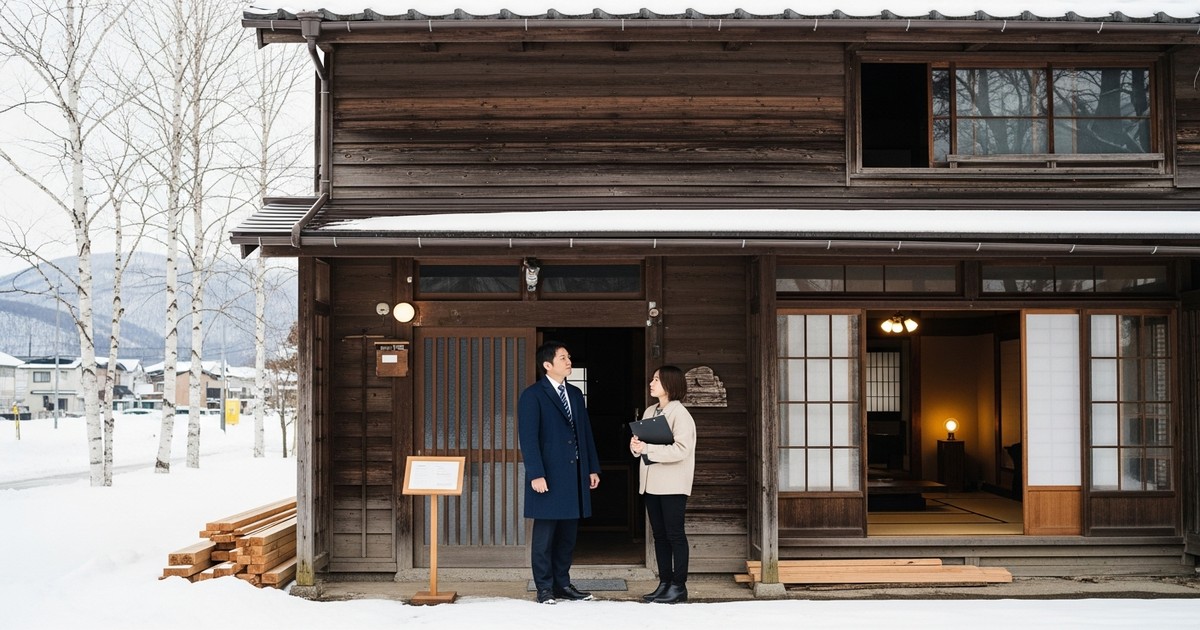
In Asahikawa, the growing number of vacant homes has become a serious issue, driven by population decline and an aging society. According to the Ministry of Internal Affairs and Communications’ Housing and Land Survey, the vacancy rate across Hokkaido, including Asahikawa, has been climbing year after year, with many wooden houses over 30 years old simply left abandoned. At the same time, Asahikawa serves as a gateway to Asahiyama Zoo and the Daisetsuzan mountain range, drawing more than five million visitors annually—meaning accommodation demand remains solid. This gap between supply and demand has put a spotlight on the trend of converting vacant homes and aging properties in Asahikawa into accommodation facilities.
That said, operating a vacant home as an accommodation facility requires clearing several legal hurdles—including the Building Standards Act, the Hotel Business Act, and the Fire Service Act—and the costs and procedures involved often exceed initial expectations. This article walks through the concrete steps and cost estimates involved, from acquiring a property to obtaining permits, completing renovations, and finally launching operations. We’ve aimed to give anyone considering repurposing a vacant home in Asahikawa a clear grasp of the overall process and the associated costs.
Cost Breakdown for Converting a Vacant Home in Asahikawa Into an Accommodation Facility
The costs of converting a vacant home into an accommodation facility generally fall into four categories: “property acquisition costs,” “renovation costs,” “equipment and furnishing costs,” and “permit and licensing costs.” In Asahikawa’s case, property acquisition costs are dramatically lower than in Sapporo or Tokyo, which is a major advantage. However, because cold-climate insulation and heating work is essential, renovation costs tend to run somewhat higher.
Below, we break down the general price range for each cost category. Please note that these figures are only rough estimates and can vary significantly depending on the property’s condition and size.
Property Acquisition Costs
Vacant detached wooden houses in Asahikawa that are 30 to 50 years old are often sold in the range of ¥1 million to ¥5 million. In residential areas about a 10-minute drive from the city center, it’s not uncommon to find properties—including land—priced in the ¥2 million to ¥3 million range. Using Asahikawa City’s vacant home bank or real estate portal sites can also help you find even more affordable options. It’s advisable to avoid properties with unpaid property taxes or complicated ownership issues.
Renovation Costs
Renovating an aging property to a standard suitable for accommodation use typically costs between ¥5 million and ¥15 million. Broadly, interior work (replacing walls, floors, and ceilings, and reconfiguring the layout) runs ¥2 million to ¥5 million; plumbing work (replacing kitchens, bathrooms, and toilets) costs ¥1.5 million to ¥4 million; and insulation/heating work costs ¥1 million to ¥3 million. Since temperatures in Asahikawa can drop below minus 20°C in winter, installing double-paned windows, reinforcing exterior wall insulation, and upgrading heating systems are essential—and this tends to add an extra ¥1 million to ¥2 million compared with properties in mainland Japan (Honshu).
Equipment and Furnishing Costs
To operate as an accommodation facility, you’ll need to furnish the property with furniture, appliances, bedding, Wi-Fi routers, and other essentials. Per property, this typically runs ¥800,000 to ¥2 million. Furnishing a unit with four beds, a sofa, a dining set, a TV, a washing machine, a refrigerator, a microwave, and a full set of cookware—all brand new—costs around ¥1.5 million, while using secondhand items or leasing can bring this down to roughly ¥800,000 to ¥1 million. You should also budget around ¥50,000 to ¥100,000 for the initial stock of guest amenities such as towels, shampoo, and toothbrushes.
Permit and Licensing Costs
The application fee for a permit under the Hotel Business Act is approximately ¥22,000 in Asahikawa City. However, before applying, you’ll need to cover the costs of installing fire safety equipment and confirming compliance with the Building Standards Act. Installing fire safety equipment (automatic fire alarms, emergency exit lights, fire extinguishers, etc.) typically costs ¥300,000 to ¥800,000. If you hire a certified administrative scrivener (gyoseishoshi) to handle the permit application process, expect to pay a fee of ¥150,000 to ¥300,000. Additionally, if a confirmation application for a change of use is required, you should budget around ¥200,000 to ¥500,000 for design fees paid to an architect.
Permits and Legal Procedures You Must Clear
When converting a vacant home in Asahikawa into an accommodation facility, you’ll generally need to obtain a business permit under either the Hotel Business Act or the Private Lodging Business Act (the “Minpaku Law”). Since the regulations and the maximum number of operating days differ between the two frameworks, it’s important to choose the approach that best fits your business plan. In addition, regardless of which framework you choose, you must also satisfy the requirements of the Building Standards Act and the Fire Service Act to operate legally.
The typical timeline for obtaining all necessary permits, starting from the property contract, is about two to four months. Since this includes preliminary consultations, fire safety equipment installation, preparation of application documents, and on-site inspections, it’s wise to build in some buffer when planning your schedule.
Permits Under the Hotel Business Act (Simple Lodging Business License)
If you want to operate year-round with no limit on the number of operating days, obtaining a “simple lodging business” (kan’i shukusho) license under the Hotel Business Act is the standard route. In Asahikawa, applications are filed with the public health center (Asahikawa City Public Health Center). To obtain a simple lodging license, requirements include: guest rooms having a total floor area of at least 33 square meters, ventilation/natural lighting/artificial lighting meeting certain standards, and toilets and washbasins being appropriately arranged. Regarding the requirement to have a front desk (genkan-choba), recent legal amendments have made it possible in some cases to substitute this with ICT devices, so be sure to confirm the current rules with the public health center in advance.
Notification Under the Private Lodging Business Act (Minpaku Law)
If operating within a limit of 180 days per year is acceptable for your business, you can use the notification system under the Private Lodging Business Act instead. Notifications are submitted to the prefectural governor (the Governor of Hokkaido), and there is no fee involved. Compared with the simple lodging license, the equipment requirements are more relaxed, and in many cases the standard facilities of an ordinary house are sufficient—this is a key advantage. That said, Asahikawa City and Hokkaido may impose additional restrictions on operating areas or periods through local ordinances, so be sure to check the latest ordinance details. Since the 180-day annual cap directly affects profitability, it’s important to run the numbers in advance to confirm you can achieve sufficient returns as a business.
Change of Use Under the Building Standards Act
Converting a residential property into an accommodation facility falls under a “change of use” as defined by the Building Standards Act. Following a 2019 amendment to the law, the floor area threshold that triggers the requirement for a confirmation application in connection with a change of use was raised from 100 square meters to 200 square meters. Since typical detached houses in Asahikawa generally have a total floor area of around 100 to 150 square meters, in most cases a confirmation application will not be necessary, provided the property is under 200 square meters. However, even when a confirmation application isn’t required, the property must still comply with the substantive provisions of the Building Standards Act (such as fire compartmentation and evacuation routes), so it’s recommended that you have an architect conduct a preliminary check.
Fire Service Act Requirements and Equipment Installation
Because accommodation facilities are classified as “specified fire-protected objects” under the Fire Service Act, they are subject to stricter fire safety equipment standards than ordinary residences. Specifically, automatic fire alarm systems (mandatory regardless of total floor area), emergency exit lights, and fire extinguishers are all required. A preliminary consultation with the Asahikawa City Fire Department can help you determine the specific equipment needed for your property. After installing the fire safety equipment, you must undergo an inspection by the fire department and obtain a “Certificate of Compliance with Fire Service Laws and Regulations.” Without this certificate, your Hotel Business Act permit application won’t be accepted, so this should be the very first procedure you tackle.
Things to Watch Out for in Asahikawa—and Keys to Success
Converting a vacant home into an accommodation facility in Asahikawa comes with cold-climate challenges that differ from those found in mainland Japan or major urban centers. At the same time, by leveraging Asahikawa’s location and tourism assets, you can carve out a unique competitive edge that other areas simply can’t match.
First and foremost, winter freeze prevention is a top priority. Investments such as heat-tracing tape to prevent frozen pipes, snow-load mitigation measures for the roof (snow-guard brackets and heating elements to prevent falling snow), and road heating around the entrance are all essential for ensuring guest safety and comfort. It’s wise to budget an additional ¥300,000 to ¥800,000 for these measures. If the property is unstaffed, outsourcing snow removal will cost roughly ¥30,000 to ¥50,000 per month during the winter season (November through March).
On the other hand, Asahikawa offers unique strengths, including a location about 30 minutes by car from Asahiyama Zoo and roughly an hour from the Furano-Biei area. In winter, it also functions as a gateway to ski resorts, meaning you can expect demand for accommodation year-round. It’s also conveniently located about 30 minutes by car from Asahikawa Airport to the city center, making it highly accessible for inbound travelers as well. Nightly rates for a whole-property rental (accommodating 4-6 guests) typically run ¥15,000 to ¥30,000, with the potential to achieve occupancy rates of 70-80% during peak seasons (summer tourist season and winter ski season).
Total Cost Simulation and Estimated Payback Period
Let’s now add up all the costs discussed so far and run a simulation of the total investment required to convert an aging vacant home in Asahikawa into a whole-property rental accommodation facility. Assuming a property acquisition cost of ¥3 million, renovation costs of ¥8 million, equipment and furnishing costs of ¥1.2 million, fire safety equipment installation costs of ¥500,000, and permit-related costs of ¥400,000, the total initial investment comes to approximately ¥13.1 million.
On the revenue side, assuming an average nightly rate of ¥20,000 and an annual occupancy rate of 60% (roughly 219 nights occupied), annual revenue would come to approximately ¥4.38 million. Subtracting annual operating expenses (cleaning fees, utilities, communication costs, consumables, snow removal, management fees, etc.) of ¥1.5 million to ¥1.8 million leaves an annual net profit of roughly ¥2.6 million to ¥2.9 million. Under this calculation, the payback period for the initial investment would be approximately 4.5 to 5 years. Of course, this figure will vary significantly depending on the property’s acquisition cost and the scope of renovation work, but Asahikawa’s low property acquisition costs are a key factor in accelerating the return on investment.
Struggling With Accommodation Operations Using a Vacant Home? Talk to Stay Buddy Inc.
Converting a vacant home in Asahikawa into an accommodation facility requires extensive specialized knowledge and effort across property selection, renovation, permit acquisition, and building an operational structure. In particular, navigating the Hotel Business Act and the Fire Service Act can be daunting for first-timers, and this is an area where mistakes and rework are common without expert support.
Stay Buddy Inc., a minpaku management agency, provides one-stop support for everything accommodation operators need—from property selection and permit acquisition assistance to guest acquisition, cleaning, and guest support once operations are underway. We’re also happy to advise on business planning and financial simulations for repurposing vacant homes.
Whether you’re thinking “I have a vacant home but don’t know how to make use of it,” “the permit process seems complicated and I’m worried,” or “I’m looking for a partner I can trust to handle operations,” we welcome inquiries at any stage. Please don’t hesitate to get in touch with Stay Buddy Inc.