Leave Your Minpaku Management to the Experts
Free Online ConsultationIf you’re planning to start a ryokan (traditional inn) business or thinking about renovating an existing property, understanding regulations like the Fire Service Act and the Building Standards Act is an unavoidable challenge. You may have come across the term “vertical shaft compartmentalization (tateana kukaku),” which plays a crucial role in ensuring building safety.
This vertical shaft compartmentalization plays an extremely important role in preventing fire spread and ensuring safe evacuation routes for guests. However, many people find the concept and specific requirements complex and difficult to understand without specialized knowledge.
“What exactly is vertical shaft compartmentalization?”
“Why is it necessary for the ryokan business?”
“How should I handle this at my own property?”
For those with these kinds of questions, this article will clearly explain everything from the basics of vertical shaft compartmentalization to its importance in the ryokan business and specific countermeasures you can take. We’ll break down the complex building and fire codes as simply as possible, so please read through to the end to help with your ryokan operations.
What Is Vertical Shaft Compartmentalization? Understanding the Basics
First, let’s look at the basic concept behind the term “vertical shaft compartmentalization.”
1. Fire Compartmentalization That Prevents the “Chimney Effect” During a Fire
Vertical shaft compartmentalization is a type of fire compartmentalization defined under the Building Standards Act. It aims to prevent the “chimney effect“—where flames and smoke rapidly spread through vertical spaces within a building that connect multiple floors, such as atriums, stairwells, elevator shafts, and duct spaces during a fire.
Imagine a fire breaking out inside a building. If there’s nothing separating the floors, flames and smoke can reach the top floor in no time. Smoke in particular spreads faster than flames, obscures visibility, and affects breathing, making evacuation extremely difficult. This chimney effect can cause fire damage to become severe in a very short amount of time.
Vertical shaft compartmentalization requires that certain spaces be enclosed (separated) using fire-resistant walls, floors, and fire doors to prevent this kind of vertical fire spread. This helps slow the spread of fire and smoke from the floor of origin to other floors, buying time for evacuation and supporting firefighting efforts.
2. What Kind of “Vertical Shaft” Spaces Are Covered
Specifically, the “vertical shafts” subject to this compartmentalization requirement refer to spaces that penetrate multiple floors, such as:
- Stairwells: The staircase and surrounding space within a building.
- Elevator shafts: The vertical passage used by elevators.
- Atriums: Open spaces spanning multiple floors.
- Pipe spaces and duct spaces: Vertical spaces containing electrical wiring, plumbing, and air conditioning ducts.
- Escalators: In some cases, escalator spaces found in commercial facilities are also included.
Because of their structure, these spaces are prone to becoming pathways for fire spread, which is why proper compartmentalization is required.
The Importance of Vertical Shaft Compartmentalization in the Ryokan Business
So why is vertical shaft compartmentalization especially important for the ryokan business?
1. Ensuring the Safety of an Unspecified Large Number of Guests
Accommodation facilities such as ryokan and hotels host an unspecified large number of guests. Unlike at home, guests are usually unfamiliar with the building’s layout and evacuation routes. If a fire breaks out at night in particular, it becomes extremely difficult for sleeping guests to quickly grasp the situation and evacuate safely.
Under these circumstances, properly implemented vertical shaft compartmentalization can suppress the spread of fire and keep evacuation routes safe for a certain period of time. This buys guests time to calmly evacuate, minimizing the risk to human life. This is fundamental to the most important aspect of running a ryokan business: ensuring guest safety.
2. Legal Obligations and Government Guidance
Facilities operating as ryokan are required to implement fire prevention measures under various laws, including the Building Standards Act, the Fire Service Act, and local fire prevention ordinances. The installation of vertical shaft compartmentalization is strictly regulated by these laws.
- Building Standards Act: Requires fire compartmentalization based on total floor area and number of stories. In particular, buildings with three or more stories, or buildings above a certain size, are often required to have vertical shaft compartmentalization.
- Fire Service Act: In addition to installing fire safety equipment (such as automatic fire alarms and sprinklers), maintaining the fire resistance performance of compartmentalized spaces is required.
Failure to comply with these legal obligations constitutes a violation of the Building Standards Act or the Fire Service Act, potentially resulting in administrative guidance, improvement orders, or in the worst case, suspension of business operations. Furthermore, if a fire were to occur and damage were to spread due to inadequate vertical shaft compartmentalization, the business operator could also face legal and social liability.
3. Business Continuity and Trust
A fire not only puts lives at risk but can also make it impossible to continue business operations due to building damage or forced closure. Proper vertical shaft compartmentalization reduces fire risk and is essential to enhancing business continuity.
Additionally, facilities that actively invest in safety measures build greater trust with guests. A reputation for having solid safety measures in place gives guests peace of mind, which can positively impact bookings as well.
Specific Requirements and Measures for Vertical Shaft Compartmentalization
What points should you pay attention to when actually implementing vertical shaft compartmentalization?
1. Compartmentalization Using Fire-Resistant Walls and Floors
The basis of vertical shaft compartmentalization is enclosing the space with fire-resistant walls and floors that won’t burn through for a certain period of time even in the event of a fire.
“Fire-resistant construction” refers to structures made from materials with fire resistance performance as defined by the Building Standards Act, such as concrete, ALC panels, and fire-resistant boards. By fully enclosing spaces like stairwells and elevator shafts with these materials, the intrusion of flames, heat, and smoke can be prevented.
Specifically, the thickness of walls and floors, the type of materials, and the structural design are all subject to detailed regulations, making collaboration with architects and fire safety equipment specialists essential. When renovating an existing building, construction work must be carried out to meet these standards.
2. Installing Fire Doors and Fire Shutters
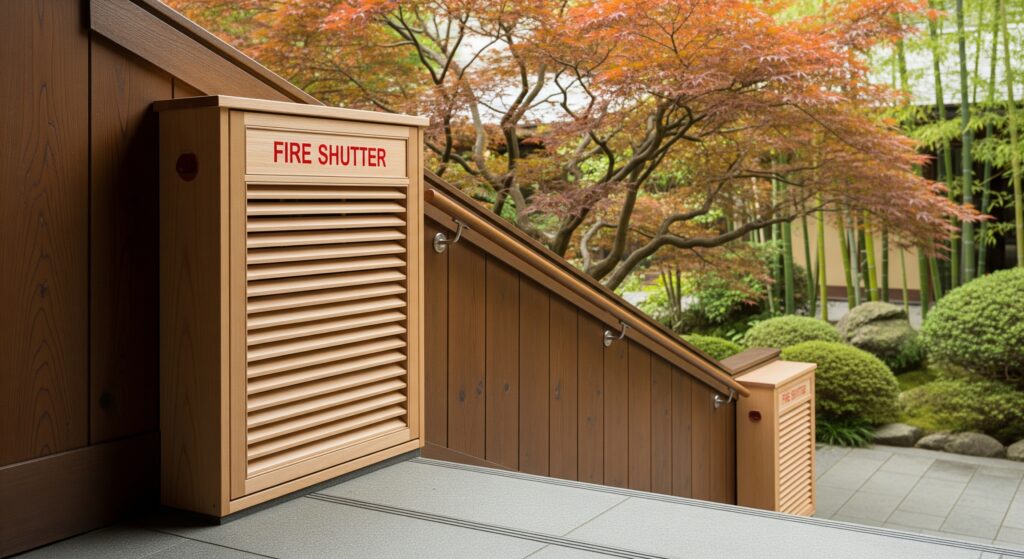
Entrances to compartmentalized spaces (such as stairwell doors and elevator doors) are required to have fire doors (either specified fire safety equipment or standard fire safety equipment) or fire shutters installed. These devices automatically close or lower during a fire, maintaining the integrity of the compartment.
- Specified fire safety equipment: Equipment that can maintain fire-blocking performance for one hour or more. This typically includes fire shutters and high-performance fire doors.
- Standard fire safety equipment: Equipment that can maintain fire-blocking performance for 20 minutes or more. This typically includes standard fire doors.
While these devices are opened and closed on a daily basis, they must be of the “closes-on-demand type,” meaning they automatically close when heat or smoke is detected during a fire. Installing fire dampers and fire-resistant sealing materials around fire doors to eliminate gaps is also important. Additionally, placing objects in front of fire doors or shutters, or keeping them permanently propped open, must be strictly avoided, as this compromises the function of the compartment.
3. Measures for Other Openings
Even within a vertical shaft compartment, if there are openings such as windows or ventilation ports, appropriate fire prevention measures are necessary.
- Fire-resistant windows: If windows are present, fire-resistant glass such as heat-resistant glass or wired glass must be used.
- Fire dampers: If ducts pass through a vertical shaft compartment, a fire damper that automatically closes during a fire to prevent fire spread must be installed.
4. Proper Maintenance and Inspection
Installing vertical shaft compartmentalization is not the end of the process. Regular inspection and proper maintenance are essential to keeping it functioning correctly.
- Regular inspections: Be sure to have a licensed fire safety equipment technician regularly inspect fire doors and shutters to confirm they operate properly and that the automatic closing mechanisms have no issues.
- Day-to-day management: Thorough daily management is also necessary, such as not placing objects in front of fire doors and not propping them open with stoppers.
- Repairs: If any damage or malfunction is discovered, prompt repairs must be made to keep the system in optimal condition at all times.
Because these measures require specialized knowledge, it’s extremely important to work closely with architects, licensed fire safety equipment technicians, or specialized fire compartmentalization contractors. Never attempt to handle these matters on your own—always seek expert advice.
Leave Your Minpaku Management to the Experts
Free Online ConsultationSafety Measures for a Successful Ryokan Business
Vertical shaft compartmentalization is just one of many safety measures required in the ryokan business. Nevertheless, its importance is extremely high, forming a foundational part of your business operations.
1. Working with Building Standards Act and Fire Service Act Specialists
When considering opening or renovating a ryokan business, be sure to consult with specialists in the Building Standards Act and Fire Service Act (such as architects and licensed fire safety equipment technicians) to receive proper guidance. They can accurately advise you on the necessary vertical shaft compartmentalization and other fire prevention measures based on your facility’s size, structure, and intended use.
By involving specialists early on, you can avoid the risk of major rework later and move your plans forward smoothly.
2. Developing a Comprehensive Fire and Disaster Prevention Plan
Beyond vertical shaft compartmentalization, ryokan facilities are required to develop and implement a comprehensive fire and disaster prevention plan, including the following:
- Installation and inspection of automatic fire alarm systems
- Installation of sprinkler systems (depending on facility size)
- Securing and marking evacuation routes
- Installation of emergency lighting
- Installation of fire extinguishers and training on their use
- Creation of a fire safety plan and implementation of drills (evacuation guidance, initial firefighting, etc.)
- Appointment of a fire safety manager (depending on facility size)
When these measures work together organically, they can minimize damage in the event of a fire and maximize guest safety.
3. Raising Safety Awareness Among Guests
It’s also important for guests to understand what to do in the event of an emergency.
- Post an evacuation route map in a visible location within each guest room.
- Clearly indicate the location of emergency exits and fire extinguishers.
- Briefly explain emergency procedures at check-in.
These efforts not only prepare you for a worst-case scenario but also demonstrate the facility’s strong commitment to safety, helping to build guest trust.
Conclusion
Vertical shaft compartmentalization is a critical fire safety measure that cannot be avoided when running a ryokan business. It’s one of the essential fire compartmentalization methods that prevents fire and smoke from spreading through vertical spaces connecting multiple floors, ensuring guests have the time they need to evacuate safely.
Since ryokan businesses host an unspecified large number of guests, protecting lives in the event of a fire is the top priority. Vertical shaft compartmentalization is both a legal obligation and a crucial factor in maintaining business continuity and social trust.
The main requirements for maintaining the function of vertical shaft compartmentalization include fire-resistant walls and floors, the installation of fire doors and fire shutters, and their ongoing inspection and maintenance. Since these require specialized knowledge, be sure to work with architects and licensed fire safety equipment technicians to carry out proper planning and construction.
Investing in safety is never a wasted cost. It’s the foundation that protects your guests’ lives and ensures the long-term success of your ryokan business.
Contact Stay Buddy for Questions About Fire Safety Equipment in Your Ryokan Business
Do you have questions like “I want to learn more about fire compartmentalization for the ryokan business,” “I’m not sure what fire prevention measures are needed at my facility,” or “I’m struggling to interpret the complex Building Standards Act and Fire Service Act”? If you have any concerns about opening or operating a ryokan business, we’re here to help.
At Stay Buddy Inc., our expert team has extensive practical experience with special zone minpaku licenses, ryokan business permits, fire safety equipment, and Building Standards Act compliance. We provide specific countermeasures tailored to your property and support to help you clear regulatory requirements. Putting your guests’ safety first, let’s work together toward building a ryokan you can operate with confidence for years to come. Feel free to reach out to us anytime.