The Complete List of Facilities Required to Obtain a Ryokan Business License and Operate a Hotel in Osaka City
With the 2025 Osaka-Kansai Expo on the horizon, Osaka is drawing more international attention than ever before as a global city. To run a full-fledged, 365-day-a-year hotel or simple lodging business in this vibrant city, you absolutely need the operating license known as **”Ryokan Business”** (Ryokan-gyo) permission.
However, the path to obtaining this license is a meticulous, highly technical process that requires you to satisfy, without exception, every single strict facility standard set by both the national government and Osaka City.
Let’s start with the conclusion of this article.
The key to successfully obtaining Ryokan Business permission is to hold a “pre-consultation” with the jurisdictional public health center and fire department at the very earliest stage—before you even begin designing or constructing your property—so you can accurately grasp the full picture of what facilities your property will require.
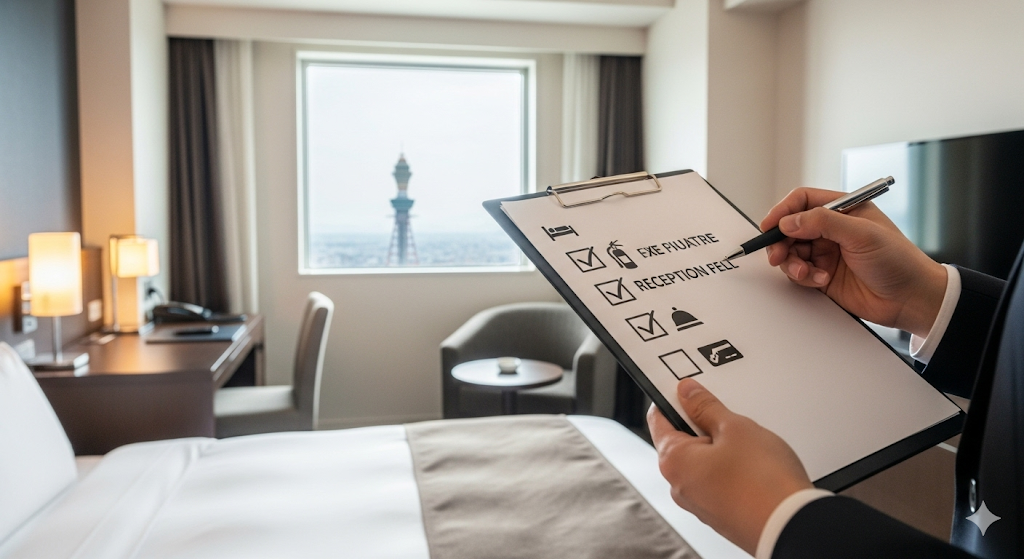
To help you move forward with confidence as you prepare for this pre-consultation and the formal application, this article provides a thorough, comprehensive checklist detailing exactly what facilities are needed to obtain a Ryokan Business license in Osaka City.
The Fundamentals: “Hotel Operations” and “Simple Lodging Operations” Under the Ryokan Business Act
The Ryokan Business Act contains several categories depending on the type of facility. For lodging businesses in Osaka City, the following two are primarily relevant:
- Hotel Operations: This is the standard for what we typically think of as a “hotel”—requiring 10 or more guest rooms, each with a floor area of at least 9㎡. Western-style construction is the basic requirement.
- Simple Lodging Operations: These are facilities that can have shared-room configurations (such as dormitories or multi-guest rooms) used by multiple unrelated guests. If you plan to run a typical “minpaku” property year-round, obtaining Simple Lodging Operations permission is the mainstream route. While the total floor area of guest rooms must generally be at least 33㎡, this requirement is relaxed to “at least 3.3㎡ per guest” when accommodating fewer than 10 guests, making it achievable even for relatively small properties.
This article will primarily focus on “Simple Lodging Operations,” while covering the basic facility requirements common to both categories.
[Bookmark This] The Essential Facilities Checklist for Ryokan Business Permission
Category 1: Guest Room Facilities
- 1. Guest Room Capacity and Floor Area (Ryokan Business Act / Building Standards Act) — The total floor area of guest rooms must meet the required standard (generally at least 33㎡ for simple lodging, with relaxation measures available). You must also clear the per-guest area requirement.
- 2. Locking Mechanisms (Ryokan Business Act) — Each guest room entrance must have a locking mechanism that guests can operate from inside the room to protect their privacy.
- 3. Bedding (Ryokan Business Act) — You must provide clean bedding (futons, beds, pillows, sheets, and covers) appropriate to the facility’s capacity.
- 4. Lighting and Ventilation Systems (Building Standards Act / Ryokan Business Act) — For the health and comfort of guests, guest rooms must have windows that secure the effective daylighting area required by the Building Standards Act, or mechanical ventilation equipment (such as exhaust fans) of appropriate capacity.
Category 2: Front Desk (Reception) Facilities
- 5. Front Desk (Reception) or Alternative Equipment (Ryokan Business Act) — In principle, a front desk is required for recording guest registers, verifying identity, and handing over keys.
- 6. [Important] Alternative Measures Using ICT Equipment — Thanks to recent deregulation, Osaka City allows for the physical front desk requirement to be waived if the following ICT equipment requirements are met:
- A video camera or similar device capable of clearly confirming the guest’s face and passport.
- Equipment that allows for the secure handover of keys (such as smart locks or key boxes). This is an extremely important point for owners aiming for unmanned operation or reduced staffing.
Category 3: Sanitation and Plumbing Facilities
- 7. Sufficient Number of Toilets (Ryokan Business Act) — An appropriate number of toilets must be installed according to the facility’s capacity.
- 8. Sufficient Number of Washing Facilities (Ryokan Business Act) — The number of faucets must likewise correspond to the facility’s capacity. Equipment capable of supplying hot water is also required.
- 9. Appropriately Sized Bathing Facilities (Ryokan Business Act) — Bathing facilities such as a bathroom or shower room that guests can use are required.
Category 4: Safety and Disaster Prevention Facilities (Fire Service Act Related)
This is where the hurdles for obtaining a license become the highest, and the costs the greatest.
- 11. [Most Important] Automatic Fire Alarm System (Fire Service Act) — This system detects smoke or heat and alerts the entire building to a fire. Depending on the facility’s total floor area and structure, installation may be mandatory and require a substantial initial investment.
- 12. Emergency Exit Signs (Fire Service Act) — These are the lighting fixtures showing the direction of emergency exits and evacuation routes, featuring the familiar pictogram of a running person on a green background. They contain built-in batteries so they remain lit during power outages.
- 13. Fire Extinguishers (Fire Service Act) — An appropriate type and number of fire extinguishers must be installed according to the facility’s floor area.
- 14. Emergency Lighting Fixtures (Building Standards Act / Fire Service Act) — These lights turn on automatically during power outages to illuminate corridors and stairways, helping ensure safe evacuation.
- 15. Use of Flame-Retardant Items (Fire Service Act) — By law, curtains, carpets, blinds, and similar items used in guest rooms and hallways must be treated with flame-retardant processing to reduce flammability.
Category 5: Other Operational Facilities
- 16. Guest Register Maintenance — You need equipment (a paper ledger or an electronic device such as a computer) to accurately record and retain for three years information such as guests’ names, addresses, and occupations.
- 17. Entrance and Approach Lighting (Ryokan Business Act) — Sufficient brightness (illumination) must be secured around the entrance so guests arriving at night can enter and exit the facility safely without tripping or falling.
3 Key Points for Preparing Your Facilities
1. Never Move Forward Without a “Pre-Consultation”
We can’t stress this enough—it’s the fastest route to success. Before proceeding with design or construction based on your own judgment, always bring a complete set of your property’s drawings and hold a “pre-consultation” with both the jurisdictional public health center (Sanitation Inspection Office) and the fire department. Getting direct, expert guidance on exactly what level of facilities your specific property will need is the single biggest key to avoiding wasted investment and costly rework.
2. Collaboration with a Team of Specialists Is Essential
Finding a property that clears all of these complex legal requirements, developing design and construction plans, and negotiating with government authorities—it’s nearly impossible for an individual owner to handle this entire process alone. Building a reliable team of specialists—including an architect, an administrative scrivener (gyoseishoshi), and a construction company experienced with Ryokan Business license applications—is an absolute prerequisite for success.
3. Accurately Estimate Your Initial Investment (Initial Costs)
In particular, when installing an automatic fire alarm system or making major layout changes, facility-related costs can easily reach into the millions of yen. Making a detailed list of all facility expenses and accurately incorporating them into your business and funding plan is essential for stable management after opening.
Conclusion: What’s Really Required Is “Safety and Comfort Worthy of a Hotel”
The many facilities required to obtain a Ryokan Business license are not merely administrative hurdles. They all serve as proof that the facility you operate guarantees a minimum standard of safety and comfort as a “highly public lodging facility” welcoming a diverse range of guests.
The determination and preparation needed to clear this “hotel-level standard” form the unshakeable foundation for being loved and achieving long-term success in the massive market of Osaka.
Let Us, the Professionals, Solve That Complex “Facility Requirements” Puzzle for You
“What level of fire prevention equipment does my property actually need?”
“What exactly do I need to do for the alternative front desk measures?”
“Just thinking about negotiating with the health center and fire department makes me feel exhausted…”
These concerns are completely understandable. The process of obtaining a Ryokan Business license involves multiple laws intertwined in complex ways, and the interpretation of requirements and necessary documents varies enormously depending on the specific property. It’s not uncommon for even a single deficient facility to become a fatal obstacle that delays opening by months.
We at Stay Buddy Co., Ltd. are a team of professionals who have supported the acquisition of numerous Ryokan Business (Simple Lodging) licenses—starting from property searches—in the intensely competitive minpaku market of Osaka City.
- We carefully assess your business plan and your property’s potential, then work alongside our experienced partner architects and administrative scriveners to map out the fastest route to obtaining your license.
- From the most time-consuming and labor-intensive pre-consultations with the health center and fire department, to preparing and submitting the enormous volume of application documents, to attending on-site government inspections—we provide complete, one-stop support for every step of the process until you, as the owner, reach opening day.
What you should be focused on is envisioning “what kind of wonderful hotel do I want to create.”
Leave the complicated, difficult-to-navigate “facility requirements” puzzle entirely to our professional team in Osaka. We take full responsibility for delivering the fastest possible start to your business.