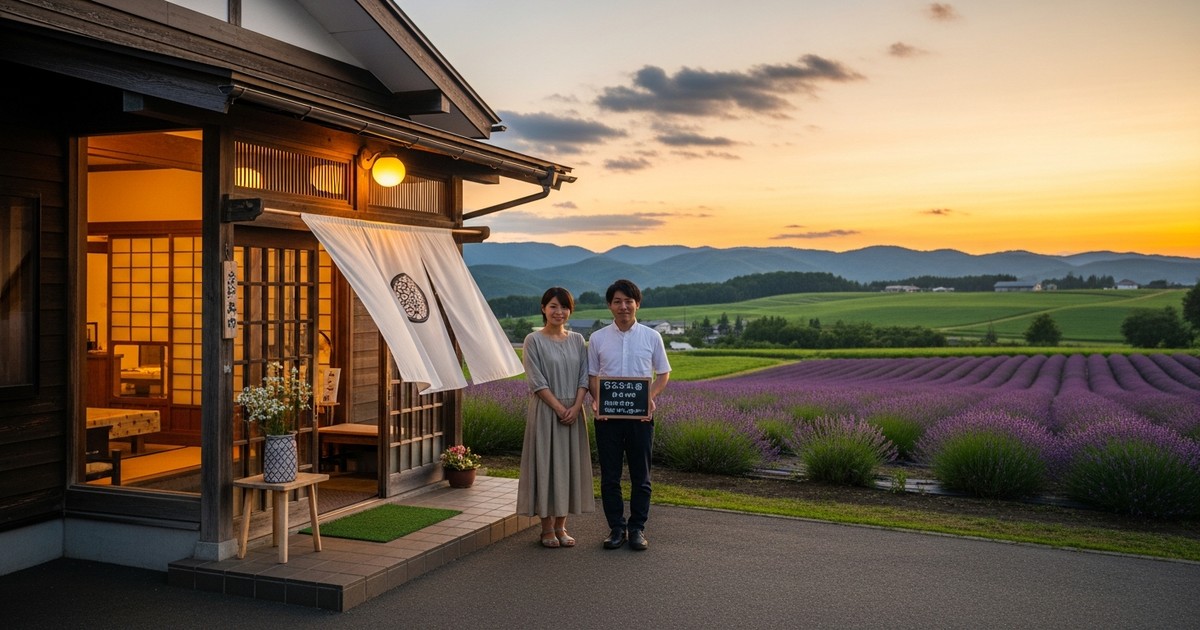
More and more people are looking to obtain a ryokan business license (simple lodging category) in Furano and operate a fully year-round accommodation business. Under the Private Lodging Business Act (the “minpaku” law), registered properties are capped at 180 operating days per year, so if you’re aiming for year-round operation, obtaining a ryokan business license is essential. Furano isn’t just famous for its lavender fields in summer—it’s also a major ski resort with strong winter demand, making it an area where you can realistically expect to attract guests throughout the entire year.
That said, obtaining a ryokan business license involves several steps, including checking the zoning district, installing fire safety equipment, and applying to the public health center, which can feel daunting for first-timers. This article walks you through the specific steps and key points for obtaining a ryokan business license (simple lodging) in Furano and achieving 365-day operation.
From selecting the right property to applying for your license and boosting occupancy after opening, we’ve organized practical, step-by-step information for you—so please read through to the end.
The Benefits and Basics of Obtaining a Ryokan Business License in Furano
The Biggest Benefit: No More 180-Day Limit
Registered minpaku properties under the Private Lodging Business Act are capped at a maximum of 180 operating days per year. Furano has two peak seasons—summer’s lavender season and winter’s ski season—and under the 180-day cap, you’d either have to sacrifice one of these seasons or only partially capitalize on both. By obtaining a ryokan business license, you can operate 365 days a year and maximize your annual revenue. For example, at an average nightly rate of ¥15,000 and an average occupancy rate of 70%, a property limited to 180 days would generate roughly ¥1.89 million per year, while a property open 365 days would generate roughly ¥3.83 million—more than double.
Characteristics of Accommodation Demand in the Furano Area
The Furano-Biei area is one of Hokkaido’s premier tourist destinations, attracting more than 2 million visitors annually. In summer (June through August), the area bustles with domestic and international tourists drawn to spots like Farm Tomita and the Blue Pond, while in winter (December through March), demand from winter sports enthusiasts centered around Furano Ski Resort remains strong. In terms of inbound demand in particular, ski tourists from Australia and Southeast Asia are on the rise, driving growing demand for whole-property rentals and long-stay accommodations. Even in the off-peak spring and autumn seasons, experience-based tourism such as farm experiences and winery tours can bring in a steady stream of guests.
Step 1: Select a Property Suited for a Ryokan Business License
Checking the Zoning District Is Your Top Priority
To obtain a ryokan business license, the property must be located in a zoning district where operating a ryokan business is permitted—this is an absolute prerequisite. Under the Ryokan Business Act, simple lodging facilities generally cannot operate in Category 1 Low-Rise Exclusive Residential Districts or Exclusive Industrial Districts. In Furano City, properties in commercial districts, neighborhood commercial districts, or quasi-residential districts within the urban area are often eligible to operate, while rural areas on the outskirts may fall outside the designated city planning zones altogether. Interestingly, areas outside city planning zones aren’t subject to zoning restrictions, which can sometimes make obtaining a license easier. Before purchasing or leasing a property, be sure to confirm the zoning designation with the City Planning Division at Furano City Hall.
Building Structure and Guest Room Size Requirements
To be licensed as a simple lodging facility, the total floor area of guest rooms must be at least 33 square meters (this requirement doesn’t apply if the facility accommodates fewer than 10 guests and ensures at least 3.3 square meters per guest). In the Furano area, it’s common to see used pensions or single-family homes renovated into accommodation facilities. As a rough price guide, a 20-to-30-year-old single-family home typically costs between ¥5 million and ¥15 million, with renovation costs of roughly ¥3 million to ¥8 million. Before purchasing, it’s important to consult with an architect and estimate the renovation costs needed to meet ryokan business standards.
Step 2: Consult in Advance with the Relevant Authorities
Prior Consultation with the Public Health Center
The authority responsible for granting ryokan business licenses is the prefectural governor (or the mayor, in cities with their own public health centers). In Furano’s case, jurisdiction falls under the Furano Regional Health Office, part of the Kamikawa Public Health Center. Before submitting a formal application, be sure to arrange a prior consultation. Bring the property’s floor plan, its address, and your planned business format (number of guest rooms and maximum occupancy). The public health center staff will provide guidance on specific facility standards, including ventilation systems, the number of toilets, washbasin facilities, and whether a front desk is required. Getting these details aligned at this stage is the key to a smooth application process later on.
Prior Consultation with the Fire Department
Applications for a ryokan business license must include a Fire Code Compliance Certificate. During your prior consultation with the fire department, you’ll be advised on the requirements for automatic fire alarm systems, evacuation guide lights, and fire extinguishers. When converting a typical single-family home into a simple lodging facility, installing a new automatic fire alarm system is almost always necessary, at a typical cost of ¥300,000 to ¥800,000. Depending on the floor area and number of stories, a sprinkler system may also be required, adding ¥1 million or more in costs. Since fire safety equipment must be designed and installed by specialized contractors, plan for a construction period of one to two months.
Confirming Change of Use Under the Building Standards Act
When converting an existing residence into an accommodation facility, buildings with a total floor area exceeding 200 square meters require a change-of-use confirmation application under the Building Standards Act. Buildings of 200 square meters or less don’t require this application, but they must still meet building safety standards (fire compartmentalization, smoke exhaust systems, emergency lighting, etc.). When renovating a single-family home in the Furano area, most properties fall under the 200-square-meter threshold, so a confirmation application often isn’t required—but caution is needed when using a pension or a large residence. Having an architect conduct a preliminary survey typically costs ¥50,000 to ¥150,000.
Step 3: Prepare the Facility and Carry Out Equipment Installation
Sanitation Facility Standards
Simple lodging facilities must meet sanitation standards to ensure guest hygiene. Specifically, an adequate number of toilets is required (generally at least one toilet per five guests), along with washbasin facilities and bathing facilities (a bathroom or shower room). Hokkaido’s local ordinances also set out detailed standards for bedding management and ventilation systems. Since winter temperatures in Furano can drop below minus 20 degrees Celsius, measures to prevent water pipes from freezing and confirmation of boiler capacity are also essential. If a water heater needs to be replaced, budget approximately ¥400,000 to ¥800,000.
Is a Front Desk Required?
The Ryokan Business Act previously required a front desk (genkan-choba) at all facilities, but following a legal revision, ICT-based alternatives are now permitted. Specifically, by verifying guest identity through a tablet device or intercom and establishing a system to respond in person within 10 minutes if needed, some facilities can forgo a staffed front desk. However, whether this alternative is permitted depends on local ordinances and the judgment of the public health center, so be sure to confirm this during your prior consultation. Installing an ICT system typically costs ¥100,000 to ¥300,000, and by using a self-check-in system, unstaffed operation becomes a realistic option.
Step 4: Apply for a Ryokan Business License and Undergo Review
List of Required Application Documents
Applying for a ryokan business license requires the following documents: a ryokan business license application form, drawings showing the facility’s structure and equipment (floor plans for each level, elevation drawings, and equipment layout plans), a certificate of registered matters for the building, a Fire Code Compliance Certificate, and—if the applicant is a corporation—the articles of incorporation and certificate of corporate registration, as well as a water quality test report (if using well water). In Hokkaido, the application fee for simple lodging facilities is ¥22,000. If you hire a certified administrative scrivener (gyoseishoshi) to prepare the documents, expect fees of roughly ¥150,000 to ¥300,000. Even if you prepare the documents yourself, you’ll almost certainly need an architect’s help to create the drawings.
From On-Site Inspection to License Issuance
Once your documents pass review, staff from the public health center will conduct an on-site inspection. During the inspection, they’ll verify that the actual facility matches the application drawings, that sanitation standards are met, and that fire safety equipment has been properly installed. If any issues are identified, you’ll need to make corrections before a re-inspection. The standard timeframe from application to license issuance is two to four weeks, though it can take over a month during busy periods. Once the license is issued, you can begin operating that same day. Working backward, it’s realistic to plan for a minimum of three to four months from property acquisition to opening for business, with six months being a more comfortable timeframe.
Step 5: Operational Strategies for Achieving 365-Day Occupancy
Listing on Multiple OTAs and Pricing Strategy
To achieve high occupancy year-round, it’s important to list your property on multiple OTAs (online travel agencies) such as Airbnb, Booking.com, Rakuten Travel, and Jalan, diversifying your booking channels. In the Furano area, it’s common to see average nightly rates of ¥12,000 to ¥20,000 per room during summer, and ¥15,000 to ¥30,000 during the winter ski season. Meanwhile, during the off-peak spring and autumn seasons, lowering rates to around ¥8,000 to ¥12,000 and offering multi-night discounts (such as 10% off for stays of three nights or more) can help boost occupancy. Achieving an average annual occupancy rate of 70% is a level at which the business can be considered viable.
Catering to Inbound Guests and Differentiating Your Property
Furano is well known internationally. By providing property descriptions and house rules in English and Chinese, and introducing a multilingual self-check-in system, you can effectively capture inbound demand. Facilities that lean into unique concepts—such as whole-property rentals with wood-burning stoves, properties featuring saunas, or pet-friendly accommodations—have actually recorded high occupancy rates as points of differentiation. A one-group-per-day, whole-property rental style also streamlines cleaning and reduces the likelihood of guest trouble, offering benefits in terms of operating costs as well.
Building a Cleaning and Management System
Maintaining 365-day operation requires a stable cleaning and management system. Since securing cleaning staff can be more difficult in the Furano area compared to urban centers, we recommend establishing partnerships early on with local cleaning companies or silver human resource centers (staffing services for retirees). Cleaning costs typically run ¥5,000 to ¥10,000 per session, depending on the size of the facility. For owners managing their property remotely, a realistic option is to appoint a local management partner or outsource operations to a property management company. Management fees generally run 10% to 30% of revenue (varying by company and scope of services), covering everything from cleaning coordination and guest communication to price adjustments.
Keys to Successfully Obtaining a Ryokan Business License in Furano
To summarize the steps for obtaining a ryokan business license in Furano and achieving 365-day operation: property selection → prior consultation → facility preparation → license application → launch of operations. Plan for an overall timeline of around six months, and expect to budget roughly ¥5 million to ¥15 million just for licensing and renovation costs, not including the cost of acquiring the property itself.
The key to success is maintaining close communication with the public health center and fire department during the prior consultation stage, minimizing the need for rework later on. It’s also worth remembering that obtaining the license is not the finish line—it’s the starting point. Only by planning ahead for post-licensing operations can the goal of 365-day occupancy truly become a reality.
Have Questions About Obtaining a Ryokan License or Running Your Property? Talk to Stay Buddy Inc.
Are you unsure where to start with obtaining a ryokan business license in Furano or operating an accommodation facility? Perhaps you’ve found a property but feel uncertain about the license application process, or you’ve obtained your license but can’t seem to boost your occupancy rate.
Stay Buddy Inc., a vacation rental management company, offers one-stop support covering everything you need for accommodation operations—from helping you obtain a ryokan business license to OTA listings, pricing, guest communication, and cleaning coordination.
With extensive operational experience throughout the Hokkaido region, we can offer concrete advice on license feasibility and revenue simulations from as early as the property selection stage.
If you’re interested in starting an accommodation business in Furano, please don’t hesitate to reach out to Stay Buddy Inc.