For owners running minpaku (private lodging) properties in Hokkaido, snow removal issues are one of the biggest headaches of the winter season. Every year, reports pour in of snow-related troubles: entrances blocked by accumulated snow, parking spaces rendered unusable, or snow piled onto neighboring property lines. Even in cases where owners have outsourced management to a property management company rather than handling it themselves, the question of “who is responsible for snow removal?” and “how far does the management company’s responsibility extend?” often remains ambiguous—leading to poor guest reviews or disputes with neighbors.
This article introduces concrete examples of snow removal troubles commonly seen in Hokkaido minpaku operations, and explains how to think about the scope of a management company’s responsibility, what points to confirm at the contract stage, and what measures owners themselves should take. Owners hoping to run a successful winter minpaku operation should be sure to read through to the end.
Common Snow Removal Troubles in Minpaku Operations
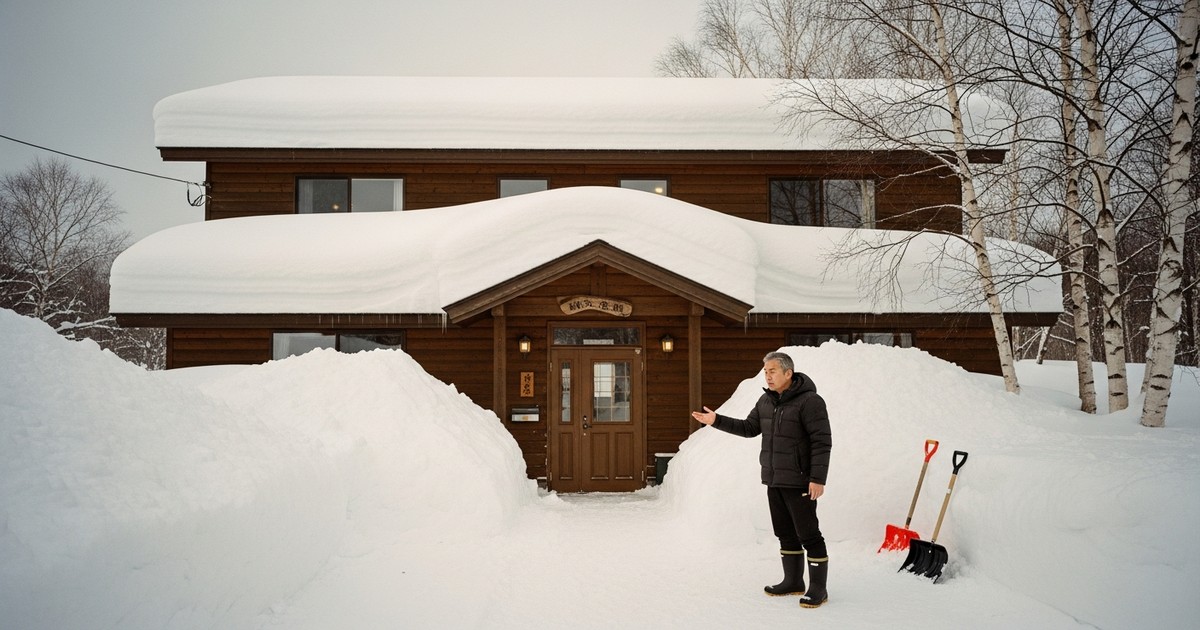
In Sapporo, Hokkaido’s largest city, annual cumulative snowfall can reach as much as 5 meters in some years, and tourist destinations like Niseko and Furano see even heavier snowfall. Unlike ordinary rental housing, minpaku properties have guests turning over in short cycles, which creates a structural problem: it’s often unclear who is responsible for clearing snow.
The troubles most commonly reported can be broadly divided into three patterns. First, cases where snow removal at the entrance or on-site pathways isn’t completed in time, preventing guests from entering the building at check-in. Second, cases where insufficient snow clearing of parking spaces makes it impossible to park a rental car, leading guests to demand refunds. Third, cases where cleared snow is pushed onto neighboring property or public roads, prompting complaints from local residents. In every case, the longer the response is delayed, the worse the damage becomes—leading to serious consequences such as lower review ratings or complaints to local authorities.
Why Is the Scope of Snow Removal Responsibility So Ambiguous?
Cases Where the Management Contract Lacks a Snow Removal Clause
Minpaku property management contracts generally spell out services such as cleaning, guest support, and reservation management. However, because snow removal is a “seasonal task,” it’s often left out of the contract entirely. Even the guidelines for minpaku management operators published by Japan’s Ministry of Land, Infrastructure, Transport and Tourism make no specific mention of snow removal, and no unified industry standard currently exists.
If snow removal isn’t specified in the contract, the management company can refuse to handle it as “outside the scope of the agreement.” In one actual case, an owner asked a management company to clear snow, only to be told “that’s outside our contracted scope,” forcing the owner to scramble and hire a snow removal contractor at a cost of ¥15,000–¥20,000 per visit. It’s not uncommon for snow removal costs alone to exceed ¥300,000 over a single winter season.
The Unclear Line Between “Building Management” and “Snow Removal”
Licensed minpaku management operators have a duty to maintain the safety of the building. For example, if a passerby is injured by snow falling from the roof, the manager could be held liable. On the other hand, opinions differ on whether clearing accumulated snow on the property grounds falls under “building management.”
Generally, maintaining the safety of the building itself (such as removing snow from the roof or preventing frozen pipes) is interpreted as part of management duties, but many management companies consider routine snow clearing on the grounds to fall outside that scope. This gap in understanding is the root cause of many disputes.
Checkpoints for Clarifying the Management Company’s Scope of Responsibility
Snow Removal Clauses to Include in the Contract
The most reliable countermeasure is to spell out snow removal terms clearly at the contract stage with your management company. Specifically, the following items should be agreed upon in writing: the areas subject to snow removal (entrance, parking lot, on-site walkways, etc.), the trigger condition for removal (how many centimeters of snowfall before action is taken), the frequency of removal (only before check-in, or daily), cost responsibility (a fixed monthly fee or actual-cost reimbursement per visit), responsibility for arranging outsourced snow removal contractors if applicable, and who bears responsibility if the response is delayed.
For example, specifying concrete numbers and conditions—such as “snow will be cleared from the entrance and parking lot by 2:00 PM on the day of check-in whenever snowfall exceeds 10 cm, at a cost of ¥5,000 per visit billed to the owner at month-end”—can prevent misunderstandings between both parties.
Understanding the Going Rate for Snow Removal
Snow removal costs vary significantly depending on the area and scope of work. For a typical detached-house minpaku property in Sapporo, a seasonal contract (December through March) typically runs ¥20,000–¥50,000 per month. For a one-time spot request on a property of about 30–50 square meters, expect to pay roughly ¥5,000–¥15,000. In the Niseko area, where snowfall is heavier, seasonal contracts can reach ¥50,000–¥100,000 per month.
When a management company includes snow removal within its scope of services, the cost is typically either added on top of the monthly management fee or billed as actual expenses. If the management fee is set at 20% of revenue and snow removal costs an additional ¥30,000 per month, that adds up to ¥120,000 in extra costs over a four-month winter season. This amount needs to either be passed on through winter pricing or factored into your annual budget.
Concrete Measures Owners Should Take
Investing in Automated Snow Removal Equipment
One way to reduce reliance on manual snow removal is to invest in equipment. A prime example is a road heating system (snow-melting system), which embeds electric heating wires or hot-water pipes beneath the entrance approach or parking area. Installation typically costs ¥30,000–¥60,000 per square meter, meaning a 20-square-meter parking lot would require an initial investment of ¥600,000–¥1,200,000. Running costs for an electric system are roughly ¥10,000–¥20,000 per month, but given the hassle and expense of arranging snow removal every time, this investment can pay for itself over the long run.
Installing snow stoppers (snow guards) on the roof can also reduce the risk of falling-snow accidents, at an installation cost of roughly ¥100,000–¥300,000 per building. Since this equipment directly contributes to guest safety, it can also help improve review ratings.
Contracting Directly with a Local Snow Removal Company
Rather than leaving all snow removal to the management company, it can also be effective for owners to sign a seasonal contract directly with a local snow removal contractor. Going through a management company can add intermediary markups, so contracting directly is often more cost-effective. In Sapporo, some independent snow removal contractors offer seasonal contracts for as little as ¥15,000–¥30,000 per month.
That said, coordinating with the management company becomes a challenge when contracting directly. Without a system to confirm with the management company whether the snow removal contractor has completed the job (for example, photo reports shared in a LINE group), it becomes unclear who is responsible if a guest complains at check-in that “the snow hasn’t been cleared.”
Managing Guest Expectations Through Advance Notice
Since it’s difficult to eliminate snow removal issues entirely, giving guests advance notice is also an important countermeasure. Simply adding notes to your Airbnb or Booking.com listing page—such as “Parking and walkway conditions may vary due to snowfall in winter” or “Please bring non-slip footwear”—can help reduce the likelihood of complaints.
It also helps to include a specific contact in your check-in instructions, such as: “In the event of heavy snowfall, snow removal may not be completed in time. If you encounter any issues upon arrival, please contact [contact info].” This encourages guests to direct their dissatisfaction to a direct message rather than a public review. In fact, listings that provide thorough winter advisories tend to score 0.2–0.3 points higher in reviews compared to those that don’t.
Snow Removal Etiquette to Prevent Neighbor Disputes
Snow removal at minpaku properties is important not only for guest satisfaction but also for maintaining good relations with neighbors. In residential areas of Hokkaido, disputes between residents over how cleared snow is disposed of are common. Because minpaku properties tend to have a less visible “face” of management, they often draw stricter scrutiny from neighbors than ordinary homes.
Specific points to keep in mind include: never leaving cleared snow on neighboring property or public roads, securing a designated snow disposal site in advance, and avoiding noisy snow removal work in the early morning or late at night. The City of Sapporo has issued guidance against dumping snow on roads, and in serious cases, this can result in a corrective order for violating local ordinances. Even when outsourcing to a management company or snow removal contractor, it is the owner’s responsibility to clearly communicate the rules regarding disposal sites. Joining the local neighborhood association and sharing snow removal costs with the community according to local customs is also essential for stable, long-term operation.
Have Questions About Minpaku Operations? Consult Stay Buddy Inc.
From winter snow removal to countless other seasonal challenges, minpaku operation presents a different set of issues throughout the year. If you’re an owner facing concerns like “I want to review my contract with my management company,” “I want to set up a solid winter operating system that includes snow removal,” or “I want to prevent disputes with neighbors before they happen,” please don’t hesitate to reach out to Stay Buddy Inc., a minpaku management specialist.
Stay Buddy Inc. can propose an operating plan tailored to your property’s location and characteristics. We provide transparent explanations from the very start—before you even sign a contract—covering whether snow removal is included, how costs are shared, and how we coordinate with local contractors.
For owners struggling with reduced winter occupancy rates or rising snow removal costs, having a trustworthy partner is the first step toward improving profitability. Please feel free to reach out to us via our contact form to get started.