Leave Your Vacation Rental Management to Us
Free Online Consultation10 Ideas for Monetizing Vacant Homes: How to Turn Abandoned Properties into Assets
Across Japan, the number of “vacant homes” (akiya) continues to rise, and it has become a serious social issue.
Simply owning a vacant home means ongoing property taxes and maintenance costs. If left neglected, it not only loses value but can also threaten the local landscape and safety. Vacant homes are sometimes even called “negative assets”—but is there really nothing that can be done?
No, that’s not true at all.
Let us share the conclusion of this article right away.
A vacant home is not a “negative asset”—it’s a “block of potential” capable of generating limitless value, depending on your ideas. The key to success lies in how well you can connect the property’s unique potential (location, size, atmosphere) with today’s increasingly diverse needs.
In this article, we’ve carefully selected 10 concrete ideas for transforming your “abandoned property” into a revenue-generating “asset,” along with the secrets to success for each.
Why Vacant Home Utilization Is a Golden Opportunity Right Now
While vacant homes tend to carry a negative image, three major tailwinds are creating unprecedented business opportunities right now.
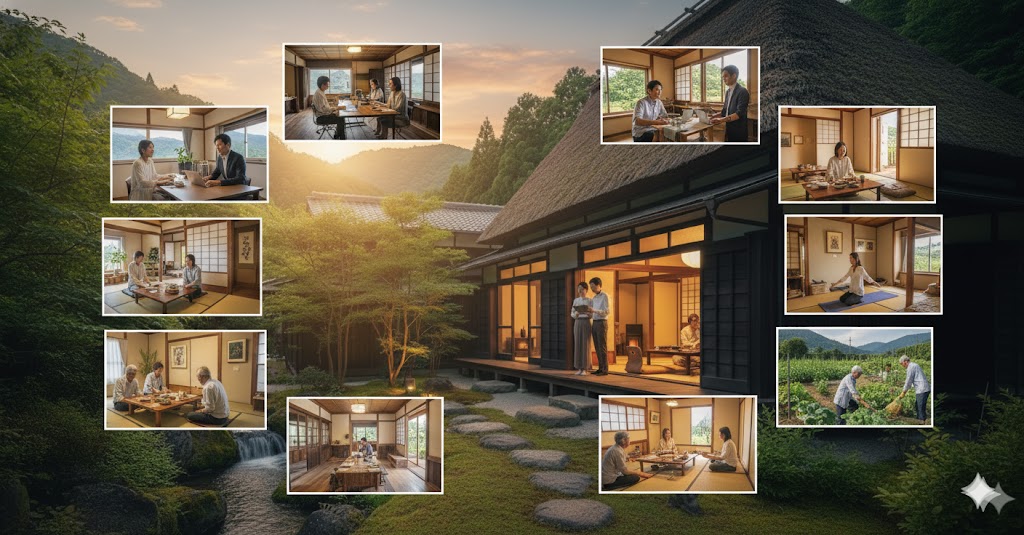
- 1. Shifting Values: From “Owning Things” to “Having Experiences.” Today’s consumers are increasingly inclined to spend money on experiences that can only be had in a particular place, rather than on owning things. The unique atmosphere and story that a vacant home—especially an old traditional house (kominka)—carries is precisely the source of this “experiential value.”
- 2. Diversifying Lifestyles: Demand for New “Places.” New ways of living and working are spreading rapidly—relocating to rural areas, dual-base living, and location-independent workations. As a result, even vacant homes in rural or suburban areas once considered “inconvenient” are seeing fresh demand.
- 3. Strong Government Support: Robust Subsidy Programs. In response to the worsening vacant home problem, both national and local governments are stepping up efforts. Numerous **non-repayable subsidies** are now available for renovating or commercially utilizing vacant homes, significantly lowering the risk of initial investment and making it easier to take on new challenges.
[10 Carefully Selected Ideas] Concrete Strategies and Success Secrets for Monetizing Vacant Homes
1. [High-Revenue Type] Whole-House Rental Accommodation (Vacation Rental / Ryokan Business License)
- The Idea: Renovate the vacant home and rent it out as an entire accommodation unit. Traditional kominka homes, in particular, enjoy tremendous popularity among inbound tourists as well as domestic families and groups.
- Secrets to Success:
- Obtain a “Ryokan Business License” (Simple Lodging): Rather than operating under the vacation rental law with its 180-day annual cap, aiming for a “ryokan business” license that allows year-round operation (365 days) is an absolute must for maximizing revenue.
- Add Experience Value: Incorporating unique experiential elements—an irori hearth, a wood-burning stove, a goemon-buro bath, or BBQs in the garden—can dramatically raise the nightly rate.
- Check Legal Hurdles: Expert investigation is essential to confirm whether the property is located in a “zoning district” that permits a ryokan business license and whether it can meet fire code requirements.
2. [Stable-Income Type] Long-Term Rental (Including Repairs/Renovation)
- The Idea: Renovate the vacant home and rent it out long-term as a standard residential property. This is the most traditional and reliable use.
- Secrets to Success:
- Clarify Your Target: Identify the rental demand in your specific area—families, single occupants, elderly residents—and tailor renovations accordingly (e.g., family-friendly layouts, barrier-free design).
- Outsource Management: Entrusting operations to a management company minimizes hands-on work while providing stable rental income (income gain).
- Understand Tenant Protection Laws: Once a property is rented out, Japan’s landlord-tenant laws strongly protect tenant rights, making it difficult for owners to demand vacancy—understanding this legal framework is essential.
3. [Community-Rooted Type] Café or Restaurant
- The Idea: Leverage the calm ambiance of a traditional home or the beauty of its garden to revive the property as a café or restaurant.
- Secrets to Success:
- Local-Sourced Menus: Develop a menu that highlights fresh local ingredients, showcasing the food culture unique to the area.
- Curated Ambiance: Preserve the character of old pillars, beams, and fixtures as much as possible while updating plumbing and kitchen equipment to modern standards—striking the right balance with “comfort” is key. (*A food service business license from the health department is required.)
4. [Time-Rental Type] Rental Space or Photo Studio
- The Idea: Offer unused hours as a “time-rental” space for parties, meetings, events, workshops, cosplay photo shoots, and more.
- Secrets to Success:
- Equip for Your Target Audience: Tailor amenities to intended use—cute decor and cooking equipment for girls’ gatherings, projectors and whiteboards for meetings, backdrop paper and lighting gear for photo shoots.
- Leverage Booking Platforms: Register on specialized matching platforms like “Space Market” or “Instabase” to streamline customer acquisition.
5. [Community-Building Type] Share House or Guesthouse
- The Idea: Renovate a vacant home with multiple rooms and operate it as a share house where multiple tenants live together, or as a guesthouse for backpackers.
- Secrets to Success:
- Build a Sense of Community: The key is designing an appealing “shared living room” that fosters interaction among tenants and with local residents—not just providing cheap housing.
- Sharpen Your Concept: Differentiate from competitors by promoting a distinctive concept that attracts people with specific hobbies or lifestyles, such as “Creators Only” or “Includes Farming Experience.”
6. [Community Contribution Type] Welfare or Community Hub
- The Idea: In areas with an aging population, use the property as a hub for day-care services, group homes for elderly residents with dementia, or community gathering spaces such as a “children’s cafeteria” or “neighborhood meeting hall.”
- Secrets to Success:
- Partner with Government and NPOs: Accurately understand local care needs and challenges, and collaborate with local government, social welfare councils, and NPOs to build a sustainable operating model.
- Ensure Stability: By linking with long-term care insurance programs, it’s possible to combine social contribution with stable business revenue. (*Specialized permits and licenses are required.)
7. [Creative Type] Coworking Space or Artist’s Studio
- The Idea: Provide a workspace for freelancers and artists who want to escape the hustle and bustle of the city and focus on work or creative projects in a quiet setting.
- Secrets to Success:
- High-Speed Wi-Fi and Ample Power Outlets: These are non-negotiable requirements for business use.
- Balance “Focus” and “Relaxation”: In addition to a dedicated workspace for concentration, designing “breathing room” spaces where people can relax—such as a veranda or garden—creates value that a typical city office cannot offer.
8. [Hobby-Focused Type] The “House of ___” (e.g., Sauna, Home Theater)
- The Idea: Install equipment tailored to a specific hobby, creating a kind of “pilgrimage site” for enthusiasts who share that passion.
- Secrets to Success:
- Go All-In on Quality: Invest at a level that satisfies even hardcore enthusiasts—for example, “a fully authentic Finnish-style sauna” or “a soundproof room approved for home theater and musical instrument practice”—rather than a half-hearted setup.
- Build Community Through Social Media: Share the property’s appeal on social media platforms that directly reach your target audience, building a devoted fan community.
9. [Zero-Cost Approach] DIY Rental (Free Rent)
- The Idea: When “major renovations are needed, but I can’t afford them myself,” you can allow tenants to freely renovate the property through DIY in exchange for a period of free rent, or offer the property at below-market rent.
- Secrets to Success:
- Clarify Contract Terms: Clearly define in the contract how much renovation is permitted and what restoration obligations apply upon move-out, to prevent future disputes.
- Choose Passionate Tenants: It’s important to identify tenants who are genuinely enthusiastic about doing creative work in the home—not just people looking for cheap rent.
10. [Last Resort] Demolish and Utilize as “Vacant Land”
- The Idea: When the building is severely deteriorated and restoration would be enormously costly, demolishing it and using the land as “vacant land” can be the better option.
- Secrets to Success:
- Use Subsidies: Take advantage of local government “demolition subsidies” to reduce demolition costs.
- Match Usage to Location: Identify local needs—such as a monthly parking lot, storage yard for a nearby factory or construction site, a community garden plot, or solar power generation—and explore ways to generate income from the land as-is. Note, however, that property tax reductions will no longer apply once the structure is demolished.
Conclusion: A Vacant Home Is a “Rough Gem” Waiting for the Light of a Good Idea
A vacant home is no longer just a nuisance. With your ideas and passion, it’s a seed of hope for the future, carrying limitless possibilities.
Using the 10 ideas introduced here as inspiration, why not take the first step toward discovering the value your vacant home holds—value that no one else has noticed yet—and enrich both your community and your own life?
Let Our Professionals Polish That “Rough Gem” into a Real Business
“I’ve got some ideas, but how do I turn this into a concrete business plan?”
“Applying for subsidies or obtaining a ryokan business license sounds so complicated…”
“I want an objective assessment of which approach offers the lowest risk and the greatest return.”
If these concerns sound familiar, please reach out to us.
At Stay Buddy Inc., we’re more than just a vacation rental management company. We’re real estate utilization professionals who specialize in unlocking the full potential of dormant properties and producing them into revenue-generating businesses.
Here’s what we do:
- ① We thoroughly analyze the unique character of your vacant home together with market demand in the area, then propose the most profitable usage ideas—whether that’s a vacation rental, mixed-use facility, or something else—based on data.
- ② We turn that concept into a precise “business plan” solid enough to convince financial institutions, supporting you through subsidy applications and securing financing.
- ③ From navigating complex permits and licenses (such as ryokan business law) to space production and post-launch customer acquisition, we accompany you through every step of transforming your vacant home into a “revenue-generating asset”—all as a single, seamless service.
Let’s turn your “idea” into sustainable “revenue.”
Would you like to map out a concrete path forward, together with us? We’d love to hear about the untapped potential your vacant home holds—please don’t hesitate to reach out.