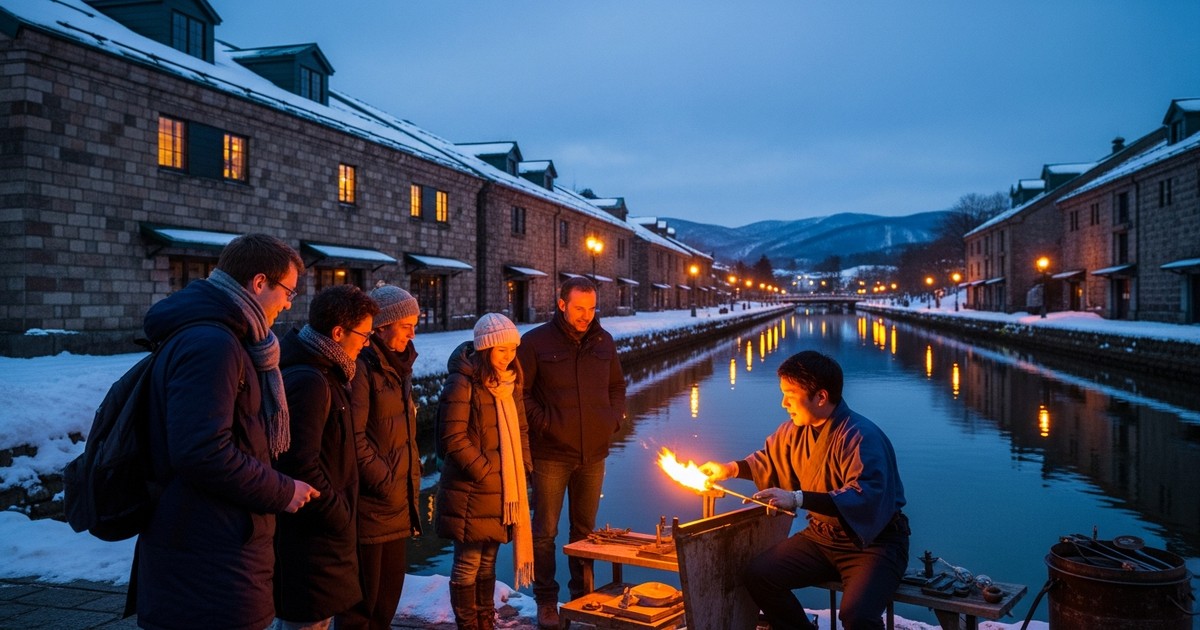
Otaru is an area rich in tourism appeal for international visitors, from its glass-blowing workshops and canal-side streetscapes to its fresh seafood cuisine. However, simply operating an accommodation is no longer enough to maximize inbound tourism results in Otaru. Travelers around the world are increasingly seeking not just a place to sleep, but an authentic local experience—and this trend continues to strengthen year by year. Offering accommodation plans combined with experience content has become the key to differentiation and higher revenue.
In fact, a study published by Airbnb reported that bookings for “stays with experiences” command an average price 30–50% higher than accommodation alone, with review scores also rising by 0.3–0.5 points. In Otaru’s case, there are countless experience menus that can be designed around local resources—glassworking, sushi-making, sake tasting, guided walks through the Snow Light Path, and more.
This article breaks down, step by step, how to attract inbound travelers to Otaru accommodations by adding experience content. From planning your concept to multilingual support, pricing design, and promotion, we cover everything at a level you can put into practice right away—so be sure to use this as a reference.
Step 1: Select Experience Content That Drives Inbound Tourism in Otaru
When selecting experience content, it’s important to start by thinking about “what can only be done in Otaru.” International travelers place high value on truly unique experiences at their destination, so generic programs that could be offered in any city are unlikely to drive bookings. In Otaru’s case, there are clearly defined local resources: the glass craft culture epitomized by Kitaichi Glass, the historic scenery of the Otaru Canal, the seafood harvested from nearby waters including the Shakotan Peninsula, and the whisky and sake distilleries of the Yoichi–Otaru area.
Specifically, it’s effective to design experience menus around the following categories: glasswork workshops (60–90 minutes, cost of ¥1,500–2,500 per person), sushi-making experiences (90–120 minutes, cost of ¥3,000–4,000 per person), photo walks with historical guides around the Otaru Canal (120 minutes, guide labor cost of ¥8,000–12,000 per session), and sake or whisky tasting tours (90 minutes, cost of ¥2,000–3,000 per person). When making your selections, research the review counts and ratings of popular Otaru-area experiences on OTAs (Airbnb Experiences, Viator, Klook, etc.) to identify high-demand genres. Experience categories with 100+ reviews and a rating of 4.5 or higher can be reliably judged to have strong demand.
Step 2: Build a Collaborative Framework with Local Businesses
Accommodation operators don’t need to provide every piece of experience content themselves. In fact, partnering with local artisans and businesses allows you to improve the quality of experiences while keeping costs and risks low. Otaru is home to roughly 30 glass workshops and more than 50 sushi restaurants, offering plenty of potential partners for experience programs.
The key to a successful partnership is establishing a clear compensation structure. A common commission model has the accommodation receive a referral fee of 10–30% of the experience fee (the exact rate depends on the company and the scope of what’s delegated). For example, if a ¥5,000-per-person glassworking experience is sold to 30 guests per month, a 20% commission generates an additional ¥30,000 in monthly revenue. Experience providers also benefit, since they gain a steady stream of customers without spending on customer acquisition—creating a win-win relationship. Before partnering, confirm whether the provider has experience hosting international guests, can communicate at least minimally in English, and can accommodate small, private groups (2–6 people). Be sure to clearly specify the cancellation policy, minimum group size, and insurance coverage in the contract.
Step 3: Design Pricing for Accommodation Plans with Experiences
When incorporating experience content into accommodation plans, pricing design determines both your booking appeal and profitability. As a basic principle, setting a package price discounted 5–10% below the simple sum of “accommodation fee + experience fee” tends to boost booking rates. This is because it gives travelers the sense that booking as a set is a good deal.
Here’s a concrete pricing example. If a one-night stay costs ¥15,000 and a sushi-making experience costs ¥6,000 per person, the simple sum is ¥21,000—but you would set the package price at ¥19,000 (roughly a 10% discount). Assuming a payment of ¥4,500 to the experience provider (75% of the experience fee) and an accommodation cost of ¥8,000, the gross profit per booking is ¥6,500. Compared to the ¥7,000 gross profit for accommodation alone, this may seem lower at first glance—but because experience-inclusive plans boost average occupancy by 10–15 percentage points, total monthly revenue actually increases. For instance, if a 10-room property’s occupancy rises from 65% to 78%, total monthly room-nights increase from roughly 195 to 234, resulting in an estimated gross profit increase of over ¥250,000 per month. It’s also effective to vary plans by season—for example, a winter “snowy canal night walk + local sake tasting” package, or a summer “Shakotan Blue sea kayaking + seafood BBQ” package. Pairing seasonal appeal with your packages gives travelers a compelling hook to book.
Step 4: Set Up Multilingual Support and a Smooth Booking Flow
Along the path to booking an experience-inclusive accommodation plan, the language barrier is the single biggest drop-off point for inbound travelers. At minimum, prepare your booking page and experience descriptions in English, Simplified Chinese, and Korean. Ideally, translations should be checked by native speakers; but to keep costs down, an efficient approach is to create a draft translation using DeepL or ChatGPT, then have it proofread by a native speaker through a crowdsourcing platform (such as Gengo) for ¥20,000–30,000 per language.
Design your booking flow around two channels working together: OTAs and direct bookings on your own website. On OTAs, include photos and descriptions of your experience plans in your Airbnb listing, presenting it as a “special package including an experience.” On Booking.com, add experience details to the “Activities” section of your property page and note the package pricing in the special remarks. For your own website, integrating with Google Hotel Ads is effective—running ads for keywords like “Otaru glass workshop stay” or “Otaru sushi experience accommodation” can draw in travelers specifically seeking experiences. Since the cost-per-click for Otaru-related keywords on Google Ads is relatively low, at around ¥50–150, you can run test campaigns on a monthly budget of just ¥30,000–50,000. On the day of the experience, handing guests an English-language experience guide sheet at check-in (covering the meeting point, items to bring, duration, and emergency contact info) can help prevent trouble and ease any anxiety.
Step 5: Use Social Media and Reviews to Drive Ongoing Bookings
The greatest strength of experience content is that it naturally creates photo- and video-worthy moments. A smiling guest holding their finished glasswork, a photo of sushi they made themselves laid out on the table, a video of a nighttime walk along the snowy canal—intentionally design scenes that make guests want to share them on social media of their own accord. Specifically, you can set up photo spots during the experience (a branded backdrop panel, a beautifully lit workstation, etc.) and hand out cards featuring your property’s official hashtag (e.g., #OtaruStayExperience).
On Instagram, the hashtag “#otaru” appears on more than 300,000 posts, making it a platform travelers actively use to gather information. Posting experience footage as a Reel typically achieves 2–3 times the reach of a standard photo post. Google Maps reviews also directly influence booking decisions, so hand out review request cards with a QR code after the experience ends to encourage guests to post. Offering an incentive—such as “leave a comment about your experience and receive an original glass charm”—can raise the review submission rate from a typical 5–8% to 20–25%. Since accumulated reviews also affect your ranking in OTA search results, this builds a foundation for sustained bookings over the medium to long term. On TripAdvisor, ranking in the top 5 under the “Otaru Experiences” category can drive several thousand monthly views, so it’s worth strategically working to grow both your review count and your rating.
Step 6: Run a Data Analysis and Improvement Cycle
After introducing experience-inclusive plans, the key to maximizing revenue is repeatedly improving based on data. At minimum, you should track five KPIs: the booking rate for experience-inclusive plans (as a share of all bookings), participation rate and satisfaction (on a 5-point scale) for each experience, the cancellation rate for experience-inclusive plans, the review submission rate, and the repeat booking rate.
As a general benchmark, if the booking share of experience-inclusive plans falls below 20% of the total, you’ll need to reconsider how the plan is being promoted. In some cases, simply changing the thumbnail image on an OTA listing to a photo of the experience improved click-through rates by 15–20%. For experience menus with a satisfaction score below 4.0, consider renewing the content or switching partners. Ideally, aggregate your data monthly and run a quarterly cycle of swapping out experience menus and adjusting prices. Since an experience that’s popular in winter may see no bookings in summer, seasonal lineup changes are essential. For example, an effective approach is switching from a December–February “Snow Light walk + hot wine” package to a June–August “morning market tour + seafood rice bowl-making” package.
Contact Stay Buddy for Accommodation Management and Inbound Tourism Marketing in Otaru
From planning experience content and building partnerships with local businesses to multilingual support, OTA management, and pricing design, attracting inbound travelers to your accommodation requires a wide range of expertise. Handling all of this on your own can place a significant burden in terms of both time and cost.
Stay Buddy Inc., a vacation rental management company, provides comprehensive support for accommodation operations in destinations including Otaru. We offer end-to-end, one-stop management covering everything from property selection and design to planning experience-based packages, optimizing OTA listings, handling multilingual guest communication, arranging cleaning services, and providing revenue reports.
If you’re interested in running an accommodation that incorporates experience content, or if you already operate a property and want to improve its occupancy rate or average guest spend, please feel free to contact Stay Buddy Inc. After hearing about your current operations, we’ll propose a concrete improvement plan along with a revenue simulation.