Leave Your Minpaku Management to the Experts
Free Online ConsultationWhat Is the Resident Briefing Required for Ryokan Business Operations?
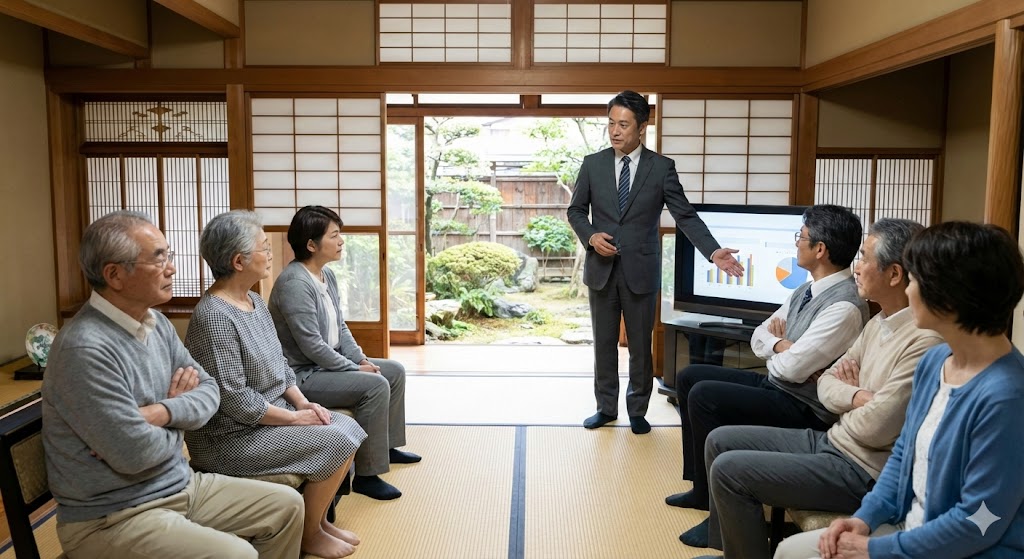
When starting an accommodation business under a Ryokan Business Law license (hotel or simple lodging), there’s one process that makes most operators the most nervous and gives them the biggest headache: the **”prior briefing session for neighboring residents.”**
“What if they oppose it…?”
“What if someone intimidating shows up and the whole plan falls apart…?”
It’s completely natural to feel anxious about this. But this briefing session is not just an administrative formality. It’s actually your first and greatest **”opportunity to build trust”**—the foundation for having your business accepted by the local community and generating stable revenue for years to come.
In particular, some municipalities, including Osaka City, legally require a strict resident briefing session in accordance with local ordinances before you can even apply for a ryokan business license. This is a step you simply cannot skip.
In this article, we’ll thoroughly explain everything you need to know about the “resident briefing session” that’s essential to running a ryokan business—from its legal standing, to the concrete steps involved, to professional know-how for avoiding trouble and earning residents’ understanding.
What Is a Resident Briefing Session, and Why Is It Necessary?
Let’s start by understanding the basic definition of a resident briefing session and why it matters so much.
The “Obligation” Side: An Administrative Requirement
The Ryokan Business Law itself doesn’t explicitly require a resident briefing session. However, many municipalities, including Osaka City, mandate prior explanation to neighboring residents as a licensing requirement through their own **”Ryokan Business Law Enforcement Ordinances” or “Administrative Guidance Guidelines.”**
In other words, before you can even submit your license application, you must first create a track record (in the form of a report) showing that you have “informed neighboring residents of the business plan and sought their understanding.” Without this, you won’t even get to the review stage.
The “Protective Shield” Side: Risk Management
Beyond being a legal obligation, this briefing session serves a crucial risk-management function.
Neighboring residents often harbor strong concerns about accommodation facilities—especially minpaku-style operations—regarding “noise,” “garbage problems,” and “deteriorating public safety.”
If you suddenly start operating without ever showing your face or offering any explanation, those concerns will curdle into “distrust” and “anger,” potentially leading to complaints over minor issues and troubles that threaten your entire operation.
Explaining things sincerely and resolving concerns in advance is the strongest protective shield against future trouble.
Who, When, and How? Requirements for Holding the Briefing Session
Specific rules vary by municipality, but let’s look at the general requirements (using Osaka City as a reference example).
1. Who Counts as “Neighboring Residents”
Generally, this includes residents living in buildings within a certain radius of the property boundary line—for example, “10 to 30 meters”—as well as the owners and managers of those buildings.
In most cases, you’re also expected to greet and explain your plans to the neighborhood association chair or community leader, not just residents within the specified radius. It’s wise to cast a wide net, including borderline properties, to prevent future complaints of “nobody told me about this.”
2. Timing of the Briefing
In principle, you must conduct the briefing **before** submitting your license application to the health center, and then report the results.
To avoid suspicion from residents wondering “what’s being built here?” once construction begins, the best timing—both practically and emotionally—is before, or simultaneously with, the start of interior renovations or fire safety equipment installation.
3. Methods of Explanation
- In-Person Explanation (Individual Visits): For residents whose daily life will be most directly affected—immediate neighbors on both sides, behind, across the street, or above/below in an apartment building—an **in-person** explanation is generally required.
- Flyer Distribution (General Notice): For residents within a broader radius, distributing flyers describing the business plan may be an acceptable alternative.
- Assembly-Style Meeting: This involves renting a community hall and gathering residents for a single, collective briefing. It’s sometimes required for large-scale facilities, but for individual small-scale properties, door-to-door visits remain the standard approach.
What Should You Say? Essential Topics to Cover
The content you’re required to explain during the briefing is often specified by local ordinance, but fundamentally, it’s about providing information that addresses residents’ concerns.
1. Operator Information
Make it clear “who is running this business.” Share the owner’s name, contact information, and company name if applicable. Preparing a greeting letter with a photo can help residents feel more comfortable and connected.
2. Facility Overview
Explain “what kind of facility will be built.” Cover the type of license (e.g., simple lodging), number of guest rooms, maximum occupancy, and building structure, using floor plans and other visual aids.
3. Operations and Safety Measures
This is the part residents care about most.
- Check-in Method: Where and how will you verify guest identities?
- Waste Disposal: Clearly state that waste will be handled by a licensed commercial disposal contractor and that you won’t use the neighborhood’s garbage collection points.
- Noise Control Measures: Explain concrete steps such as enforcing strict house rules, installing double-glazed windows, and using noise sensors.
- Fire Safety Measures: Describe how the facility will be equipped with fire safety systems, such as automatic fire alarms, to ensure safety.
4. [Most Important] Emergency Contact Information
To address the worry of “who do I call if it’s noisy in the middle of the night?”, clearly provide a **24/7, Japanese-language emergency contact (a call center or management company)**.
Demonstrating that “we’ll respond immediately if anything happens” is the single most reassuring thing you can offer.
5 Golden Rules for a Successful Resident Briefing Session
Simply explaining things isn’t enough—you also need to handle the emotional side of the conversation with care.
Rule 1: Dress Neatly and Speak Politely
First impressions are everything. Visit in a suit or similarly clean, professional attire rather than work clothes or casual wear. Your language should also strike a balance—polite and humble, without becoming overly formal or businesslike.
Rule 2: Focus on “Listening,” Not “Persuading”
When residents express harsh opinions or concerns, don’t argue back or try to win them over with legal technicalities.
Acknowledge their feelings first—”You’re absolutely right,” “I’m sorry for causing you concern”—and show them that you’re **genuinely willing to listen**. That’s the first step toward building trust.
Rule 3: Don’t Promise What You Can’t Deliver
Don’t make impossible promises just to smooth things over in the moment, such as “It will absolutely never be noisy” or “There will absolutely never be litter.” Instead, offer sincere, realistic responses like “We’ll implement the strongest possible measures” or “We’ll increase the frequency of our patrols.” Lies or empty reassurances always come back to haunt your credibility later.
Rule 4: Handle Absences Thoroughly
If no one answers when you visit, try again on different days and times. If you still can’t reach someone, leave your materials along with a note saying something like “We visited several times but you weren’t home…” Creating this **record of your effort to explain** matters when it comes time to report to the authorities.
Rule 5: Keep Detailed Records
Document who you met, when, what questions they asked, and how you responded—everything, in detail. This not only forms the basis of the “resident briefing report” you’ll submit to the authorities but also serves as evidence to prevent “he said, she said” disputes down the line.
Conclusion: A Resident Briefing Session Is a Place to Win Allies, Not Make Enemies
If you go into a resident briefing session viewing it negatively—as “a place where I’ll get yelled at” or “a place for complaints”—you won’t get good results.
Instead, think of it as **a place to pay proper respect** to your future neighbors, as a newcomer about to start a business in their community—**a declaration that “we’re not suspicious people; we’ll operate while protecting the safety of this neighborhood.”**
If you approach it with sincerity and dedication, even residents who were initially wary may come to say, “Let us know if anything comes up,” becoming allies or informal watchdogs looking out for your business.
As the first step toward building a facility that’s loved by the community, face this process head-on with honesty and integrity.
Let Our Professionals Handle Your Neighbor Relations
“I don’t know what to say during the briefing, and I’m nervous about how residents will react…”
“I can’t spare the time to make multiple visits during weekday afternoons.”
“If opposition arises, I won’t be able to handle it on my own.”
If any of these concerns sound familiar, please reach out to us.
We are Stay Buddy Co., Ltd., a team of professionals who have supported numerous ryokan business license acquisitions, primarily in Osaka City—one of the most competitive minpaku markets in Japan.
On behalf of property owners, we handle:
- ① Individual visits to neighboring residents and conducting the briefing sessions
- ② Professional handling of questions and concerns from residents
- ③ Preparation of the detailed “resident briefing report” required for submission to the authorities—we handle this entire process, one of the most delicate and challenging steps in obtaining a license, as a complete one-stop service.
We don’t just deliver a formal, by-the-numbers explanation.
We approach every case with a focus on **”how to resolve residents’ concerns and turn them into supporters of your facility,”** carefully building genuine consensus with the local community.
Leave all the troublesome neighbor relations and administrative procedures to us, the professionals. That way, you can focus entirely on creating your ideal hotel—and on the profits that follow.
For a safe and secure start to your business, please feel free to reach out to us for a consultation.