Leave Your Minpaku Management to Us
Completely Free Online ConsultationConstruction, IT, Food Service…Success Stories of Companies Entering the Hotel Industry from Other Sectors
Following the major event of the Osaka Expo, Osaka’s accommodation market has completely shifted from “temporary special demand” to a “mature period based on genuine demand.” Thanks to the steady strength of inbound demand and expectations for the next catalyst—the Integrated Resort (IR)—the accommodation business remains an extremely attractive investment target.
In this mature market, it is **”companies entering the hotel industry from other sectors”** that are making rapid strides, even outpacing existing hotel chains.
Let’s start with the conclusion of this article.
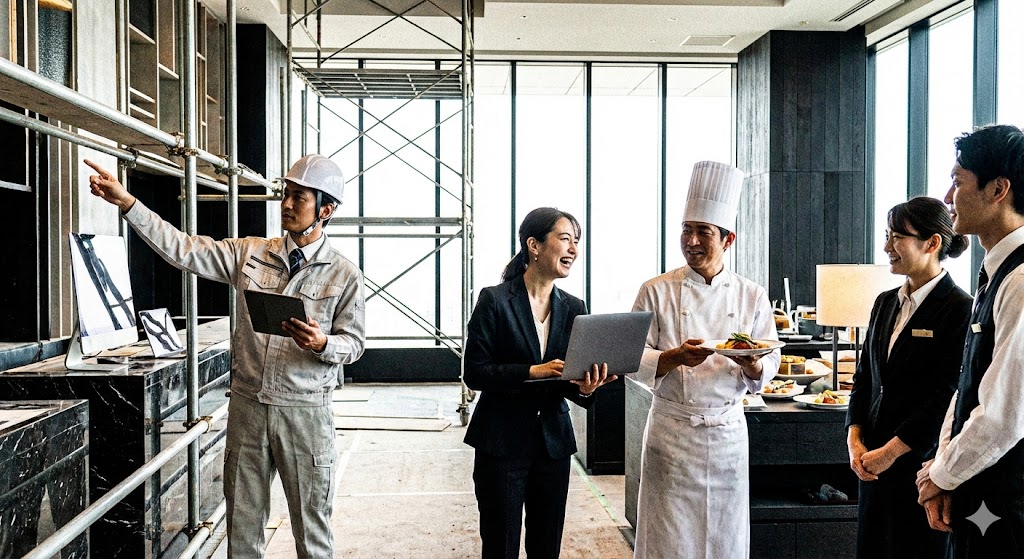
The biggest reason why cross-industry entry into the hotel business succeeds lies in “not being bound by the conventions of the hotel industry.” By combining their “core business strengths”—the cost competitiveness of construction companies, the technology and labor-saving expertise of IT firms, the content strength of food service businesses—with the hotel space, these companies create overwhelming differentiation (a sharply defined concept). Furthermore, by outsourcing on-site operations to “hotel management professionals,” they completely cover their weakness of inexperience, establishing highly profitable business models.
This article thoroughly dissects the specific business models and strategies of how three different industries—construction, IT companies, and food service—are each leveraging their core business strengths to succeed in the hotel business.
Why Cross-Industry Entry into the Hotel Business Is Happening Now
Hotel management used to be a “closed industry” requiring specialized know-how, skilled staff, and massive initial investment. Today, however, that barrier has dramatically lowered.
Lower Entry Barriers Through “Unbundling of Operations”
The biggest reason is that hotel operations have become easier to systematize and outsource.
Reservation management (channel management systems) and price adjustments (revenue management) are now automated by IT tools, while on-site cleaning, linen arrangements, and 24-hour guest support are handled by specialized property management companies.
In other words, entrant companies no longer need to hire and train “hotel staff” themselves. Companies can now focus on “what kind of hotel to create (planning)” and “who to entrust operations to (partner selection),” making cross-industry entry much easier.
“New Value” Demanded in an Oversupplied Market
Countless business hotels line the streets of Osaka. Simply building “a clean room just for sleeping” only leads to being caught up in price wars.
What guests want is “an experience they can only have there.” This is exactly the opportunity for cross-industry companies—those who can bring fresh ideas not found in the existing hotel industry and create new stay-time value—to win in today’s market.
[Success Story 1] Construction & Real Estate: Winning with Spatial Design and Cost Competitiveness
Entry from construction companies or real estate developers is the most natural fit for hotel development, making it a classic pattern for maximizing profits.
“Minimizing Initial Investment” Through In-House Construction
The greatest strength of construction companies is their ability to handle everything from development to construction in-house (or through a strong network of partner companies).
The biggest hurdle in the hotel business is “initial investment”—construction and renovation costs. Because these companies can keep costs close to raw cost without intermediary margins, they can dramatically shorten their return on investment (ROI) period compared to other market entrants.
Using the Hotel as a “Showroom”
One mid-sized local construction firm fully leveraged its expertise in “solid wood architecture” to open a Japanese-modern whole-building rental accommodation.
This goes beyond a simple lodging business—it functions as a “livable showroom” that showcases the company’s construction techniques to domestic and international guests. Guests who are moved by the space often go on to commission the company for their own home construction, creating a brilliant synergy effect with the core business.
Know-How in Property Conversion
Real estate companies have access to routes for cheaply acquiring “problem properties” or “underutilized real estate” (such as old office buildings and warehouses) before they hit the open market.
By skillfully navigating the Building Standards Act and the Hotel Business Act to convert these properties into hotels, they revitalize them into highly profitable assets yielding over 10%—generating cash flow that far exceeds what their core real estate leasing business could produce.
[Success Story 2] IT & Tech Companies: Winning with Data Utilization and Labor-Saving Operations
Entry from IT companies overturns the conventional wisdom that the hotel industry is labor-intensive, using technology to achieve remarkable profit margins.
Reducing Fixed Costs Through Thorough Unmanned/Labor-Saving Operations
A hotel launched by one IT company has no staff stationed on-site.
Reservations through payment are all completed online, and the hotel uses smart locks that unlock with a passcode sent to the guest’s smartphone. Check-in procedures are handled via video calls and passport scanning on tablets placed at the property.
This has succeeded in slashing “labor costs (front desk staff)”—the biggest expense in hotel management—to the absolute minimum, significantly lowering the break-even point.
Data-Driven “Dynamic Pricing”
The strength of IT companies lies in their ability to collect and analyze data.
They thoroughly implement “dynamic pricing,” using AI (artificial intelligence) to analyze vast amounts of data—including competitor pricing trends nearby, local event information, flight booking status, and historical trends—to adjust room rates on a daily or even hourly basis.
On high-demand days, they aggressively raise prices to maximize revenue; during slow seasons, they lower prices to maintain occupancy. This “art of pricing” achieves profitability that overwhelms existing hotels relying on individual staff intuition.
[Success Story 3] Food Service: Winning by Creating Stay Value Centered on “Dining”
Entry from food service companies succeeds with an approach that positions “eating” rather than “sleeping” as the primary purpose of the hotel’s function.
“Auberge-Style” Urban Hotels
One company operating multiple high-end restaurants opened a boutique hotel with its flagship restaurant on the ground floor and guest rooms on the upper floors.
They package and sell the experience itself: “Enjoy the finest dinner and wine at the restaurant, then drift off to sleep in a quality room without worrying about the time to head home.”
Whereas existing hotels “offer meals as an accompaniment to lodging,” food-service-originated hotels take the reversed approach of “providing lodging space to maximize the impact of the dining experience,” capturing enthusiastic fans (repeat guests).
Breakfast Specialization and Delivery Services
There are also examples of hotels that intentionally forgo an on-site restaurant, instead gaining popularity through a service that delivers “exquisite breakfast boxes” made in their core business’s central kitchen to each guest room’s doorknob every morning.
This “delicious surprise,” made possible only by a company with culinary expertise, draws extremely high ratings (5 stars) in guest reviews, creating a positive cycle that attracts even more guests.
Common “Golden Rules” for Successful Cross-Industry Entry
While construction, IT, and food service take entirely different approaches, successful cross-industry entrants share common “golden rules.”
They Fully Commit to Their Core Business Strength (Concept)
They don’t try to create “an ordinary hotel.”
They concentrate their management resources on areas where they can win—”design quality,” “contactless convenience,” “the ultimate dining experience”—and narrow their target audience intensely. Creating a concept that a specific someone will actively choose, saying “I want to stay here,” rather than trying to please everyone, is the key to surviving in Osaka’s fiercely competitive market.
They Outsource Their Weakness (Hotel Operations) Entirely to Professionals
Most importantly, they don’t try to operate the hotel themselves.
For companies from other industries, daily room cleaning, handling late-night guest inquiries, and updating listings to match OTA (booking site) algorithms are completely outside their area of expertise. Trying to do everything in-house here leads to quality decline from lack of know-how, potentially even damaging their core business brand.
Successful companies focus solely on their strength—”planning and development”—while fully entrusting the gritty post-opening work of “on-site operations, cleaning, and marketing” to experienced, professional property management companies. This rational commitment to “leaving the rice cake making to the rice cake maker” is the true source of their strength.
Conclusion: Your Company’s Core Business Can Become the Ultimate Hotel Concept
The hotel business is no longer exclusive to hoteliers.
- Construction companies generate overwhelming yields through “cost competitiveness and spatial design.”
- IT companies maximize profit margins through “technology-driven labor savings and data utilization.”
- Food service companies capture passionate repeat guests through “the killer content of dining experiences.”
Your company’s core business surely has untapped strengths. When you install that strength into the “accommodation” space, you’ll create a one-of-a-kind hotel business that competitors simply cannot replicate.
Complete Support for Cross-Industry Entry into the Hotel Business. Trust Stay Buddy.
“I want to build a hotel leveraging our company’s real estate and construction know-how, but I’m worried about the barriers of the Hotel Business Act.”
“I want to create a concept that leverages our core business strengths, but I don’t understand the accommodation market trends.”
“I’m looking for a trustworthy partner who can handle everything after opening—reservation management, multilingual support, and cleaning operations.”
Leave all these concerns to us.
We at Stay Buddy Inc. are a team of professionals specializing in accommodation business consulting and property management, focused exclusively on Osaka City.
We have guided numerous cross-industry companies to success in entering the hotel business.
- Thorough market research combined with your company’s core strengths to design a “winning concept”
- Prior investigation and development support by expert teams to clear complex hotel business permits and fire safety regulations
- Support in building unmanned front desk systems using IT tools
- “Complete property management” including hotel-quality cleaning management and 24/7/365 multilingual guest support
We leverage your company’s “strengths” while perfectly covering your weak point—”operations.”
To ensure your hotel venture as a new business is set on a guaranteed path to success, Stay Buddy will be your strongest partner. Please feel free to contact us for a free business feasibility assessment and concept consultation.