Leave Your Vacation Rental Management to Us
Free Online ConsultationWhen it comes to running a vacation rental, whether or not a property has a clear concept can make or break both booking rates and profitability. Platforms like Airbnb are flooded with countless listings, and in this environment, simply offering “a place to sleep” is no longer enough to stand out. Designing a clear concept for your property and differentiating it from the competition is directly tied to achieving stable occupancy and higher nightly rates.
In this article, we’ll explore why properties with a strong concept get chosen more often, what specific differentiation strategies exist, and what to keep in mind when actually designing a concept for your property. We’ll include real numbers and case studies so you can put this into practice right away.
Why Concept-Driven Differentiation Is Essential for Vacation Rentals
The number of registered vacation rentals in Japan has surpassed tens of thousands cumulatively, and in major cities and tourist destinations, oversupply has become the norm. In Kyoto alone, for example, more than 4,000 vacation rental properties are registered, giving guests an enormous range of choices. To get your property chosen from among all these options, you need to offer more than just a competitive price—you need to present “an experience only your property can provide.”
Looking at Airbnb search results, listings that establish a distinct visual identity through their titles and thumbnail images see click-through rates that are 1.5 to 2 times higher on average compared to generic listings. Properties with a clearly defined concept also tend to cluster around review scores of 4.8 or higher, creating a virtuous cycle that drives even more bookings. In other words, a “concept” isn’t about vaguely making a space look stylish—it’s a strategic design approach that correctly sets guest expectations and then exceeds them.
The Revenue Gap Between Properties With and Without a Concept
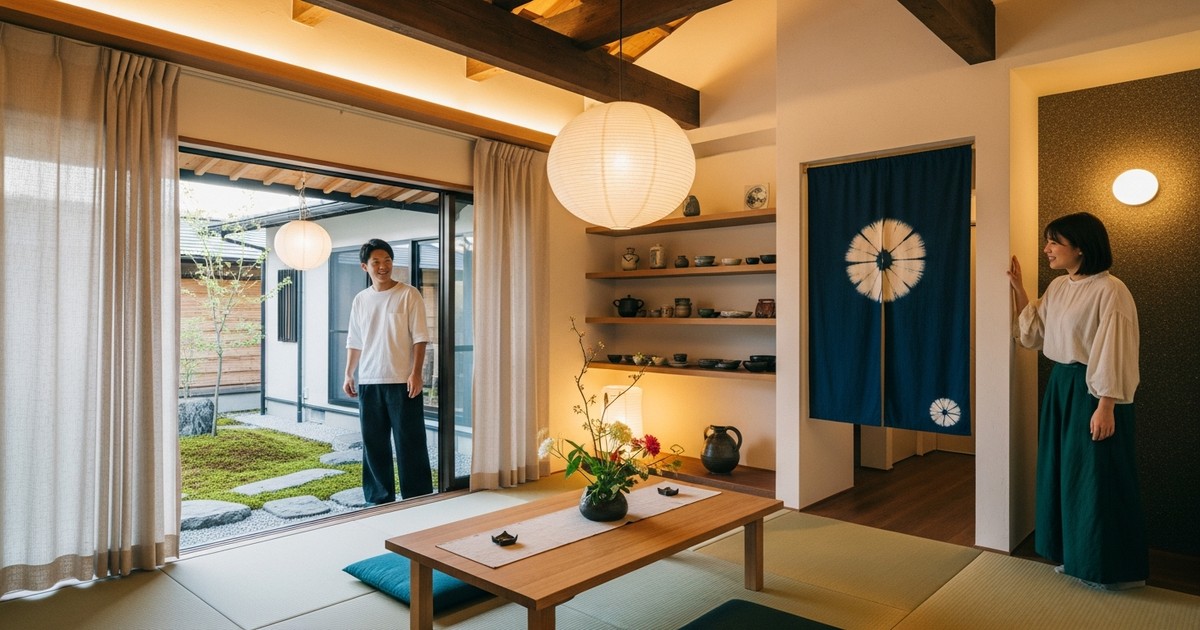
Let’s look at some concrete numbers to see just how much having a concept can impact revenue. Comparing similar 1-bedroom, 4-guest properties in the same city and area, a property with a generic interior and no clear concept typically commands an average nightly rate of around 8,000 to 10,000 yen. Meanwhile, a property designed around a “Japanese modern” theme—complete with tatami spaces, shoji screens, and a Japanese tea set—can consistently maintain occupancy at a nightly rate of 15,000 to 20,000 yen.
This difference becomes substantial when calculated on an annual basis. Assuming 70% occupancy and 21 bookings per month, a property without a concept generates roughly 180,000 yen per month, or 2.16 million yen per year. In contrast, a property with a strong concept generates roughly 350,000 yen per month, or 4.2 million yen per year—a gap of more than 2 million yen annually. Given that the initial investment in interior design typically runs 500,000 to 1,000,000 yen, this cost can be recovered within about six months.
How to Create a Concept That Resonates With Guests
Start by Clearly Defining Your Target Guest
The most important step in concept design is defining specifically who you want to stay at your property. If you target “all travelers,” you end up with a property that resonates with no one in particular. Instead, narrow things down—for example, “couples in their 20s and 30s looking for a photogenic space” or “couples in their 50s and beyond who want to quietly experience Japanese culture.” Define the age group, travel style, and desired experience clearly.
Narrowing your target creates consistency across your interior design direction, amenity choices, and even the tone of your listing copy. In one real case, a property that specifically targeted “families with children” and provided a crib, children’s tableware, and a picture book corner saw repeat bookings from family guests account for 30% of all bookings.
Leverage the Location and Characteristics of the Property
Rather than forcing a concept onto a property, it’s far more effective to draw one out from the property’s own unique characteristics. An older traditional townhouse (machiya) can lean into a Japanese aesthetic, while a property in a fishing port town can naturally embrace a design motif inspired by the sea and fishing culture. A unit in a high-rise apartment building might work well with an “urban retreat” concept that highlights the night view.
What matters most is whether guests, upon arrival, feel that “it’s exactly like the photos” or even “it exceeds my expectations.” Forcing a concept that doesn’t match the property’s actual location or characteristics raises the risk of reviews saying “it looked different from the photos.” Rather than hiding your property’s weaknesses, think about how to draw out and maximize its strengths.
Design an Experience That Appeals to All Five Senses
It’s also important not to limit your concept to visual appearance alone. By incorporating elements that appeal to smell, sound, touch, and taste alongside visual interior design, you create a stay that guests will genuinely remember. For example, a property with a “forest hideaway” concept might pair wood-toned furniture with a hinoki cypress aroma diffuser and potted plants arranged near the windows.
Even something as simple as offering locally roasted coffee or Japanese tea as a welcome drink upon arrival can significantly boost guest satisfaction. These touches typically cost just a few hundred yen per group, but reviews mentioning “I loved the tea” or “the scent was so relaxing” have a positive ripple effect on future booking conversion rates.
Concrete Strategies for Achieving Differentiation
Theme-Focused Interior Design
The most straightforward differentiation method is committing fully to a specific theme in your interior design. For instance, one property built around a “Showa-era retro” theme incorporated a low table (chabudai), a monitor styled to look like an old CRT television, and vintage posters. This spread organically on social media with comments like “it feels like stepping back in time,” expanding awareness without any advertising spend. The initial interior investment was about 800,000 yen, but the property now receives more than 5 direct bookings per month via social media, which also reduces platform commission fees.
Other theme options include “Scandinavian style,” “Asian resort,” “minimalist,” and “art space,” among many others. The key is committing fully rather than doing things halfway—unifying everything down to the small decor items and linen colors to complete the overall aesthetic.
Adding Experience-Based Content
An “experience-based” approach that adds value beyond the stay itself is also highly effective. Examples include placing a tea ceremony experience kit in the room with a QR code linking to a how-to video, or partnering with nearby restaurants to offer coupons for special menu items. Properties that offer some kind of experiential element tend to see review scores that are 0.2 to 0.3 points higher on average.
These experiences don’t need to be elaborate. Simply leaving a board game, a hand-made local area guide map, or a “host’s recommendations notebook” listing nearby routes can make guests feel they’re getting an experience unique to that property. These touches often cost just a few thousand yen, making them extremely cost-effective initiatives.
Optimizing Your Listing Through Storytelling
Your listing page is the single most important touchpoint for communicating your property’s concept to guests. Rather than simply listing features like “spacious living room” or “5-minute walk from the station,” it’s important to write descriptions that tell a story aligned with your concept. For example, a description like “This 80-year-old townhouse has been renovated with a modern sensibility. Slide open the lattice door, and a traditional earthen entryway welcomes you inside” sparks guests’ imagination and increases their desire to book.
Photos should also be shot and selected to match this story. Hiring a professional photographer typically costs 20,000 to 50,000 yen per session, but since photo quality directly impacts click-through and booking rates, this is an area worth investing in. Shooting during hours when natural light streams in, and including scenes that show people actually enjoying the space, helps convey a vivid sense of what staying there would be like.
Common Pitfalls in Concept Design and How to Avoid Them
Falling Into Self-Indulgence and Losing Touch With Market Needs
If you decide on a concept based purely on the owner’s personal tastes and preferences, a gap can emerge between the concept and actual guest needs. In one case, an owner committed so heavily to a “fully traditional Japanese” theme that they furnished the property with futon bedding only, and received multiple reviews from overseas guests saying “there was no bed, so I couldn’t sleep well.” You need to strike a balance that stays true to your concept while not sacrificing basic comfort.
As a countermeasure, before finalizing your concept, read through at least 50 reviews of competing properties in the same area to understand what guests value and what frustrates them. Concept design grounded in real data significantly reduces the risk of failure.
Failing to Account for Maintenance Costs
No matter how attractive an interior looks, if it requires excessive time and money to maintain, your operation won’t be sustainable. For example, a sleek all-white interior may photograph beautifully, but stains and dirt show up easily after each stay, requiring more frequent linen changes. In some cases, the cost of replacing white sofa covers alone can run 10,000 to 20,000 yen per month.
When designing your concept, be sure to factor in ease of cleaning, the durability of fixtures and furnishings, and replacement costs from the very beginning. Many properties that maintain high occupancy rates achieve this by choosing materials that balance design appeal with practicality—for example, using dark-toned furniture that doesn’t show dirt easily, and adding brightly colored cushions or artwork as accents.
Contact Stay Buddy Inc. for Vacation Rental Concept Design and Differentiation
Stay Buddy Inc., a vacation rental management company, provides comprehensive support—from concept design and interior planning to listing creation and full property management. Drawing on our extensive track record across numerous properties, we propose the optimal concept for your property based on thorough analysis of the local area and target guests.
If you’re a property owner who has a property but isn’t sure what concept to build around it, who’s already operating but struggling to boost occupancy, or who feels stuck in a price war due to a lack of differentiation from competitors, we encourage you to reach out to us.
We provide concrete advice covering everything from market research and financial simulations to interior design direction. Let’s work together to make the most of your property’s strengths and build a vacation rental that guests choose again and again. To get in touch with Stay Buddy Inc., please feel free to reach out through the contact form on our official website.