Leave your minpaku management to the experts
Completely Free Online ConsultationMore and more minpaku properties are welcoming guests who visit specifically for outdoor and sports activities. Guests who choose a minpaku to enjoy hiking, surfing, skiing, cycling, fishing, and similar activities near their destination have needs that differ significantly from those of hotel guests. To accommodate these guests properly, hosts need to prepare with a different mindset than usual—covering facilities, traffic flow within the property, information provision, and cleaning arrangements.
This article breaks down the key points to consider when hosting outdoor-focused guests at your minpaku, organized by facilities, operations, and marketing. Capturing sports and outdoor demand can be a highly effective differentiation strategy, with some properties—depending on location—seeing occupancy rates rise by 10 to 20%.
Because these guests behave very differently from typical sightseeing travelers, the challenges you need to anticipate also differ. Let’s walk through practical, actionable information step by step.
Facilities and Environments Outdoor Guests Look For at Minpaku Properties
An Entryway or Mudroom Designed for Dirt and Grime
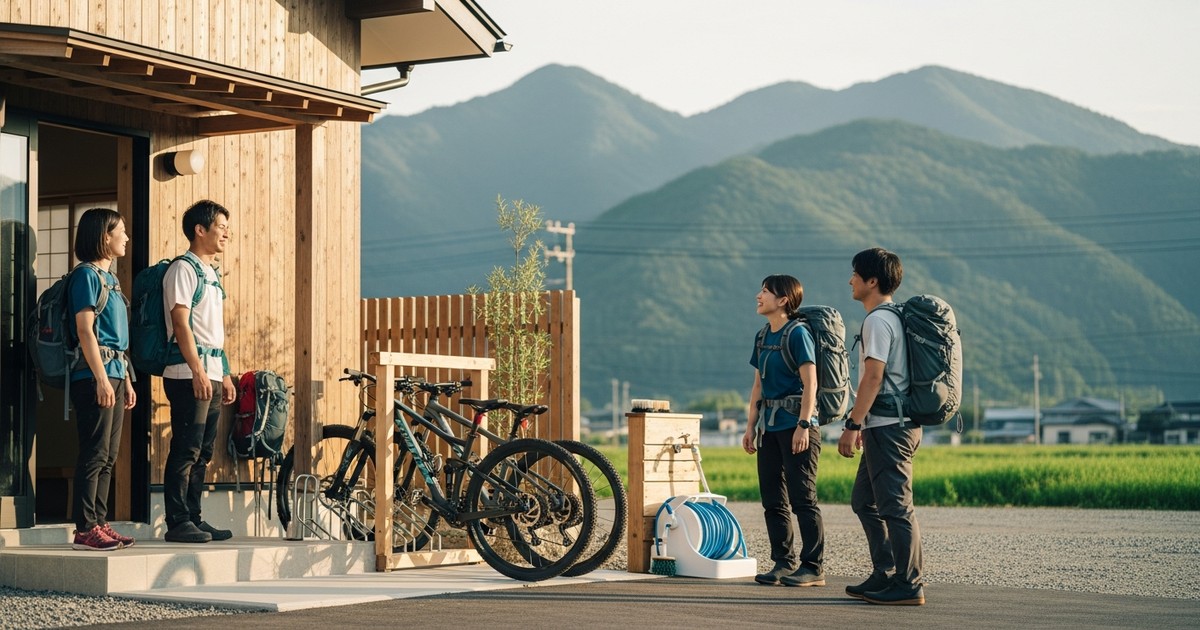
Guests returning from outdoor activities often bring back mud-caked boots, wetsuits, and sand-covered surfboards. Typical minpaku entryways tend to be small, with limited space for removing shoes, creating a real risk that dirt and grime will spread into the living space. Securing even a small mudroom area—about one tatami mat’s worth, finished in tile—lets you keep both guest satisfaction and property condition intact.
Concretely, simply keeping a waterproof mat or tarp at the entrance and providing a shoe brush and bucket can make a meaningful difference. If renovation isn’t feasible, setting up a simple outdoor washing area with a faucet is another option. A basic outdoor faucet installation runs about 30,000–50,000 yen, while tiling a mudroom area typically costs 100,000–150,000 yen.
A Space for Washing and Drying Gear
Ski equipment, fishing rods, tents, wetsuits—outdoor gear needs to be washed and dried after use. Since a standard bathroom often isn’t sufficient, it’s worth installing an outdoor faucet with a shower head, or setting up a drying area in a garage or under the eaves.
A bathroom dryer can handle drying to a certain extent, but it’s not enough for large tents or ski wear. Simply providing two or three folding drying racks along with a dehumidifier can significantly boost guest satisfaction. A standard household dehumidifier priced around 10,000 yen is more than adequate.
Securing Storage and Parking Space
Guests visiting for outdoor activities tend to bring a lot of gear. A group of four heading out for skiing, for example, might bring four sets of skis, boots, outerwear, and other equipment—two to three times the luggage of a typical traveler. Since gear scattered around the entryway or hallway increases the risk of damage or soiling, it’s important to provide dedicated storage space.
In areas where guests are expected to travel by car, securing parking is also essential. Vehicles carrying surfboards or kayaks on roof racks often have increased clearance height, making most multi-level parking structures unusable. Having even one or two flat, ground-level parking spaces on the property is a significant advantage. If you need to secure a nearby monthly parking contract, expect costs of around 5,000–15,000 yen per month—though this can be recovered by charging guests a parking fee of 1,000–2,000 yen per night.
Designing Flexible Check-in and Check-out Times
Accommodating Early Morning Departures and Late-Night Returns
Surfers often head out as early as 5 a.m., and 6 a.m. departures are common for hikers and skiers as well. Conversely, guests returning from fishing or hiking sometimes don’t get back until after 8 p.m. The typical minpaku schedule of 3 p.m. check-in and 10 a.m. check-out simply doesn’t align well with these guests’ patterns.
Installing a smart lock allows guests to check in early or return late at night without needing to meet you in person. Smart lock installation typically costs 10,000–30,000 yen for the unit, plus a monthly service fee of 500–1,500 yen. Some minpaku properties offer a late check-out option—extending to 11 a.m. or noon—for a fee of 1,000–2,000 yen, improving both guest convenience and your revenue.
Designing Multi-Night Discounts
Outdoor-focused guests tend to book multi-night stays of two to four nights rather than a single night. Research on minpaku properties near ski resorts shows that average length of stay is 1.5 times longer than that of typical sightseeing guests. Offering multi-night discounts can help stabilize occupancy while encouraging guest loyalty.
A practical approach is to offer 10% off from the second night onward, and 20% off for stays of four nights or more. For a property priced at 15,000 yen per night with a three-night booking, the total without a discount would be 45,000 yen, versus 41,500 yen with the 10% multi-night discount. However, since multi-night stays reduce the number of cleanings required, you save on cleaning costs (typically 5,000–8,000 yen per cleaning), which actually improves your overall profit margin.
How Much Local Activity Information Should You Provide?
Creating a Guest Book or Digital Guide
For outdoor-focused guests, detailed local information is often a deciding factor in choosing where to stay. Preparing a guide with specifics—distance and travel time to nearby trailheads, the characteristics and hazards of local surf spots, rental shop hours and pricing, and contact information for the nearest hospital in case of emergency—tends to lead to better reviews.
In addition to a printed guest book, an efficient approach is to create a digital guide using Google Docs or Notion and send the link once the booking is confirmed. Creating the guide typically takes 3–5 hours the first time, but updates afterward require minimal effort. If you partner with local activity providers and arrange exclusive discounts for your guests, you may even earn a referral commission of 5–10%.
Added Value Through Partnerships with Local Businesses
Partnering with local activity providers—guided trekking tours, SUP experiences, mountain bike rentals, and the like—can substantially increase the value of your property as accommodation. In fact, minpaku properties offering package deals that include activities have reported booking values 20–30% higher than standard plans.
A good way to start is to list 5–10 activity providers in your area and reach out to them directly to propose a partnership. A referral-based commission arrangement tends to be the simplest structure, and providers often welcome the opportunity as a new customer acquisition channel. That said, under Japan’s Private Lodging Business Act (Minpaku Shinpo), you’ll need to clearly define the scope of liability when offering services beyond accommodation itself.
Managing the Increased Burden of Cleaning and Maintenance
Budgeting for Higher-Than-Usual Cleaning Costs
After outdoor-focused guests stay, properties often end up with sand, mud, grass, and pine resin—types of grime that typical stays don’t produce. Dirt tends to concentrate around the entryway, bathroom, and sink area in particular. Cleaning that normally takes 2 hours might take 2.5–3 hours after an outdoor-heavy stay.
If you outsource cleaning, a typical job costing 5,000–8,000 yen might incur an additional 1,000–2,000 yen surcharge. You’ll want to decide in advance whether to build this into your nightly rate or charge it separately as a cleaning fee. Since Airbnb allows you to set a separate cleaning fee, a realistic approach is to clearly label your property as outdoor-friendly and set the cleaning fee at 8,000–10,000 yen.
Managing Wear on Consumables and Fixtures
Properties that frequently host outdoor guests tend to go through towels faster—typically needing replacement 1.5–2 times more often than a standard minpaku. Since white towels show mud stains easily, it’s worth switching to darker-colored towels, or keeping separate sets for outdoor and indoor use. Commercial-grade towels cost roughly 300–500 yen each, and buying in sets of 30 can bring the total to around 10,000 yen.
Flooring also deserves attention. Solid hardwood floors scratch easily, and ski boot buckles or crampon spikes can leave deep gouges. Laying cushion flooring or tile carpet along the path from the entryway to the living space can help keep repair costs down. Tile carpet costs about 500–800 yen per tile and can be replaced piece by piece where damaged, making it an efficient option for long-term cost management.
Differentiating Your Listing Through Smart Presentation
Making Your Target Audience Clear Through Photos and Titles
On Airbnb and other booking platforms, clearly highlighting your property’s outdoor-friendliness can boost booking rates among your target audience. Beyond photos of the exterior and interior, it’s effective to include images of the gear-washing area, drying space, storage shelving, and parking. Adding two or three scenic photos of nearby activity spots also helps guests picture the experience awaiting them during their stay.
Your title should include specific distances and times—phrases like “10-minute drive to the trailhead,” “5-minute walk to the surf spot,” or “in front of the ski resort shuttle stop.” Analysis shows that listings with concrete numbers, rather than vague descriptions, see click-through rates 15–25% higher. In your description, list the types of gear you can accommodate and the specifics of your washing facilities in bullet-point form, so guests can make an informed decision before booking.
Review Strategy and Building a Repeat Guest Base
Guests who visit for outdoor activities tend to return to the same location again and again. Surfers often adopt a spot as their “home break” and keep coming back, while hikers may return to the same base to explore different seasonal routes. Building a base of repeat guests like these can dramatically reduce your customer acquisition costs.
The key to attracting repeat guests starts with reviews that clearly convey how well-equipped your property is for outdoor activities. Sending a thank-you message after check-out along with a discount code for their next stay is an effective tactic. Even a 10% increase in repeat bookings can save tens of thousands of yen annually in advertising costs and platform fees. If you have your own direct booking site, you can also avoid OTA commissions (typically 15–20%), further improving your profit margin.
Preparing for Insurance and Trouble Response
Insurance Coverage for Property Damage Risk
The risk of property damage from outdoor gear is higher than at a typical minpaku. Specific risks range widely—a surfboard putting a hole in a wall, a ski’s metal edge scratching hardwood flooring, muddy water staining tatami mats, and more. Airbnb’s Host Guarantee program can cover up to 100 million yen, but it doesn’t always apply smoothly to every case.
A more realistic safeguard is enrolling in dedicated minpaku property insurance. Annual premiums vary depending on the size of your property, but plans in the 10,000–30,000 yen range typically offer coverage of 500,000–1,000,000 yen per incident. Additionally, setting a security deposit of 3,000–10,000 yen for guests can act as a deterrent against minor damage.
Emergency Contact Procedures
Outdoor activities carry inherent risks of injury and accidents. While minpaku hosts aren’t directly liable, posting a list of contact information for the nearest emergency hospital, fire department, and police station inside the property gives guests peace of mind. In mountainous areas, including contact information for the local mountain rescue team, or for coastal properties, noting lifeguard coverage, is a thoughtful touch.
Keeping a first-aid kit on hand is also a basic precaution. Stock it with items suited to minor outdoor injuries—disinfectant, adhesive bandages, gauze, athletic tape, and cooling spray. The kit typically costs 2,000–3,000 yen to assemble, and can be maintained with a restock every six months. These small touches directly translate into higher review ratings.
Have Questions About Minpaku Management? Talk to Stay Buddy Inc.
Running a minpaku property that caters to outdoor demand involves numerous practical challenges—equipment investment, rethinking your cleaning setup, optimizing your listing, and more. Handling all of this on your own requires significant time and experience, and mistakes in judgment can delay your return on investment.
Stay Buddy Inc. offers comprehensive minpaku management support, from defining the right target audience for each property, to advising on equipment installation, creating listings, arranging cleaning, and handling guest communications. We have extensive operational experience in areas with strong outdoor demand and can propose concrete strategies to maximize revenue based on your property’s unique characteristics.
Whether you’re just starting out in minpaku or you’re already operating but struggling with occupancy, please feel free to reach out. We’ll put together a concrete plan tailored to your property’s location and target guest profile.
To consult with Stay Buddy Inc., please use the contact form on our official website or give us a call. Your first consultation is completely free.