Leave Your Vacation Rental Management to the Experts
Free Online ConsultationPhotography is one of the single most important factors influencing your Airbnb listing’s booking rate. In fact, Airbnb itself has stated that listings using professional photos see up to a 40% increase in bookings compared to those without. But simply snapping photos of your rooms isn’t enough. How many photos you need, and the order and composition in which you showcase each space, directly shapes a guest’s decision to book.
This article breaks down the ideal number of photos for a high-performing Airbnb listing, along with concrete guidance on what to shoot and how to structure your photo set. Whether you’re just starting out in vacation rental hosting or you’re already running a property but struggling to grow bookings, revisiting your photos is one of the fastest, most effective improvements you can make.
It’s not uncommon to see listing views more than double simply by improving photo quality and composition. By the end of this article, you’ll have a clear picture of exactly what to photograph in your own property and how to arrange those images.
The First Decision to Make: How Many Photos Do You Need?
Airbnb allows up to 200 photos per listing, but more isn’t always better. Too much information can actually cause guests to lose interest and click away. As a general rule, studio and 1-bedroom units perform best with 15–20 photos, while family-oriented properties with two or more bedrooms should aim for 25–35. This guidance is based on behavioral data showing that guests typically stop scrolling somewhere around the 30-photo mark.
A useful breakdown looks like this: 3–5 photos of the living room, 2–3 photos per bedroom, 2–3 photos of the kitchen, 2–3 photos of the bathroom, 2 photos of the exterior/entrance, 1–2 photos of the surrounding area, and 3–5 additional detail shots of amenities and facilities. Listings with 10 or fewer photos tend to leave guests feeling that information is lacking and uncertain, which significantly lowers booking rates. One host who increased their photo count from 12 to 28 reported a 1.8x increase in monthly bookings as a result.
Why Your Cover Photo (Photo #1) Determines Everything
The cover photo shown in search results is the single biggest factor in whether a guest clicks into your listing at all. On Airbnb’s search screen, guests see a photo, title, price, and review score all at once—but eye-tracking studies consistently show that a user’s gaze goes to the photo first. In other words, if your cover photo doesn’t make a strong impression, guests won’t even click through to see how great the rest of your listing is.
Ideal cover photos are shots of open spaces like the living or dining room that convey a sense of spaciousness. Shooting diagonally from one corner of the room during a time of day when natural light is streaming through the windows will make the space appear larger than its actual square footage. For properties with high ceilings, a low-angle shot can be especially effective. On the other hand, using a close-up of a bed or a bathroom as your cover photo fails to communicate the overall appeal of the property. Many hosts have reported a 25% increase in click-through rate simply by swapping out their cover photo.
How to Compose Living Room and Dining Room Shots
A Wide Shot Showing the Full Space
The living room is where guests will spend the most time, and it plays a major role in shaping their overall impression of the property. Start by shooting one wide-angle photo from a corner that captures the whole room. Using a wide-angle lens (equivalent to a 16–24mm focal length) will naturally emphasize the sense of space. That said, going too wide can introduce distortion that makes guests uneasy—around 18mm tends to offer the best balance.
Detail Shots That Help Guests Picture Themselves There
In addition to the wide shot, add 1–2 detail photos that evoke everyday life—a coffee cup on the table, a blanket draped over the sofa. These “lifestyle shots” make it easier for guests to imagine themselves actually staying in the space. Data shows that photos with a touch of tasteful styling tend to convert better than sterile, completely lived-in-free images.
Key Points for Photographing the Bedroom
A Straight-On Shot of the Bed
The most important thing in any bedroom photo is that bed size and cleanliness are immediately obvious. Shoot from the foot of the bed facing straight ahead, capturing the pillows, sheets, and comforter neatly arranged. Bed size (single, double, queen, etc.) is information that directly affects a guest’s booking decision, and if it can’t be determined from the photo, it becomes a source of doubt. White linens are a favorite among successful hosts because they convey cleanliness and create a hotel-like impression.
Ambient Shots Featuring Windows and Lighting
For a second shot, capture the mood of the room using natural light from a window or ambient lighting. Since guests use bedroom photos to judge whether they’ll sleep well, aim for a calm tone that’s neither too dark nor too bright. Opening the curtains halfway to let in natural light, combined with a lit bedside lamp, creates a warm, inviting photo. For properties with multiple bedrooms, be sure to take at least two photos of each room so guests can clearly tell the rooms apart.
Kitchens and Bathrooms: Showcasing How Well-Equipped They Are
Tips for Photographing the Kitchen
The kitchen matters especially to longer-stay guests. The basic approach is one wide shot of the whole space plus one close-up of cookware and dishware. Make sure to capture any appliances guests will care about—induction cooktop, microwave, refrigerator, rice cooker, and so on. Photos that show a well-stocked kitchen reassure guests that they can cook for themselves, which is especially effective for winning bookings from families and business travelers. A neatly arranged shot of seasonings and basic tableware also communicates a high level of hospitality.
Tips for Photographing the Bathroom
Cleanliness is everything in bathroom photos. Before shooting, wipe away all water droplets and mineral deposits, and fold towels neatly and evenly. Be mindful of your angle so you don’t end up reflected in the mirror, and shoot from the doorway looking inward. If there’s a bathtub, be sure to highlight it—Japanese-style bathtubs are a major draw for international guests. Arrange amenities like shampoo and body wash so they’re visible in the shot. If the toilet is in a separate room, it’s a nice touch to photograph it separately as well.
Easily Overlooked Shots: Exterior, Access, and Neighborhood
Building Exterior and Entrance
The building’s exterior is a shot that’s surprisingly easy to forget. Guests visiting a place for the first time naturally feel some anxiety, and having a photo that confirms “this is the right building” goes a long way toward putting their minds at ease. For apartment buildings, include shots of the auto-locked entrance or elevator; for houses, capture the gate or front door. Since many guests check in after dark, it’s also a thoughtful touch to include one nighttime exterior photo.
Nearest Station and Nearby Spots
Photos showing the distance to the nearest train station, along with nearby convenience stores or supermarkets, are especially valuable for international guests unfamiliar with the area. A real photo of the station and the walking route is far more convincing than simply writing “5-minute walk to the station” in text. If the property is near a popular tourist attraction, including one photo of that spot helps visually communicate the value of the location.
Photo Order Matters Just as Much for Booking Rates
The order in which you arrange your photos also influences guests’ decision-making. Since Airbnb’s algorithm factors in cover photo click-through rate and time spent on a listing, your photo composition indirectly affects your listing’s search ranking as well. The recommended order is: cover photo (full living room) → living room details → bedroom → kitchen → bathroom → other amenities → exterior → neighborhood.
This sequence mirrors the natural thought process guests go through when evaluating a property. First, they want to understand what the space looks like overall; then they check whether it looks comfortable to sleep in, whether they can cook, and whether it’s clean. Finally, they look at the exterior and surrounding area to form their overall judgment. Conversely, leading with an exterior shot, or stringing together several photos with near-identical angles, causes guests to lose interest and stop scrolling. One property optimized its photo order and saw average listing view time increase from 38 to 54 seconds—resulting in three additional bookings per month.
Technical Points to Keep in Mind While Shooting
The Best Time of Day for Natural Light
The best time for indoor photography is between 10am and 2pm. During this window, the sun sits high in the sky, casting soft, even light through windows. Overcast days actually work in your favor for indoor shots, since they avoid the harsh shadows caused by direct sunlight. Avoid using flash, as it tends to create unnatural shadows; if a particular area is too dark, a portable LED light will give you a more natural result.
Composing with Level Horizontals and Verticals
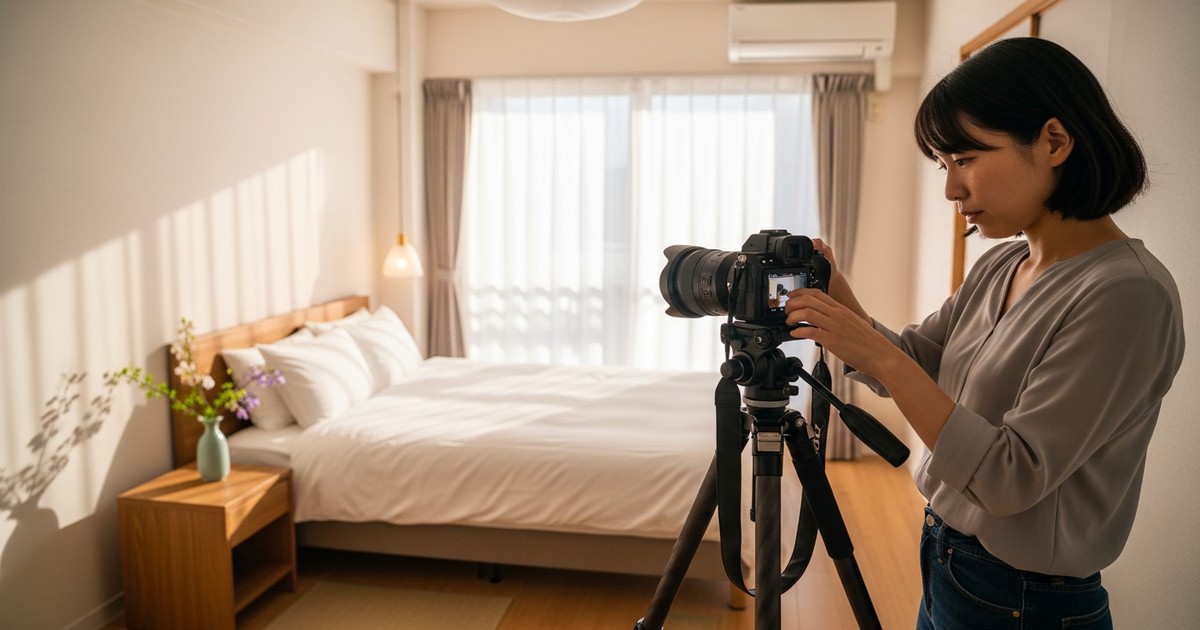
Nothing looks more off to guests than a photo with crooked horizontal or vertical lines. Use a tripod and turn on your camera’s grid lines to check your framing as you shoot. Even with a smartphone, simply enabling the grid overlay in settings makes a huge difference in the precision of your composition. When wall and ceiling lines run perfectly straight, the entire photo instantly looks far more professional.
Tidying and Styling Before You Shoot
The success of a photo shoot is largely determined before you even pick up the camera. Move all personal belongings, trash cans, and cords out of frame, and keep tabletops styled with just a few minimal items—a houseplant, one or two books, a coffee cup are ideal examples. Too much clutter makes a room feel messy, while removing every trace of life makes it feel cold and uninviting. The sweet spot is somewhere in between, similar to the styling you’d see in hotel room photography.
Should You Hire a Professional or Shoot It Yourself?
Airbnb once offered a free professional photography service, but that program has since ended. Hiring a professional interior photographer typically costs between ¥15,000 and ¥50,000 per property—around ¥15,000–25,000 for a studio unit and ¥30,000–50,000 for a 2-bedroom or larger property. Since this cost is easily recovered through just a few months of increased bookings, it offers an excellent return on investment.
That said, thanks to major advances in smartphone camera technology, it’s entirely possible to capture great-quality photos yourself if you understand the basics. Many of the latest smartphones come equipped with ultra-wide lenses that are well-suited to indoor photography. That said, if you’re not confident handling natural light or styling a space, a hybrid approach works well: hire a professional for your first shoot, then use those photos as a reference for future self-shot updates to your listing.
Let Us Handle Your Vacation Rental Photography
Photos on Airbnb shape a guest’s first impression of your property and play a decisive role in your booking rate. But getting real results requires experience and know-how—from planning the composition and styling each space, to determining the optimal photo order. Many hosts find it difficult to handle everything themselves while balancing their primary work.
Stay Buddy Inc. provides end-to-end vacation rental management support, from directing property photo shoots and optimizing listings to day-to-day operational management. Drawing on our experience managing a large number of properties, we can propose a photo composition strategy tailored to drive bookings.
Beyond just improving your photos, our comprehensive support—covering pricing strategy, guest communication, and cleaning management—helps minimize the burden on hosts while maximizing revenue. Whether you’re just getting started in vacation rental hosting or you’re already running a property and looking to improve, feel free to reach out to Stay Buddy Inc. anytime.