Leave your vacation rental management to us
Completely Free Online ConsultationAmenities Keep Disappearing… How Vacation Rental Cleaning Companies Handle “Inventory Management” and “Theft & Loss Prevention”
If you run a vacation rental, one quietly persistent drain on both your sanity and your profits is “missing inventory.”
“I know I restocked fresh towels, but the count doesn’t add up.”
“The cutlery and glasses keep dwindling little by little.”
“The entire spare stock of toilet paper walked out the door.”
Low-cost consumables might be something you can write off as a business expense, but when hair dryers, appliances, or premium linens go missing, the losses become impossible to ignore. And above all, the vague, nagging stress of “I have no idea who did it” or “there’s nothing I can do to stop it” gradually saps an owner’s motivation to keep going.
Let’s get straight to the conclusion of this article.
The one and only effective solution to prevent inventory loss isn’t appealing to guests’ goodwill—it’s building a system, in partnership with your cleaning company, that leaves solid evidence before check-in and after check-out, every single time.
If you can’t pinpoint exactly when something went missing and during which guest’s stay, you can’t file a claim with the platform and will simply have to eat the loss. In this article, we’ll take a deep dive into the reality of missing inventory, the concrete management methods professional cleaning companies use, and the psychological tactics that discourage would-be thieves in the first place.
Why Does Inventory Disappear? Three Common Patterns
Before implementing countermeasures, you need to calmly categorize the causes of “why things go missing” in the first place. In fact, not everything can be chalked up to “malicious theft by guests.”
1. Guests Accidentally Taking Items Home
The most common scenario involves items like towels, chargers, and umbrellas being taken by accident. These are easily mistaken for the guest’s own belongings, and it’s not uncommon for them to end up in a suitcase unconsciously during packing. Since there’s no malicious intent, contacting the guest afterward usually just gets you an “I didn’t even notice”—and since the cost of shipping to retrieve the item often exceeds its value, it becomes a real, practical loss.
2. Concealing Damage
This happens when a guest breaks a glass or plate, or stains the sheets, and—fearing they’ll be charged for it—decides to make the evidence disappear by throwing away or taking the damaged item with them. If they simply claim “it was never there to begin with,” owners are left with no way to counter the claim, which is a genuinely painful position to be in.
3. Management Errors by Cleaning Staff
This one is surprisingly easy to overlook. Perhaps the previous staff member miscounted linens when sending them out for laundering, or moved an item to a different location and simply forgot to report it—an internal operational error. If these mistakes keep getting blamed on guests, the underlying problem will never actually get solved.
Your Cleaning Company as the “Fortress”: Professional Inventory Management Techniques
How well-organized the management system is at the front line—your cleaning company—dramatically changes your loss rate. Here are the management techniques that trustworthy companies actually put into practice.
Strict Separation of “Stock” and “Display Items”
The most fundamental countermeasure is not leaving excess supplies within a guest’s reach.
For example, if you casually leave spare toilet paper or detergent sitting out on a shelf, you increase the risk that guests will mistake it for an “amenity they’re free to take home.”
- Display stock: Only set out the bare minimum (e.g., 2 rolls of toilet paper) in holders or baskets.
- Reserve stock: Keep it in a locked storage unit (an owner’s locker) or a back-of-house area. By having the cleaning company strictly control this “in-and-out” process, you physically cut off the risk of large-scale removal.
“Fixed-Point” Photo Reporting
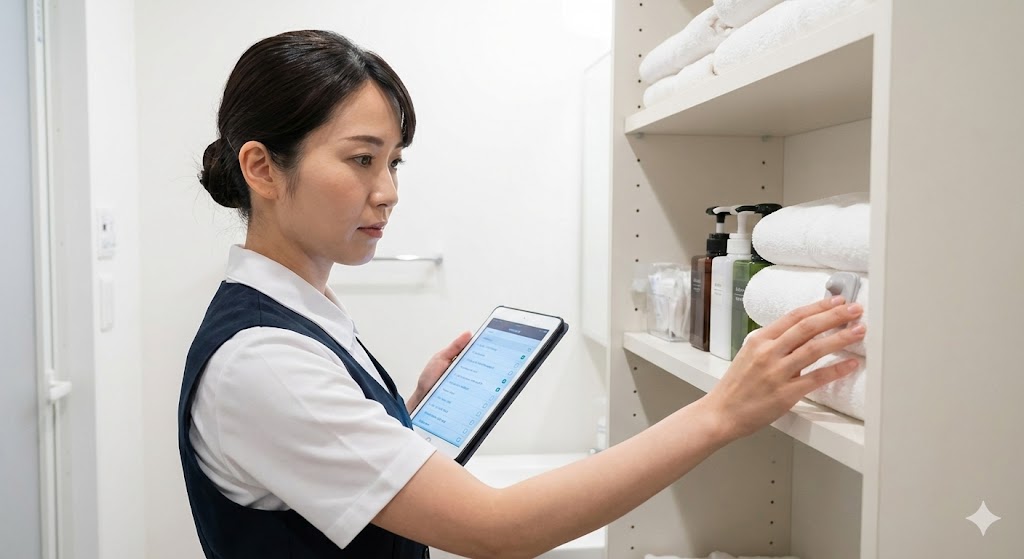
To notice when “something that should be there is gone,” photo reports taken from the exact same angle every single time are essential.
- Inside kitchen drawers (the layout of cutlery)
- The hair dryer and cups in the bathroom
- The placement of remote controls. Photographing these areas without fail every time cleaning is completed—and keeping them on file in a report—makes it possible to prove, when a future guest complains “there’s no hair dryer,” that it was definitely there right after the previous cleaning. This becomes the grounds for billing the prior guest.
Recording “Quantities” for Items Removed and Brought In
For linens (sheets and towels), visual checks alone aren’t enough—you need numerical tracking as well.
- The number of soiled linens collected
- The number of fresh linens newly set out
- The number of spare linens remaining in storage. Requiring these to be reported every single time makes it possible to identify exactly when the numbers stopped matching up—whether during the guest’s stay or when linens were handed off to the laundry service.
Psychological Approaches to Preventing Loss and Theft
In addition to physical management measures, it’s also effective to create a psychological deterrent that makes guests feel “this place is being carefully monitored.”
Displaying an “Inventory List”
Place an inventory list with photos in a visible spot inside the unit, accompanied by a message such as “We check that all these items are accounted for at checkout.”
This serves as a silent, implicit pressure that says “we know exactly what’s here,” which powerfully discourages impulsive, opportunistic taking of items.
Labeling Items with Stickers or Logos
For high-value items like hair dryers, kettles, and Wi-Fi routers, attach a property logo sticker or a label reading “Property of [Property Name].” This not only discourages theft intended for resale, but also strongly reinforces in guests’ minds the sense that “this is something I’m borrowing.”
Stating “Compensation Amounts” Clearly in Your House Rules
Clearly state, in your booking site listing and in-room guidebook, that “if any item is found to be taken or damaged, we will charge the actual cost plus an arrangement fee.” When specific amounts are listed (e.g., “Lost key: ¥20,000”), guests tend to handle the property with noticeably more care.
Handling the Aftermath: What to Do When Something Actually Goes Missing, and How to File a Claim
No matter how thorough your countermeasures are, losses can still happen. What matters most is how quickly you respond afterward.
An “Immediate Report” from Your Cleaning Company Is Critical
The moment right after a guest checks out and cleaning staff enter the unit—when they conduct their inspection—is the decisive window.
“The TV remote is missing.”
“There’s one bath towel missing.”
This report needs to reach you before the next guest checks in, and before the previous guest posts a review. If too much time passes, doubts will start to creep in—”maybe the cleaning staff lost it,” or “maybe the next guest is lying”—making it impossible to establish the facts.
The Claims Process for Airbnb’s “AirCover” and Similar Programs
Platforms like Airbnb offer host protection programs (such as AirCover). Filing a claim requires the following evidence:
- Before-damage photos: Photos from the previous cleaning completion report showing the item was there.
- After-damage photos: Photos taken at the start of the current cleaning showing the item is missing, or showing the damage.
- Purchase receipts: Documentation proving the item’s value. If your cleaning company is diligent about photo reporting, evidence for points 1 and 2 comes together automatically, allowing your claim to sail through the approval process and helping you recover your financial loss.
In Summary: Inventory Management Isn’t a “Cost”—It’s “Asset Protection”
It might seem like “just” a matter of supplies, but small losses add up—annual losses from missing inventory can range anywhere from a few tens of thousands to over a hundred thousand yen.
- Keep reserve stock under lock and key so you never tempt guests into acting on impulse.
- Have your cleaning company thoroughly maintain fixed-point photos and quantity reports to leave a solid trail of evidence.
- Show guests that the property is being actively managed, creating a psychological deterrent.
By putting these measures into practice, you can minimize the risk of inventory loss to the greatest extent possible. And above all, the biggest benefit is freeing yourself from the mental stress of “ugh, something else is missing…” so you can focus on running your business with a positive mindset.
Inventory Management and Security, All Covered: Trust Stay Buddy for an Ironclad Management System
“I keep having problems with missing inventory, but my current cleaning company just says ‘we don’t know anything about it.'”
“I want detailed, number-based reports covering everything from consumable restocking to inventory tracking.”
“In the event of theft, I want someone to gather all the evidence photos needed to file a claim with the platform.”
Whatever your concern, leave it all to us.
We at Stay Buddy Inc. are a team of vacation rental management and cleaning professionals specializing in properties throughout Osaka City.
We’re not just a “cleaning service.”
- Thorough “fixed-point photography” and “quantity management” across every property and every item, powered by our proprietary app
- A management system that turns consumable inventory trends into data, detecting fraud and waste
- On-the-ground consulting, from proposing locked storage installations to deterrent measures like labeling items
- Immediate reporting when loss is discovered, plus claims support to help maximize owner profits
Before you resign yourself to thinking “losing inventory is just unavoidable,” why not bring in a professional management system instead?
To protect your assets and ensure your profits stay firmly in your hands—get in touch with us for a free property assessment and personal consultation, no obligation required.