Leave your vacation rental management to us
Free Online ConsultationEven when you outsource cleaning for your vacation rental to an external company, a steady stream of low ratings from guests about cleanliness can seriously damage your entire operation. Data from Airbnb shows that once a listing’s cleanliness score drops below 4.5, its search ranking falls dramatically—making cleaning quality a direct driver of both bookings and revenue.
In reality, it’s not unusual for booking rates to drop by 10–20% after just a single review mentioning “cleaning wasn’t thorough,” “there was hair left behind,” or “the drain was clogged.” The biggest risk of all is the assumption that everything is fine simply because you’ve handed cleaning off to a professional company.
This article walks you, step by step, through exactly what to do when your vacation rental cleaning company’s quality falls short of expectations—how to review your cleaning standards and drive real improvement. It covers everything from building a checklist and negotiating contract terms to the criteria for deciding whether to switch providers, all in immediately actionable detail.
The Reality of Quality Issues Common with Vacation Rental Cleaning Services
Common Complaint Patterns That Show Up in Guest Reviews
Guest complaints about cleaning quality tend to fall into three main categories. The first is “visible dirt”—hair on floors or tables, mold in the bathroom, greasy residue in the kitchen. The second is “odors”—foul smells from the drain, lingering cigarette smoke from previous guests, or the musty smell of damp towels. The third is “supply and amenity failures”—unrefilled toilet paper, missing amenities, or stained linens.
In one host’s case, out of 30 stays per month, cleaning-related complaints occurred three times a month—a 10% complaint rate that makes it impossible to maintain Airbnb Superhost status. Simply telling your cleaning company to “do a better job” won’t solve the problem. You need to clearly define exactly what’s wrong and what level of quality you expect.
Structural Causes of Declining Quality on the Cleaning Company’s Side
There are structural reasons behind declining quality at cleaning companies. First, when the fee per cleaning job is only around ¥3,000–5,000, the job needs to be finished within 60–90 minutes to remain profitable. As a result, hard-to-see areas often get skipped. During peak season, it’s also difficult to secure enough staff, which means less experienced cleaners sometimes get sent in.
In addition, it’s extremely common for cleaning standards to never be put in writing between the host and the cleaning company. If you only say “please make it nice and clean” verbally, there’s bound to be a gap between what the company considers “clean” and what you consider “clean.” One survey found that roughly 60% of hosts who use cleaning services don’t share a clear cleaning checklist with their provider.
How to Objectively Evaluate Your Current Cleaning Quality
Get a Real Picture with Surprise Inspections
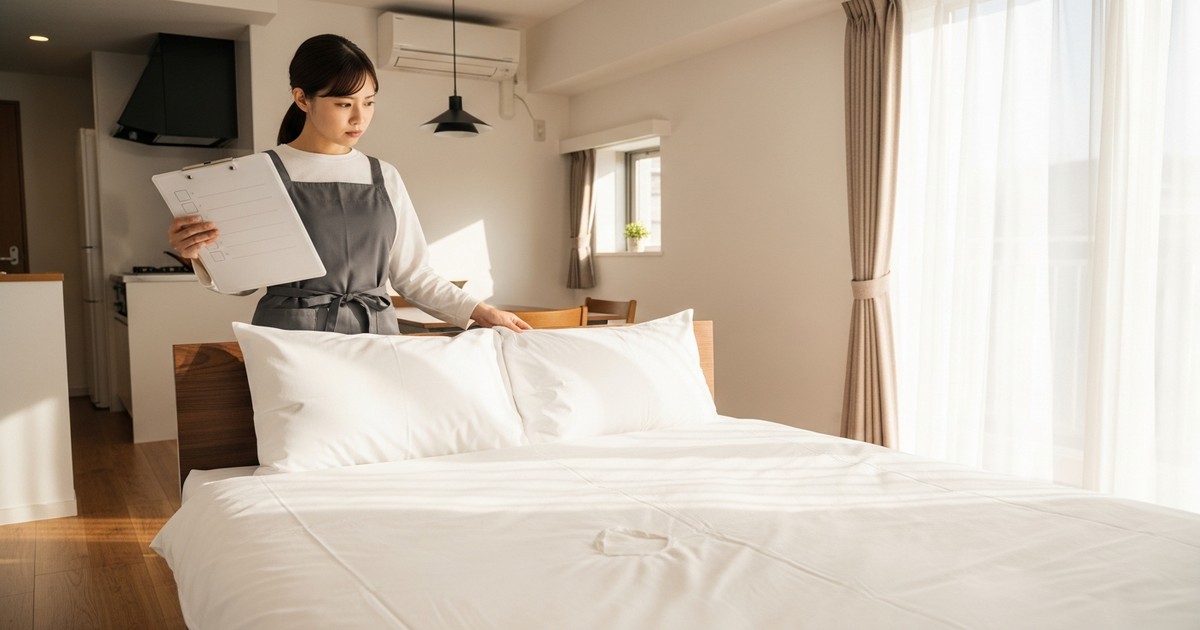
The first thing to do is check the property yourself right after it’s been cleaned. Doing this every time may not be practical, but aim to conduct surprise checks two to three times a month. Ideally, check the property immediately after receiving the cleaning-completion report. If you announce your visit ahead of time, the cleaning will likely be more thorough than usual—so it’s essential that these checks be unannounced.
When you inspect, take photos with your smartphone to keep a record. Pay special attention to the back of the toilet bowl, the bathroom drain, under the bed, the inside of the refrigerator, the inside of the microwave, window tracks, and the air conditioner filter. These are the spots most likely to get skipped during cleaning—and the ones most likely to leave guests feeling uncomfortable.
Quantitatively Analyze Guest Reviews
List out all your reviews from the past six months and pull out any mentions of cleanliness. Sorting them by keywords such as “clean,” “spotless,” “dirty,” “hair,” or “smell” will reveal patterns in the issues you’re facing. For example, if the period when your cleanliness star rating dropped from 4.7 to 4.3 lines up with a change in cleaning staff, you can pinpoint a human-related cause.
As a concrete way to quantify the problem, calculate your “cleaning complaint rate” by dividing the number of negative cleaning-related mentions by your total number of reviews. If this figure exceeds 5%, urgent action is needed. A rate of 3% or below is within an acceptable range, but you should always aim for zero. Turning the issue into a visible number also gives you solid leverage when negotiating with your cleaning company.
Creating a Cleaning Checklist to Put Standards in Writing
Designing Cleaning Items Broken Down by Area
The most effective way to overhaul your cleaning standards is to create a detailed checklist and share it with your cleaning company. Build the checklist by dividing the property into areas. Specifically, split it into seven areas—”entrance/hallway,” “living room,” “kitchen,” “bathroom/washroom,” “toilet,” “bedroom,” and “balcony/veranda”—and set 5–10 checkpoints for each area.
For example, in the kitchen, you should set at minimum these seven items: “remove mineral deposits from the sink,” “wipe away oil stains around the stove,” “wipe down the inside of the refrigerator and check for leftover items,” “clean the inside of the microwave,” “wash dishes and return them to their proper storage spots,” “replace the trash bag and deodorize the bin,” and “check and replenish condiments and consumables.” A total of 40–60 items across all areas is a typical benchmark.
Prevent Miscommunication with a Photo-Illustrated Manual
A checklist alone often fails to convey exactly how clean something needs to be, so it’s recommended to prepare “pass” and “fail” reference photos for each item. For example, for sink mineral deposits, post a photo of the sink fully cleaned side by side with a photo showing faint residue still remaining.
Creating this manual takes about 3–5 hours the first time, but once it’s built, you can reuse it indefinitely. Create it in Google Docs or a spreadsheet and share the URL—updates become easy from there. In one host’s case where this method was introduced, cleaning-related complaints dropped to zero within three months, and the cleanliness rating recovered from 4.4 to 4.8.
Concrete Strategies for Negotiating Higher Cleaning Standards with Your Provider
How to Present Improvement Requests Backed by Data
When asking your cleaning company for improvement, the key to success is discussing the issue based on objective data rather than venting frustration emotionally. Specifically, present the cleaning complaint rate mentioned earlier, a graph showing your star rating trend, and photos taken during your surprise inspections, and clearly state in numbers: “This is our current quality level, and this is the level we’re aiming for.”
In the negotiation, it’s effective to set concrete KPIs—such as “reduce the cleaning complaint rate from the current 8% to under 2%” or “maintain a cleanliness star rating of 4.7 or higher”—and set a deadline of within three months to achieve them. Vague requests won’t drive improvement, so always pair your numbers with a deadline.
Restructure Compensation to Build in Quality Incentives
Revising the fee structure is also an effective way to fundamentally improve cleaning quality. For instance, you could set a base fee of ¥4,000 per job, with a ¥500 per-job bonus paid out if there are zero complaints for the month. For 20 cleanings a month, that would total a ¥10,000 bonus. On the other hand, establish clear rules such as forfeiting the following month’s bonus if a complaint occurs.
When introducing this kind of arrangement, it’s important to get agreement in writing—a verbal agreement can become a source of disputes. It’s also effective to require photo reports upon completion of each cleaning job, since this encourages cleaning staff to keep the checklist in mind while they work. A good standard is to require at least seven photos, one for each area.
Criteria for Deciding Whether to Switch Cleaning Companies If Improvement Isn’t Happening
Three Warning Signs That It’s Time to Consider Switching
If your cleaning complaint rate still hasn’t dropped below 5% three months after requesting improvement, it’s time to consider switching cleaning companies. Beyond that, if you’re seeing any of the following three warning signs, switching is strongly recommended: first, the checklist has been handed over but isn’t actually being followed on-site; second, photo reporting has become a mere formality, with the same recycled-angle photos being sent every time; third, it’s become the norm for the point-of-contact to take more than 48 hours to respond to messages.
These signs indicate a problem with the company’s overall management structure. If the issue lies with an individual staff member, swapping personnel can solve it—but a management-structure problem is fundamentally difficult to fix, making a switch to a different cleaning company the rational choice.
Key Points to Check When Choosing a New Cleaning Company
When selecting a new provider, get quotes from at least three companies and compare them on the following points. First, check whether they have a “cleaning manual.” Companies with their own standardized cleaning manual tend to have a stronger commitment to quality control. Next, look at their “staff training program”—how many hours of training new hires receive after being brought on, and whether regular skill checks are conducted.
Their “policy on liability and compensation” is also important. Decide in advance who bears responsibility if equipment is damaged during cleaning, or if a refund becomes necessary due to a guest complaint caused by inadequate cleaning. If you choose based solely on the lowest price, you’re likely to run into the same problems again—so for a price difference of just ¥500–1,000 per job, it’s advisable to prioritize quality instead.
Building a System to Maintain Cleaning Quality Over the Long Term
Ongoing Quality Management Through Monthly Review Meetings
Even after you’ve overhauled your cleaning standards, quality tends to slip again over time. To prevent this, set up a monthly review meeting with your cleaning company. Thirty minutes is plenty of time. In the meeting, share that month’s cleaning complaint rate, the average cleanliness rating from guests, and the results of your surprise inspections, and agree on concrete improvement steps for the following month whenever issues come up.
In the case of one host who kept up these monthly reviews for six months, the cleanliness star rating stabilized at 4.8 or higher, and the listing earned Superhost status. As a result, they were able to raise their nightly rate by 15% without seeing any drop in booking rate. Maintaining cleaning quality translates directly into increased revenue.
Systematize Automatic Collection of Guest Feedback
Setting up a system to automatically send guests a survey after checkout lets you catch problems before they end up in a public review. Use Airbnb’s messaging feature or an automated email tool to send a simple two-question survey: “On a scale of 1 to 5, how satisfied were you with the cleanliness?” and “Was there anything that concerned you?”
A good way to boost your response rate is to offer a discount coupon (5–10%) for the next stay as an incentive for answering. Once this feedback data builds up, it not only helps you catch problem areas early but also gives you compelling evidence to back up improvement requests to your cleaning company. Once you’ve gathered 10 or more responses a month, you’ll have data that’s statistically meaningful enough to act on.
If You’re Struggling with Cleaning Quality in Your Vacation Rental Business, Talk to Stay Buddy Co., Ltd.
Stay Buddy Co., Ltd. is a specialized vacation rental management company offering comprehensive, one-stop support—including full oversight of cleaning quality. We come equipped as standard with our own dedicated cleaning checklist and photo-reporting system, ensuring thorough quality checks after every cleaning job.
If you’re an owner who’s worried about your current cleaning company’s quality, unsure how to set cleaning standards, or looking to improve your cleanliness ratings from guests, please don’t hesitate to reach out to Stay Buddy Co., Ltd. We’ll listen carefully to your current challenges and propose the optimal cleaning operation tailored to your specific property.
Improving cleaning quality leads directly to better reviews, a stronger booking rate, and maximized revenue. Get in touch today, and let’s work together to solve your cleaning quality challenges.