Leave your minpaku management to us
Free Online ConsultationRunning your minpaku with a family-focused approach can set you apart from the competition and help you build a stable stream of bookings. Families tend to stay longer and come back more often, which translates into real financial benefits. In fact, data shows that properties targeting families achieve occupancy rates 10-15% higher than average listings.
However, simply labeling your property “kid-friendly” isn’t enough. What family guests truly want is an environment that keeps children safe, amenities that let the whole family stay comfortable, and systems that allow them to maintain their daily routines even while traveling. This article walks through exactly what you need to prepare and how to run your property once you decide to specialize in family-friendly minpaku.
Whether you’re just starting out or looking to renovate an existing property with families in mind, we’ve put together practical, actionable insights you can use right away.
The Benefits of Going Family-Friendly and What Makes This Market Unique
Families are an incredibly attractive target segment in the minpaku market. They tend to stay longer—typically 2 to 4 nights—and since bookings often involve four or more guests, the per-night rate is higher too. For example, a property priced at ¥10,000 per night for two guests can often be repositioned for families to accommodate 4-6 guests at ¥15,000-¥25,000 per night. Fewer check-ins and cleanings also mean lower operational costs overall.
Families also have clear reasons for choosing minpaku over hotels: a kitchen to prepare baby food or kids’ meals, a washing machine to quickly clean dirty clothes, and the freedom to let children be a little noisy without worrying about disturbing neighbors. These are needs hotels struggle to meet, making them a genuine strength of the minpaku format. According to Airbnb research, roughly 60% of travelers with young children search specifically for accommodations with a kitchen.
Safety Measures and Child-Friendly Environment Setup
Furniture and Equipment Safety
Safety is the single most important priority for family-friendly minpaku. Practical measures include attaching corner guards to tables and shelves, fitting outlet covers, and installing baby gates on staircases. These safety items typically cost a few hundred yen each, and you can outfit an entire property for around ¥5,000-¥10,000.
You should also secure tall, tip-prone furniture to walls with L-brackets and keep blind cords bundled up out of children’s reach. Window opening restrictors are essential for any property on the second floor or above. Since accidents can have irreversible consequences, going above and beyond on safety measures is what builds real guest trust.
Bathroom and Water Area Safety
The bathroom is where accidents involving children happen most often. Lay down a non-slip bathtub mat, set the shower to limit water temperature to 48°C or below, and install a simple lock on the bathroom door so children can’t enter unsupervised. Storing cleaning products under the sink in a childproof, lockable box also helps prevent accidental ingestion.
Providing a toilet training seat is greatly appreciated by families with toddlers who are potty training. These typically cost ¥1,500-¥3,000. Adding a step stool alongside it lets children wash their own hands, which also takes some pressure off parents.
Stocking Up on Kid-Friendly Supplies and Amenities
Age-Specific Supply Checklist
Since family guests bring children ranging from infants to upper elementary school age, it’s important to stock supplies that cover the major age groups. For ages 0-2, prepare a crib (or futon bedding for babies), a baby bath, and a diaper trash bin. Cribs can be rented for about ¥3,000-¥5,000 per month, or you can purchase a foldable model for ¥10,000-¥20,000.
For ages 3-6, kids’ tableware sets (plastic plates, cups, spoons, and forks), a step stool, and children’s hangers are all appreciated touches. Children over 7 generally don’t need special equipment, but board games, playing cards, and picture books can boost guest satisfaction. Budgeting ¥30,000-¥50,000 for initial supplies across these categories should be more than sufficient.
Dining Equipment and Consumables
Beyond standard cookware, having a child-safe knife and cutting board, plus a mortar and blender for making baby food, will boost your ratings. Since microwaves are essential for warming baby food and milk, adding multilingual instruction labels is a thoughtful touch. A high chair costs ¥5,000-¥10,000, while a more affordable clip-on chair that attaches to the table runs around ¥3,000.
For consumables, keeping a small stock of children’s toothbrushes, gentle body soap, and baby wipes is hugely appreciated by guests who forgot to pack them. These can be sourced for under ¥500 per set and also make for great talking points in your listing. Some hosts report a 20-30% increase in bookings from families simply by highlighting these small details in their amenities section.
Layout and Interior Design Considerations
Bedroom Layout and Bedding Choices
Bedroom layout is what families care about most. Ideally, offer a larger bedroom where parents can sleep alongside young children, plus a separate room with a bed or futon for older kids. If using a bed, install a bed rail to prevent falls—these cost ¥2,000-¥4,000 and are easy to attach and remove. If you have a tatami room, setting it up with futons makes co-sleeping easier and is especially popular with families traveling with infants and toddlers.
Bedroom blackout quality is another often-overlooked factor. Children have a harder time falling asleep in bright rooms, so invest in curtains rated for at least Class 1 light-blocking. It’s a ¥5,000-¥10,000 investment per window, but reviews mentioning “our kids slept so well” become a powerful asset for future bookings.
Living Room and Shared Space Considerations
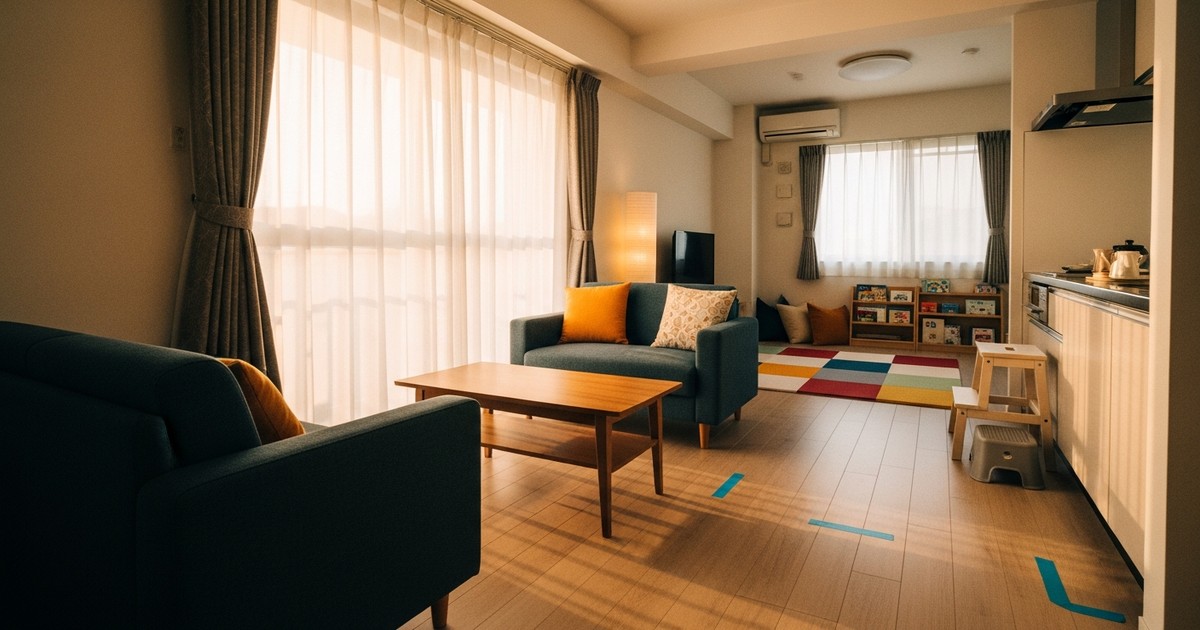
Make a point of setting aside play space in the living room. Laying down about two tatami mats’ worth of joint play mats (roughly ¥2,000-¥3,000) gives peace of mind to parents with crawling or cruising babies. Simply adding a toy box with picture books, stuffed animals, and a drawing set can transform the entire feel of the room into one that says “families welcome.”
Setting up the TV with access to streaming services like YouTube or Netflix helps keep kids entertained during rainy days or evenings. A Fire TV Stick or Chromecast costs around ¥5,000 to add. Wi-Fi speed matters too—aim for at least 50Mbps download speed, and post the password somewhere easy to find.
Listing Strategy and Attracting Guests
What to Highlight in Photos and Descriptions
A well-crafted listing is essential for winning over family guests. Include at least three photos showing kid-friendly features—cribs, high chairs, toy corners, and the like. According to Airbnb data, listings that feature photos of child-friendly equipment receive roughly twice as many inquiries from families compared to those that don’t.
In your description, spell out specific amenities in a bullet-point list: “Crib available,” “Corner guards installed,” “Kids’ tableware provided.” A vague phrase like “kids welcome” doesn’t tell guests what’s actually available and won’t drive bookings. Also list the distance and travel time to nearby parks, pediatric clinics, and drugstores—this level of detail significantly boosts peace of mind for parents.
Review Strategy and Leveraging Word of Mouth
Families place enormous weight on reviews when choosing where to stay. Whether a listing has reviews specifically mentioning “stayed here with kids” can make or break the booking decision. After checkout, send a message like “We hope your kids had a great time!” to naturally encourage guests to leave a review. Once you’ve accumulated five or more positive reviews from families, bookings from that same target segment tend to stabilize and grow.
Don’t underestimate social media buzz either. Setting up a photogenic kids’ corner or charming interior details increases the odds that guests will spontaneously share photos online. Adding a custom photo spot or welcome card in the room can also encourage hashtagged posts.
Providing Local Information and Guest Support
Creating a Family-Friendly Area Map
One of the first things family guests want to know upon arrival is what’s nearby. Prepare a simple homemade map showing walkable supermarkets, convenience stores, parks, hospitals (pediatric clinics), and pharmacies. A Google Maps screenshot with pins and brief notes is more than enough. Printing costs just a few dozen yen per sheet, but the impact on guest satisfaction is enormous.
Consider also including information on indoor play spaces for rainy days, restaurants with kids’ menus, and stroller-friendly tourist spots—this kind of local insight offers value competitors can’t match. Sharing knowledge only a local resident would know creates the kind of experience that turns into “I’m so glad we stayed here” feedback.
Emergency Response Manual
Prepare an emergency information sheet and post it somewhere visible, covering contact details for the nearest emergency hospital, information on night and holiday clinics, and instructions for calling an ambulance (in English for international guests), in case a child suddenly develops a fever or gets injured. Keeping a thermometer and a basic first-aid kit (bandages, disinfectant, cooling sheets, etc.) on hand is also essential—these kits typically cost ¥2,000-¥3,000.
Clearly stating how to reach the host or management company, along with 24-hour availability, significantly boosts guests’ sense of security. A review saying “they responded immediately when something came up” is one of the most powerful drivers of future bookings from families.
Contact Stay Buddy Inc. for Your Minpaku Management Needs
Running a family-friendly minpaku property covers a wide range of responsibilities—from safety measures and supply selection to listing optimization and guest support. Handling all of this on your own can be overwhelming, and if you’re managing multiple properties or balancing this with a full-time job, professional support becomes essential.
Stay Buddy Inc. is a professional minpaku management company offering one-stop support, from concept design and target strategy to day-to-day guest communication. We’ve built up extensive know-how in creating family-focused properties and can provide concrete advice on everything from supply lists to safety measure oversight and review-generation strategies.
If you’re wondering “I want to attract more families but don’t know where to start” or “I want to boost occupancy at my existing property,” please reach out to Stay Buddy Inc. We’ll propose the optimal management plan tailored to your property and local area.