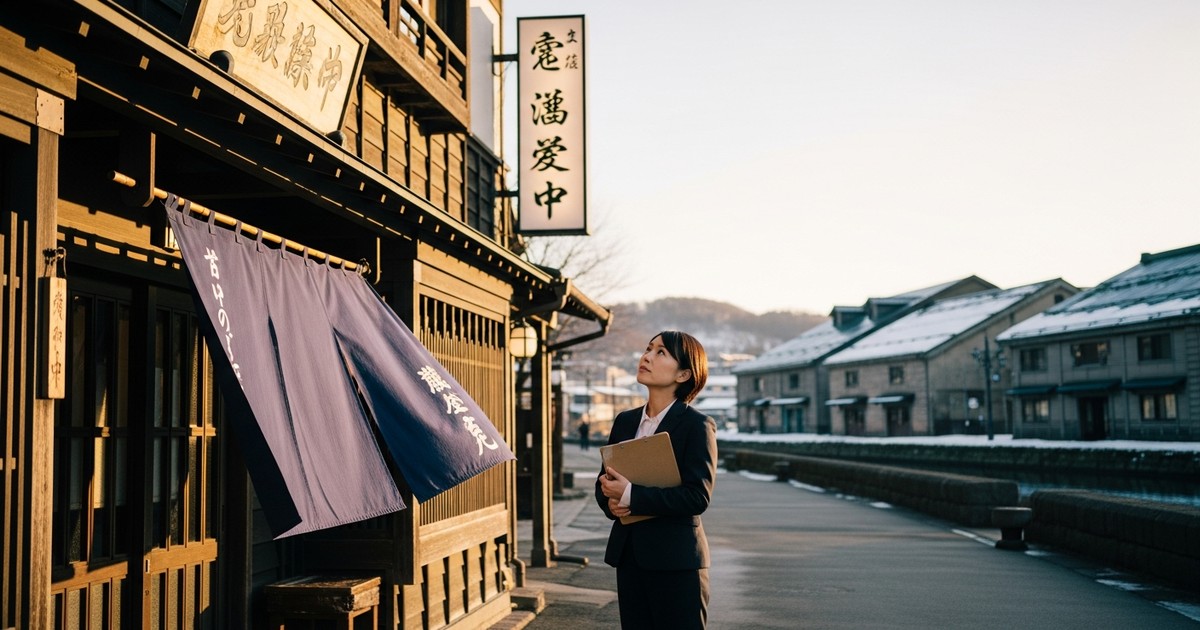
Obtaining a ryokan business license in Otaru requires confirming the applicable zoning district and completing the application procedures with the local health center. Among the many areas of Hokkaido, Otaru is known for its historic streetscapes and picturesque canal views, which draw tourists in droves and drive strong demand for accommodation facilities. However, when you actually try to start a ryokan business, there are several hurdles to clear—zoning restrictions under the City Planning Act, compliance with the Building Standards Act and Fire Service Act, and screening by the health center, among others.
This article systematically explains everything you need to know about opening a ryokan business in Otaru City—from the basics of zoning districts, to the specific application procedures with the health center, estimated costs, and common pitfalls. We’ve compiled practical, hands-on information so that anyone planning to open a minpaku (vacation rental) or ryokan in Otaru can proceed through the process with confidence and clarity.
Note that the Ryokan Business Act divides operations into categories such as “Ryokan/Hotel Business” and “Simple Lodging Business,” and when an individual opens a business in Otaru City, it’s common to obtain a license for Simple Lodging Business. This article focuses primarily on simple lodging while also covering points that apply equally to ryokan/hotel operations.
The First Thing to Check When Obtaining a Ryokan Business License in Otaru: Zoning Districts
What Is a Zoning District?
A zoning district is a set of land-use rules established by a municipality under the City Planning Act. There are three broad categories—residential, commercial, and industrial—which are further divided into 13 specific types overall. Since ryokan business is considered a “commercial activity that provides accommodation services,” it is not permitted in certain zoning districts designated for protecting residential living environments. Specifically, ryokan business is generally prohibited in the following six zones: Category 1 Low-Rise Exclusive Residential Zone, Category 2 Low-Rise Exclusive Residential Zone, Category 1 Medium-to-High-Rise Exclusive Residential Zone, Category 2 Medium-to-High-Rise Exclusive Residential Zone, Industrial Zone, and Exclusive Industrial Zone.
In Otaru, the central Sakaimachi-dori area and the canal district are largely designated as Commercial or Neighborhood Commercial zones, where ryokan operations are permitted. On the other hand, residential neighborhoods such as the Asari and Sakura districts include areas designated as exclusive residential zones, and there have been actual cases where operators only discovered zoning restrictions after acquiring a property. Be sure to confirm the zoning designation with Otaru City’s Urban Planning Division before signing any property contract. You can also view the city planning map on Otaru City’s official website.
How to Check Otaru City’s Zoning Map
You can view Otaru City’s zoning designations on paper city planning maps at the counter of the Urban Planning Division at City Hall, or check online using the “Hokkaido Geographic Information System” provided by the Hokkaido prefectural government. By entering the property’s address, you can find out which zoning district it falls under. Even if a real estate agent tells you that operation is “permitted,” it’s important to make a habit of verifying the city planning map yourself. In fact, there have been reported cases where an application was rejected because a real estate agent had given an incorrect explanation of the zoning designation.
In addition to checking the zoning district, it’s also worth confirming whether an exception under “Building Standards Act Article 48 Proviso Approval” applies. This proviso approval system relaxes zoning restrictions under certain conditions, but the screening process can take several months and may require the consent of neighboring residents—so in practice, it’s more reliable to choose a property in a zone where ryokan operation is already permitted.
Structural Standards and Facility Requirements Under the Ryokan Business Act
Guest Room Area and Occupancy Standards
For Simple Lodging Business, the Enforcement Order of the Ryokan Business Act requires a total guest room floor area of at least 33 square meters. This is based on a calculation of at least 3.3 square meters per person when the number of guests is fewer than 10. If you’re renovating an old wooden house in Otaru into a simple lodging facility, the existing floor plan may not meet this area requirement, so it’s essential to calculate this from the floor plan in advance.
For Ryokan/Hotel Business, the minimum area per guest room is set at 7 square meters or more. Regarding the requirement to install a front desk (genkan-choba), amendments to the law since 2018 have allowed alternative measures in some cases, such as ICT-based identity verification. However, the operational standards required by Otaru’s health center can sometimes be stricter than the national standards, so be sure to confirm this during your preliminary consultation.
Ventilation, Lighting, and Illumination Requirements
Guest rooms must have adequate ventilation and natural lighting. Specifically, the Building Standards Act requires an effective daylighting area equal to at least 1/7 of the guest room’s floor area. Because Otaru receives heavy snowfall in winter, windows can become blocked by snow, and the health center may require the installation of mechanical ventilation equipment to account for this. As a general guideline, illumination inside guest rooms should be at least 75 lux.
There are also standards for ventilation in toilets and bathrooms. For shared toilets, an appropriate number must be installed—generally, at least one toilet per five guests is used as a benchmark. For bathrooms and showers, you’ll also need to check the standards set by the Public Bathhouse Act.
Fire Safety Equipment and Fire Prevention Management
Ryokan business facilities fall under the category of “specified fire prevention buildings” under the Fire Service Act. This means automatic fire alarm systems, guide lights, and fire extinguishers must be installed. Depending on the total floor area and capacity, sprinkler systems may also be required. It’s standard practice to consult with the Otaru Fire Department before submitting your application to the health center. Fire safety equipment installation can cost anywhere from several hundred thousand yen to over one million yen, so it’s advisable to get quotes early in your business planning.
Facilities with a capacity of 30 or more people are required to appoint a fire prevention manager, and that person must hold a Class A Fire Prevention Manager qualification. The training course takes two days to complete and costs around 8,000 yen. Since this training is only held a few times a year in Otaru, be sure to plan your schedule with plenty of lead time.
Specific Steps for Applying to Otaru City Health Center
The Importance of a Preliminary Consultation and What Documents to Bring
In Otaru City, applications for ryokan business licenses are handled by the Public Health Division of the Otaru City Health Center. Before submitting your formal application, be sure to have a preliminary consultation. Bringing the property’s drawings (floor plan and elevation drawings), the results of your zoning confirmation, and the property’s certificate of registered matters to this initial consultation will help things go smoothly. Since preliminary consultations may require an appointment, confirm the schedule by phone before visiting.
During the preliminary consultation, staff can tell you whether the facility’s structure meets the required standards, what renovation work may be necessary, and give you a list of documents needed for the application. Since it’s possible to learn at this stage that “this property will not be approved,” it’s ideal to have this consultation before signing a lease or purchase contract for the property. The preliminary consultation is free of charge and typically takes 30 minutes to an hour.
List of Required Application Documents and Notes on Filling Them Out
The main documents required for a ryokan business license application at the Otaru City Health Center are as follows: the Ryokan Business License Application Form; drawings clarifying the facility’s structure and equipment (site plan, floor plans for each level, front elevation, side elevation); a copy of the building’s certificate of inspection completion; if the applicant is a corporation, a certificate of registered matters and articles of incorporation; a water quality test report (if well water is used); and a Fire Code Compliance Notification.
One point requiring particular attention is the building’s certificate of inspection completion. Many buildings in Otaru were constructed before the 1970s, and quite a few properties lack this certificate. If it’s missing, you’ll need to have a licensed architect prepare a survey report to certify compliance with the Building Standards Act, which can add an extra 200,000 to 500,000 yen in costs. Also, since the drawings must include precise measurements, it’s most reliable to have them prepared by a licensed architect.
Application Fees and Review Period
The application fee for a ryokan business license is 22,000 yen for Ryokan/Hotel Business and 11,000 yen for Simple Lodging Business (based on Hokkaido prefectural ordinance, subject to revision). Fees are generally paid in cash at the time of application. If there are no deficiencies in the documents and no issues are found during the on-site facility inspection, the review process typically takes about two weeks to one month from the time of application to approval.
However, if document corrections are required or if renovation guidance is given for the facility, the process can be extended by several more weeks or even months. In Otaru, applications tend to concentrate in early spring ahead of the tourist season, so if you’re aiming to open before peak season, you should begin the application process at least three months in advance. Starting operations before your license is officially issued constitutes a violation of the Ryokan Business Act and can result in penalties of up to six months’ imprisonment or a fine of up to 1,000,000 yen—so never jump the gun.
Common Pitfalls and How to Avoid Them in Advance
Application Rejection Due to Insufficient Zoning Verification
The most common mistake is signing a property contract without confirming its zoning designation. Even in Otaru, there have been cases where a property just a few minutes’ walk from the canal—seemingly a prime location—was designated as a Category 1 Exclusive Residential Zone, resulting in a rejected application. Don’t rely solely on a real estate agent’s explanation; always check the city planning map yourself. The Urban Planning Division can also be reached by phone for inquiries.
Additionally, if a building straddles the boundary line between two zoning districts, the determination is based on which zone contains the majority of the building. Properties near zoning boundaries require especially careful confirmation.
Disputes with Neighboring Residents
Under the Ryokan Business Act, facilities located within roughly 100 meters of schools or child welfare facilities are subject to a procedure requiring that the opinions of the facility administrator be heard. In densely populated residential areas of Otaru, complaints from neighbors about noise or garbage disposal have sometimes caused problems for operations even after a license has been obtained. Greeting neighbors before opening and explaining your operating rules in writing (check-in/check-out times, garbage disposal rules, noise countermeasures) can help prevent such disputes.
In Otaru, winter snow removal is also a frequent source of friction with neighbors. Clarifying who is responsible for clearing snow from the road and sidewalk in front of the accommodation facility, and establishing a clear management system, is also essential for smooth operations.
Issues with Non-Conforming Existing Buildings
Buildings constructed before 1981 may be “non-conforming existing buildings” that do not meet current earthquake resistance standards. When applying for a ryokan business license, the health center or building guidance division may request a seismic diagnosis. If seismic reinforcement work turns out to be necessary, costs can range from 1,000,000 to over 5,000,000 yen, significantly impacting your business plan. It’s essential to check the construction date and seismic performance of a property at the stage of property selection.
There is also a trend in Otaru of renovating historic buildings into accommodation facilities, but if a building has been designated as a cultural property, renovation may be subject to restrictions. It’s a good idea to check in advance with the Cultural Properties Division of the Otaru City Board of Education as well.
Estimated Costs for Starting a Ryokan Business in Otaru
Breakdown of Initial Costs
The estimated initial cost of opening a simple lodging facility in Otaru, excluding property acquisition or rental costs, is roughly 2,000,000 to 5,000,000 yen. This breaks down to approximately 1,000,000 to 3,000,000 yen for interior renovation work, 300,000 to 1,000,000 yen for fire safety equipment installation, 300,000 to 800,000 yen for furniture, fixtures, and bedding, and 150,000 to 500,000 yen for application fees and architect fees for preparing drawings.
Used properties in Otaru tend to be more affordable than in Sapporo, and older single-family homes can sometimes be purchased for as little as 3,000,000 to 8,000,000 yen. However, since older properties often require more extensive (and costly) renovations, it’s important to compare properties based on the total cost—including renovation—rather than the purchase price alone.
Outlook on Running Costs
Once operations begin, ongoing running costs typically include: utility bills of 30,000 to 80,000 yen per month, linen cleaning costs of 20,000 to 50,000 yen per month, outsourced cleaning fees of 3,000 to 8,000 yen per session, booking site commissions of roughly 12% to 15% of sales, and fire insurance premiums of around 50,000 to 100,000 yen per year. Since heating costs in Otaru rise significantly during winter, it’s important to calculate kerosene and gas expenses as an annual average rather than a flat monthly figure. It’s not unusual for winter heating costs to be three to five times higher than in summer.
If you outsource management to a property management company rather than handling it yourself, expect a management fee of roughly 10% to 30% of revenue (varying by company and scope of service). Using a management company can significantly reduce the workload involved in coordinating cleaning, guest communication, and reservation management, making it a strong option for owners who live far away or have another primary occupation.
Key Points to Manage After Obtaining Your Ryokan Business License
Creating and Retaining Guest Registers
Under Article 6 of the Ryokan Business Act, operators are required to create and retain a guest register. The register must include each guest’s name, address, occupation, and stay dates, and for foreign guests, a copy of their passport must also be kept on file. Records must be retained for three years. Introducing a tablet-based check-in system can help streamline register management and prevent omissions in recorded information.
If deficiencies in the guest register are discovered during a health center inspection, you may receive corrective guidance, and in serious cases, your license could even be revoked. It’s important to establish a reliable system for this from the very start of operations.
Sanitation Management and Regular Equipment Inspections
Beyond regular cleaning of guest rooms, toilets, and bathrooms, it’s recommended to conduct water quality testing of bathtub water at least once a year as a Legionella prevention measure. If you use a circulating bath system, you’ll also need to manage chlorine concentration levels (maintaining free residual chlorine at 0.4 mg/L or higher). Fire safety equipment inspections are required twice a year (equipment checks every six months, comprehensive checks annually), and the results must be reported to the fire department.
Since frozen water pipes are a common issue in Otaru during winter, including instructions on how to operate the drain valve in guest-facing information can help prevent equipment trouble. Since repairs for burst pipes caused by freezing can cost anywhere from 100,000 to 300,000 yen, preventive measures make good financial sense as well.
For Accommodation Management in Otaru, Consult Stay Buddy Inc.
Obtaining a ryokan business license and operating an accommodation facility in Otaru involves a wide range of tasks—from confirming zoning designations and applying to the health center, to installing fire safety equipment, managing relationships with neighbors, and handling day-to-day operations after opening. For those entering the ryokan business for the first time in particular, the complexity of the procedures and unexpected costs can be daunting.
Stay Buddy Inc., a vacation rental management company, offers comprehensive, one-stop services—from support with license applications and advice on property selection, to full operational management after opening. Our staff, who have expertise in accommodation operations across Otaru and the broader Hokkaido region, can propose the optimal plan tailored to each owner’s situation.
We’re happy to answer specific questions such as “Can this property obtain a ryokan business license?” or “How much time and money will it take to open?” Please feel free to contact Stay Buddy Inc. at any time.
Obtaining your license isn’t the finish line for accommodation management—it’s just the starting point. Leveraging professional support is by far the most reliable path to sustained, stable revenue. If you’re considering opening a ryokan business in Otaru, we encourage you to reach out and consult with us.