Leave Your Vacation Rental Management to the Experts
Free Online ConsultationOwning a short-term rental property in Japan while living abroad presents a particular challenge that many overseas investors underestimate until it becomes urgent: you cannot simply walk around with a smartphone and take your own listing photos. The quality of your photography will directly influence your conversion rate on platforms such as Airbnb and Booking.com, and yet commissioning, briefing and approving that photography must happen entirely at a distance. This guide walks through everything you need to know — from regulatory context to creative direction — so that your listing photographs work as hard as your property deserves.
Why Listing Photography Matters More in Japan Than Almost Anywhere Else
Japan’s short-term rental market is exceptionally competitive, and guests booking from overseas apply intense scrutiny to property photographs before committing. The country’s reputation for meticulous presentation means that guests arrive with high expectations. A poorly lit photograph of a tatami room, or a wide-angle shot that distorts the sense of space in a compact Tokyo apartment, will not merely fail to inspire bookings — it will actively signal that the property is managed carelessly.
There is also a regulatory dimension that shapes the physical presentation of your listing. Under the Housing Accommodation Business Act (commonly called the Minpaku Law), standard short-term rentals are capped at 180 nights per year. Some municipal governments, particularly in residential-zoned areas of cities like Kyoto and Osaka, have introduced even stricter local restrictions — prohibiting rentals on weekdays in certain wards, for example. Special National Strategic Zones (tokku minpaku) operate under different rules and can permit longer operating periods, but these apply only to designated areas and require separate licensing procedures.
The reason this matters for photography is straightforward: if your property operates under a standard Minpaku registration, it must display certain notices and safety information on or near the premises. A photographer who is not briefed properly may inadvertently capture these notices in a way that looks cluttered or confusing to international guests, or may fail to capture compliance features — such as smoke detector placements — that demonstrate the property is properly registered. Your management company should flag all of this before the shoot, not after.
Understanding the Licensing Context Before the Camera Arrives
It is worth pausing to understand which licence category governs your property, because this affects both what can legally appear in your listing and how your management company is authorised to act on your behalf.
Minpaku Registration vs Ryokan Business Licence
A standard Minpaku registration under the 2018 Housing Accommodation Business Act allows you to host paying guests for up to 180 nights per year in a residential property. The registration number must appear in your OTA listing. A ryokan business licence (旅館業法 — Ryokan Gyō Hō) is an older, more demanding licence category that removes the 180-night cap entirely but requires the property to meet stricter building, fire safety and sanitation standards. Properties operating under a ryokan licence are often marketed as ryokan-style or boutique guesthouses, and their photography brief will differ significantly — emphasising the hospitality aesthetic, amenity presentation and any traditional architectural features.
If you are considering acquiring a property specifically for short-term rental, your first conversation with a management company should clarify which licence pathway is viable, because it will determine not just your operational ceiling but your entire brand positioning — and therefore your photography brief.
Special Zone Considerations
Properties in National Strategic Special Zones (tokku) can operate beyond 180 nights provided they meet the zone’s specific requirements, which vary by designated area. Osaka City was an early adopter of this framework. If your property is in a special zone, make sure your photographer captures any features that distinguish it as a premium, fully licensed accommodation — because your pricing should reflect that status, and your photography needs to justify it.
Building Your Photography Brief Without Being On-Site
The single most important thing a remote property owner can do is produce a written photography brief before the photographer sets foot in the property. This document becomes the shared reference point between you, your management company and the photographer. A good management company will help you build it; a great one will have a template ready to adapt.
The Core Components of a Remote Brief
- Property inventory: A room-by-room list of every space to be photographed, including exterior, entrance, living areas, sleeping areas, bathroom, kitchen, any garden or engawa (veranda), and any communal spaces if applicable.
- Styling instructions: What should be on the bed (crisp white linen is the international standard), whether futons should be laid out or stored, how kitchen surfaces should be presented, whether any personal or operational items should be removed from view.
- Lighting preferences: Natural light versus artificial, time of day for exterior shots, whether to shoot with curtains or shoji screens open or closed.
- Compliance features to include: Smoke detectors, fire extinguisher placement, the Minpaku registration notice — these should appear in at least one photograph to demonstrate the property is properly registered, but they should not dominate the hero shots.
- Prohibited content: Neighbouring properties that could reveal the exact address before booking, personal belongings, any maintenance issues that are scheduled for repair.
- OTA technical requirements: Minimum resolution, aspect ratio preferences (16:9 is standard for most platforms), and the number of images required for a complete listing.
Sourcing a Photographer in Japan From Abroad
You have several options for finding a local photographer. Established interior and architectural photographers in Japan’s major cities — Tokyo, Osaka, Kyoto, Fukuoka — typically have portfolios you can review online. Some OTA platforms have referral networks. Freelance platforms can surface local talent, though vetting quality remotely requires care. The most reliable route for a remote owner is to ask your management company to recommend or engage a photographer they have worked with before. This matters because the management company can provide access, styling and on-site direction — effectively acting as your eyes. If the company is reluctant to take on this coordination role, that is a signal worth noting about how they approach the broader management relationship.
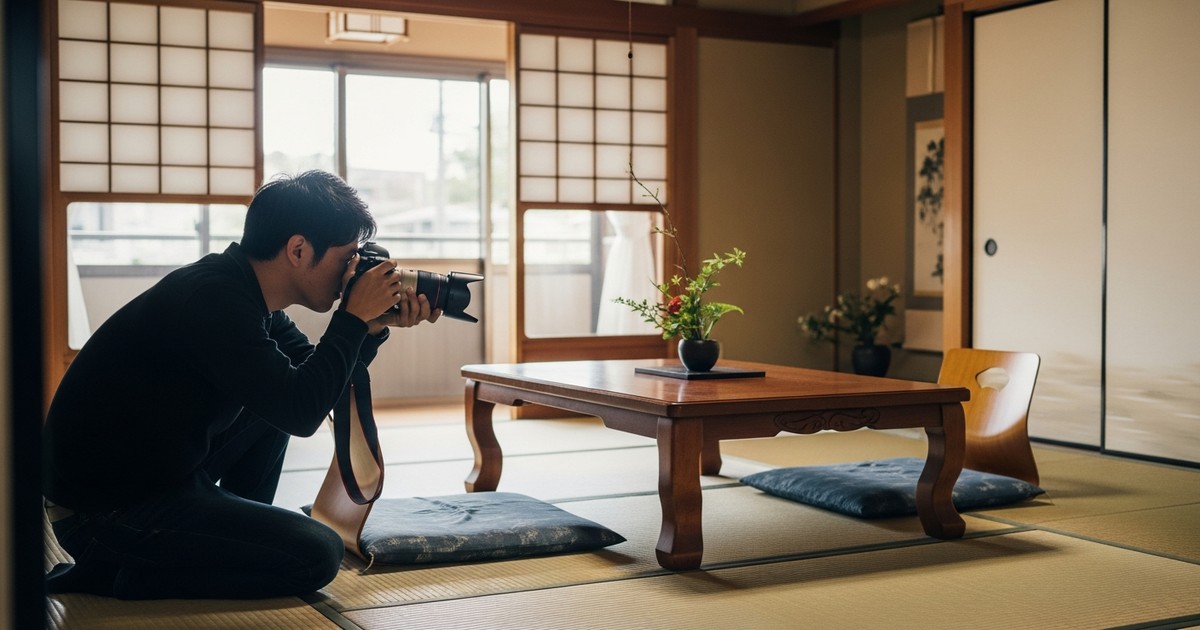
When reviewing photographer portfolios remotely, look for evidence of experience with compact Japanese spaces. Japan’s housing stock — particularly in urban areas — typically involves rooms that are smaller than equivalent Western properties. An experienced local photographer will know how to use focal length and composition to present a six-tatami room as inviting rather than claustrophobic. This is a genuine skill, not a trick, and it matters enormously for conversion.
The Shoot Day: What Should Happen Without You There
On the day of the shoot, you will not be present. This means you need a trusted representative who understands both the property and your brief. Your management company should take on this role directly. Here is what a responsible management company will handle:
- Arriving early to style the property according to the brief — fresh linen, cleared surfaces, seasonal or ambient props if appropriate.
- Conducting a walk-through with the photographer to confirm the shot list.
- Ensuring the property is presentable: windows cleaned, floors swept, any visible maintenance issues addressed or temporarily concealed with a note to follow up.
- Verifying that no compliance notices, key boxes or operational materials are captured in a way that undermines the aesthetic.
- Reviewing the first batch of images on-site and requesting reshoot of any that miss the brief before the photographer leaves.
After the shoot, the management company should send you a complete gallery for approval before any images are uploaded to OTAs. Do not accept a situation where photographs go live on Airbnb or Booking.com without your sign-off. This is your property and your listing; you have both the right and the commercial interest to approve the visual presentation.
A Comparison of Photography Approaches for Remote Owners
| Approach | Cost Range | Quality Control | Remote Owner Suitability | Key Risk |
|---|---|---|---|---|
| OTA platform photographer (where available) | Low to moderate; sometimes subsidised | Standardised but may lack local nuance | Moderate — process is managed but you have limited creative input | Generic results that do not differentiate your listing |
| Freelance photographer sourced independently | Moderate — varies significantly by city and experience | High if well briefed; low if coordination is poor | Low — requires someone on-site to manage access and styling | No on-site management support; access and quality not guaranteed |
| Photographer engaged and managed by your operator | Moderate to higher — operator coordination has value | High — operator manages brief, access, styling and review | High — designed specifically for remote ownership | Operator must be genuinely invested in quality, not just throughput |
| Smartphone photos taken by cleaner or local contact | Very low | Generally poor | Poor — not recommended for any serious listing | Significantly reduced conversion; undermines brand positioning |
Financial Context: What Photography Costs and How It Fits Your Numbers
As a non-resident owner of Japanese property, your financial picture is more complex than it would be for a domestic investor. Japan’s National Tax Agency requires that rental income earned by non-residents is subject to Japanese income tax, and in many cases a withholding obligation applies — typically at a flat rate — when payments are made to non-residents. Your accountant or tax adviser should be structuring your rental income reporting carefully, and your management company should be providing clear, itemised financial reporting that makes this easier, not harder.
Photography is a legitimate operational expense and should appear as a line item in your property accounts. Alongside it, you will typically see cleaning fees (which in Japan tend to be higher than in comparable Western markets, reflecting labour costs and the meticulous standards guests expect), OTA platform commissions (which typically fall in a range from the mid-single digits to the low-to-mid teens as a percentage of booking revenue, depending on the platform and listing tier), and management fees charged by your operator.
In this context, photography should be viewed as a yield-improvement investment rather than a cost to minimise. A well-photographed listing will typically command a higher nightly rate and achieve better occupancy, which matters particularly under the 180-night Minpaku cap — because you have a fixed ceiling on the number of nights you can sell, the revenue per bookable night is the primary lever available to you.
Seasonal and Reshooting Considerations
Japan’s seasons are visually dramatic, and guests booking long in advance are often choosing a property partly for its seasonal appeal. Cherry blossom season, autumn foliage, summer greenery and winter snowscapes are not just tourist attractions — they are legitimate marketing assets for properties with outdoor spaces, traditional gardens or views of natural features.
If your property has a garden, courtyard, engawa or any meaningful outdoor space, consider commissioning seasonal exterior photography rather than relying on a single annual shoot. This requires a management company that is proactive about flagging the opportunity and coordinating the timing — the window for peak cherry blossom, for example, is famously short and varies by region each year. Being caught with summer photographs on your listing during peak spring bookings is a missed opportunity that cannot be recovered retroactively.
Interior reshoots are also worth scheduling after any significant refurbishment or when guest feedback consistently references a specific feature as looking different from the photographs. This feedback loop — from guest reviews to listing improvement — is something your management company should be facilitating as a matter of routine, not waiting for you to request it.
What to Ask Your Management Company About Photography
If you are evaluating management companies, or if you are an existing client who has not yet had this conversation, the following questions will quickly reveal whether your operator treats photography as a genuine business function or an afterthought:
- Do you have a preferred photographer in this market, and can I see examples of their work on current listings you manage?
- Who will be on-site during the shoot to handle access, styling and quality review?
- What is your process for ensuring the photography brief reflects both the property’s strengths and current OTA platform technical requirements?
- Will I receive the full image gallery for approval before any photos are published?
- How do you handle seasonal updates or reshoots after a refurbishment?
- How is the photography cost reported in my financial statements, and is it treated as an operational expense?
- Do the listing photographs comply with the requirement to include the Minpaku registration number, and how is that handled visually?
An operator who can answer all of these questions clearly and specifically is one who has thought seriously about what remote property ownership requires. An operator who deflects, generalises or suggests you handle the photography independently has, in effect, told you something important about how they approach the rest of the management relationship.
Bringing It Together
Japan rental listing photography for remote owners is not a peripheral concern — it is one of the most direct points of leverage you have over your property’s commercial performance. The regulatory environment, the competitive landscape, the expectation of quality that Japanese hospitality carries, and the constraint of a 180-night operating ceiling all combine to make every bookable night and every booking decision matter more than in less regulated markets.
The practical answer for an owner who cannot be on-site is a management company that behaves like an operator: one that takes accountability for the photography brief, manages the shoot day, reviews the output and reports back to you with clarity and transparency. Anything less is not management — it is administration, and it will show in your booking rates.
If you are at the stage of evaluating your current listing presentation, or if you are preparing to take a property to market for the first time, the photography conversation is the right place to start. It surfaces assumptions, tests communication and sets the standard for everything that follows.